PAYING THE PRICE

Don’t be misled—you cannot mock the justice of God. You will always harvest what you plant. [Galatians 6:7 (NLT)]

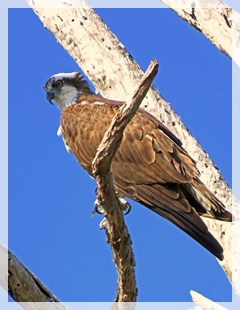
osprey“It wasn’t worth it!” I grumbled while applying cortisone over four painful red bumps on my foot. When walking around the lake at the botanic gardens, I’d spotted an osprey in a nearby tree. To get a good shot, I had to step off the paved trail into what I knew to be fire ant territory. Having had previous encounters with these stinging insects, I knew better than to stand there in sandals, but I did it anyway; the picture wasn’t worth the price I was paying for my poor decision.

It’s not just fire ants that cause us to regret our poor choices. Wanting to sow his wild oats, the prodigal son enjoyed himself while recklessly spending his inheritance but, when the hungry young man was slopping pigs, he knew his wild living hadn’t been worth it. Adam and Eve (and the rest of mankind) paid a hefty price for a bite of an apple: banishment from Eden, painful childbirth, marital discord, toil and death. I wonder if David thought adultery worth the price he paid: his first son by Bathsheba died, he was humiliated when Absalom publicly took his wives, and violence and rebellion plagued his family. King Manasseh knew better than to build pagan shrines, sacrifice his own children, and place a carved idol in the temple. The price he paid was being led away to Babylon in bronze chains with a ring in his nose. Fortunately for him, Manasseh was given a second chance by God; not everyone is so lucky. Lot’s wife had been warned; was that last look at Sodom worth the price she paid? Then again, as a pillar of salt, she could gaze at the city’s ruins forever.

After nearly 3000 prescription pills were found in her possession, a sheriff’s deputy in a northern community pled guilty to “attempted possession of a controlled substance.” Punishable by up to a year in prison, she was sentenced to seven days in jail and a year of “conditional discharge.” Less restrictive than probation, conditional discharge means the court retains jurisdiction over her with several provisions including drug and alcohol evaluations, no employment where she might have access to drugs, and no use or possession of a firearm. Since the original charge was negotiated down from felony possession (meaning four to fifteen years in prison), most of us would think she got off easy. Apparently expecting probation with no jail or restrictions, the defendant was shocked by what she considered a harsh sentence. As a deputy, she couldn’t plead ignorance of the law or its consequences; nevertheless, she thought the price she paid too high. My study Bible speculated that had David known the cost of his sin, he might not have bedded another man’s wife. I disagree. As a king, David knew the law given in Leviticus: the punishment for adultery was death for both he and Bathsheba! Like the deputy, he knew the consequences and like her, he got off easy.

Stepping onto an ant hill has painful consequences but so does sin. The penalty I paid for that photo was negligible compared to the cost of many of our poor decisions. When choosing between right and wrong, the price we pay can be far greater and longer lasting than a few insect bites. Although Jesus paid the price for our sins on the cross and God promises forgiveness when we repent, we still have to face the consequences of our sins here on earth. We, however, are not the ones who get to pick and choose what those consequences will be nor do we get to complain and say, “But God, it wasn’t worth it!”

Temptation can be tormenting, but remember: The torment of temptation to sin is nothing to compare with the torment of the consequences of sin. Remorse and regret cannot compensate for sin….though sins can be forgiven immediately – the consequences can last a lifetime. [Edwin Louis Cole]

No discipline is enjoyable while it is happening—it’s painful! But afterward there will be a peaceful harvest of right living for those who are trained in this way. So take a new grip with your tired hands and strengthen your weak knees. Mark out a straight path for your feet so that those who are weak and lame will not fall but become strong. [Hebrews 12:11-13 (NLT]

Copyright ©2018 jsjdevotions. All rights reserved.

MORE WAG, LESS BARK!

Finally, brethren, whatever is true, whatever is honorable, whatever is just, whatever is pure, whatever is lovely, whatever is gracious, if there is any excellence, if there is anything worthy of praise, think about these things. [Philippians 4:8 (RSV)]

 My son, sweeten thy tongue and make savory the opening of thy mouth; for the tail of a dog gives him bread, and his mouth gets him blows. [Story of Ahikar]

dogLast month, my husband and I attended a “Sweetheart” dinner at church. The men were in charge of the entire event and there were a few rough spots in the night. Then again, at the risk of being accused of political incorrectness or gender bias, most of the men probably were novices at that kind of event planning. Unlike the men, we women have had decades of organizing (and attending) school parties, PTA fund raisers, charity galas, birthday parties, showers, weddings, anniversary bashes, and other assorted celebrations. In spite of the glitches, there was much that went right and the evening was enjoyable and entertaining. Unfortunately, the woman sitting beside me kept criticizing how things were done—from name tags and table assignments to flowers and dessert. Her nit-picking comments became as annoying as the yapping of a bad-tempered dog and I thought of a bumper sticker I’d recently seen: “Wag More, Bark Less!”

Bad tempered dogs (and people) are nothing new; a similar proverb dates back to 500 B.C. in an Aramaic papyrus found in Egypt called the Story of Ahikar. “Wag More, Bark Less!” may be bumper sticker philosophy, but I wish more people (including me) did just that. After reading the qualifications and concerns of the candidates for our property association board, I was struck by how many were unpleasantly barking and nipping at each other rather than wagging their tails and showing me how well they’d work with one another and our management company. An on-line community newsletter was so filled with bark (and bite) that we stopped subscribing. Rarely are the letters to the editor in the newspaper anything but bark in the way of anger and criticism. While waiting at the bakery counter yesterday, an impatient woman yelled at the harried clerk and stormed away in a huff. Sometimes, it feels like we’re in a kennel full of angry upset dogs—yapping, baying, growling and snarling! Worse, once one dog (or person) starts barking, other dogs (and people) tend to join in the unpleasant clamor.

Like the woman beside me at that dinner, there are times I bark or snarl in disparagement, annoyance or anger rather than wag in happiness, appreciation, or compassion. In his letter to the Philippians, the Apostle Paul reminds us that we are responsible for what we put in our minds. Even in the bleakest of circumstances or worst of conditions, there is some small thing worthy of praise. Our job, as Christians, is to find it and think about it! Fortunately, we have the Holy Spirit to help us in that task. Moreover, as my mother used to say, “If you can’t say something nice, say nothing at all!” Thankfully, the Spirit gives us the self-control to do just that! If we can’t wag, at least we can muzzle ourselves so we don’t bark!

But the fruit of the Spirit is love, joy, peace, patience, kindness, goodness, faithfulness, gentleness, self-control; against such there is no law. … If we live by the Spirit, let us also walk by the Spirit. Let us have no self-conceit, no provoking of one another, no envy of one another. [Galatians 5:22-23, 25-26 (RSV)]

Copyright ©2018 jsjdevotions. All rights reserved.

GONE BANANAS

Passion flowerI have told all your people about your justice. I have not been afraid to speak out, as you, O Lord, well know. I have not kept the good news of your justice hidden in my heart; I have talked about your faithfulness and saving power. I have told everyone in the great assembly of your unfailing love and faithfulness. [Psalm 40:9-10 (NLT)]

We recently attended a program at our local zoo about giant armadillos. The speaker has spent the last seventeen years in the Brazilian Pantanal wetlands conducting research on several species ranging from peccaries to iguanas. Seven years ago, he became enamored by the elusive giant armadillo and it has been his focus ever since he realized this prehistoric creature (about five feet long and weighing up to 130 pounds) is a keystone species. With its many burrows (a new one every two days), it plays a crucial engineering role in the ecosystem; many other animals depend upon those burrows for their survival. The biologist’s enthusiasm for his topic was compelling and contagious. With his incredible passion for these amazing and endangered animals, he admitted to speaking about them whenever and wherever the opportunity arises.

Like many other scientists, prior to meeting the giant armadillo, this biologist did research, wrote a paper, published it, and went on to another project. The more he learned about the giant armadillo, however, the more concerned he became about its survival. Realizing that academic research alone would not save them, he began sharing his passion. He educated people about these secretive and endangered animals and lobbied for changes in land management, conservation, hunting practices, superstitions and even bee keeping. Scientific treatises alone won’t save this animal but sharing its story just might!

Listening to this biologist speak with such fervor, I couldn’t help but wonder why we Christians rarely demonstrate such passion for Jesus. Much of the time, we seem rather lukewarm about God and rarely show that same zeal about our Savior. Moreover, like research scientists, we are often content to limit our activities to the theoretical rather than the practical. But, just as field work and scientific papers alone will not save the giant armadillo, our neighbor will not get saved by our church attendance and Bible study. Our passion, like that biologist’s, must be evident. He’s trying to save animals, but we’re trying to save souls!

The late Christian musician Keith Green is reported to have said the definition of a Christian is someone who’s bananas for Jesus! I imagine that within an hour of meeting this biologist, anyone would know that he’s bananas for giant armadillos. I wonder, within an hour of meeting me, would anyone know I’m bananas for Jesus? How about you?

Jesus replied, “‘You must love the Lord your God with all your heart, all your soul, and all your mind.’ This is the first and greatest commandment.” [Matthew 22:37-38 (NLT)]

Copyright ©2018 jsjdevotions. All rights reserved.

AGAPE

Coronado beach - Bil PavlackaJesus replied, “The most important commandment is this: ‘Listen, O Israel! The Lord our God is the one and only Lord. And you must love the Lord your God with all your heart, all your soul, all your mind, and all your strength.’ The second is equally important: ‘Love your neighbor as yourself.’ No other commandment is greater than these.” [Mark 1:29-31 (NLT)]

Last summer, we enjoyed beautiful sand sculptures created by Bil Pavlacka on Coronado beach. One had been constructed as a memorial to the seven sailors who died on the destroyer Fitzgerald that month. It was not Pavlacka’s first memorial; he’s sculpted sand to honor a Navy Seal killed in Iraq and to recognize the victims of the Orlando nightclub shooting and the Paris and Brussels attacks. Those sculptures were labors of love—love for people he never personally knew but people he knew were his neighbors.

What a contrast his work is to the bumper stickers I recently saw on a truck parked beside us. There didn’t seem to be a minority group the driver wasn’t anxious to hate, insult or possibly worse since the back window also sported a “License to Kill Arabs.” According to the Southern Poverty Law Center, 917 hate groups (such as white nationalists, black separatists, racist skinheads, the Ku Klux Klan, neo-Nazis, neo-Confederates, anti-Muslim, anti-LGBT and anti-Semitic zealots) currently operate in the United States. Based on his bumper stickers, the truck’s owner must have belonged to several of them. How easy it is to spout hate for people we don’t even know; yet, they are our neighbors!

We are called to love one another—not romantic (eros) or friendship (philia) love—but agape or unconditional sacrificial love—like the love God had for us when he sacrificed His son and the love the good Samaritan had for a total stranger. It has nothing to do with attraction, affection or even liking one another. Agape love isn’t emotional; it is a choice. It also happens be one of God’s commands.

Agape love is like building an intricate sandcastle; it takes time, effort, dedication and patience. On the other hand, hate is like those bumper stickers or a well-placed kick aimed at a sandcastle; it is thoughtless and destructive. Jesus doesn’t ask us to like everyone but He does expect us to love them—to be kind, considerate, understanding, patient, tolerant, polite, and good to them. Fortunately, we don’t have to do it on our own—the Holy Spirit empowers us to love one another as God loves us. Like building a sand castle, however, it doesn’t come easy and there will be times our efforts fail. Nevertheless, we must keep at it until we get it right. What we can’t do is take the easy way out with hate!

It is the duty of every Christian to be Christ to his neighbor. [Martin Luther]

We love each other because he loved us first. If someone says, “I love God,” but hates a fellow believer, that person is a liar; for if we don’t love people we can see, how can we love God, whom we cannot see? And he has given us this command: Those who love God must also love their fellow believers. [1 John 5:19-21 (NLT)]

Copyright ©2018 jsjdevotions. All rights reserved.

EATING ELEPHANTS

The rain and snow come down from the heavens and stay on the ground to water the earth. They cause the grain to grow, producing seed for the farmer and bread for the hungry. It is the same with my word. I send it out, and it always produces fruit. It will accomplish all I want it to, and it will prosper everywhere I send it. [Isaiah 55:10-11 (NLT)]

 How do you eat an elephant? One bite at a time! [Anonymous]

elephant - TanzaniaBack in January, many people made resolutions to read the Bible. If you pledged to read the entire Bible this year, good for you. Like many who make that resolution, however, you may already have fallen behind schedule and are tempted to quit. Having tried to do it in a year, I feel your pain. After finally getting through Leviticus, Jeremiah nearly did me in with his doom and gloom. It’s not just the reading that takes time; it’s the understanding, the digesting, of what we’ve read that can slow us down. After all, there’s no point of reading it if we don’t understand it! I could read the words in a college astrophysics text but, if I didn’t understand them, I’d know no more about astrophysics on the last page than I did on the first. This year, I’m reading the Bible in chronological order and, in spite of my goal to do it in a year, it will probably take longer. For those who are discouraged or soon will be, I thought I’d rerun a previous devotion for you.

When in Africa, four hunters each bagged an enormous elephant. The elephants weighed 14,000 pounds apiece and, after butchering and processing, the men ended up with 7,000 pounds of edible meat in each of their freezers. Resolving to eat their elephants in one year’s time, they had to consume about nineteen pounds of meat a day. Within a day or two, George, realizing there was no way he could eat all that meat every day, quit. Tom made good headway until he got to the elephant’s trunk. It had a gamey taste and, with its 100,000 muscles, was tough to chew; discouraged, he also quit. Abe tried hard but he was a slow eater and only averaged five pounds a day. Knowing he’d never meet the deadline at that rate, Abe also quit. Ted, however, understood that some is better than none so he ate a little bit every day. If he was hungry, he ate more and if he wasn’t, he ate less and just picked up where he’d left off the previous day. When he encountered the chewy trunk, he moved over to the tender tasty ear for a while before returning to the tough part. One look at the calendar told him he’d never be done in a year but he didn’t let that bother him. He just kept eating the elephant, one bite at a time, until it was all gone.

That one bite at a time philosophy goes for reading the Bible as well as for eating elephants! While it’s nice to have a goal, sometimes that goal isn’t feasible. Not achieving your day’s objective, however, isn’t a reason to quit. As Ted learned, some is better than none if you want to accomplish anything. Like the elephant’s trunk, some parts of the Bible are really tough and hard to digest. When Ted got to the trunk, he took a break and moved to something easier to chew before returning to the tough part; we can do the same with our reading. Ruth, Esther and James are far easier to digest than Chronicles, Lamentations or Isaiah and we can move around in our reading when things get tough. Some people read slower and some parts of the Bible take a whole lot longer to digest than others. While setting a target date is admirable, it may be unrealistic; struggling to maintain an unrealistic pace can turn what should be uplifting into drudgery. Ted changed his objective from consuming his elephant in 365 days to polishing it off eventually and he achieved his goal. The same philosophy works for our Bible reading. If we read a little a day, taking it one page at a time, sooner or later, we will come to the end.

I have hidden your word in my heart, that I might not sin against you. I praise you, O Lord; teach me your decrees. … Be good to your servant, that I may live and obey your word. Open my eyes to see the wonderful truths in your instructions. [Psalm 119:11-12,17-18 (NLT)]

P.S. No elephants were harmed during the writing of this devotion!

Copyright ©2018 jsjdevotions. All rights reserved.

WIDENING THE CIRCLE

zebras - serengetti - tanzaniaWalk in wisdom toward outsiders, making the best use of the time. Let your speech always be gracious, seasoned with salt, so that you may know how you ought to answer each person. [Colossians 4:5-6 (ESV)]

I was attending a “Women and Wealth” seminar when we were asked to name the most important value we wished to pass on to our families. The answers were variations on the value of education, self-sufficiency, financial independence, business expertise, and a good work ethic until it came to me. When I said, “Faith in God,” my answer was met with stunned silence. Of sixteen of us, mine was the only one involving faith in God or any of the things that go along with it such as compassion, gratitude, forgiveness or generosity.

After Bible study that evening, many from our church gathered for fellowship at the nearby food court. The woman beside me confided that she didn’t know how or what to pray for her critically ill niece and we talked about prayer and faith in God. Although I don’t know her well, our shared belief made us comfortable sharing our thoughts and concerns. As I looked around the gathering, I had a pretty good idea how the rest of our group would have answered that morning’s question about values. They all recognize the importance of education, financial security, and work but they are people of faith; more likely than not, their answers would have indicated that faith.

Studies have shown that the longer one is a believer, the fewer interactions he or she has with non-believers. My experience that day told me why—when we’re with our brothers and sisters in Christ, they get “it.” Even when we don’t know one another well, we have an ease with each other that makes us family. We’re on the same wavelength; even when we disagree, we talk the same language and love the same Lord. The longer we are believers, the tighter our social group tends to become. We’re with one another during worship but also in choir practice, small groups, planning committees, service projects, or social events. Looking at the past month’s calendar, I saw that the majority of my social life centered around church activities and Christian friends; not all bad, but not all good, either.

In our last small group study (about evangelism), it was pointed out that most Christians aren’t very good about sharing the gospel, but not because we don’t want to share it. We spend so much time with other Christians that we’re rarely hanging around anyone who needs to hear it shared! It was suggested that we make a point of spending time with those outside the faith. We’re not talking about preaching on street corners or walking the beaches handing out religious tracts; we’re talking about making friends with people who aren’t believers. No one is asking us to abandon our circle of Christian friends but we should consider widening it.

Sydney Harris said that people tend to buy nonfiction books they think will agree with them. Saying they’re looking for enlightenment, they’re actually looking for confirmation of their beliefs. Pointing out that, “The stone of opposition sharpens ideas,” he adds that we’ll never truly understand our position until we understand our opponent’s. While he was writing about political opinions, his point is well taken. I know that I tend to seek out friendships with people who look, think, believe and act much the same way I do. Yet, when I think about it, some of my most rewarding friendships have been with people quite unlike me. Those are the friendships that have broadened my horizons and helped to define my faith. I hope that they’ve helped other people see Christ in a new way, as well.

Pastor Bill Hybels speaks of evangelism as simply walking across the room but we can’t do that if we’re never in a room with an unbeliever. That women’s seminar meets again next month and, while I’m not sure I have much in common with the rest of the attendees, maybe I can learn a little more about them and their beliefs and, maybe, just maybe, they’ll learn a little more about mine!

As Christ followers, we’re accountable for regularly moving in circles with people far from God, uncovering their stories with compassion and grace, and then naturally and consistently making ourselves available when God opens a door of opportunity. [Bill Hybels]

And as he reclined at table in his house, many tax collectors and sinners were reclining with Jesus and his disciples, for there were many who followed him. And the scribes of the Pharisees, when they saw that he was eating with sinners and tax collectors, said to his disciples, “Why does he eat with tax collectors and sinners?” And when Jesus heard it, he said to them, “Those who are well have no need of a physician, but those who are sick. I came not to call the righteous, but sinners.” [Mark 2:15-17 (ESV)]

Copyright ©2018 jsjdevotions. All rights reserved.