
But God said to him, “You fool! You will die this very night. Then who will get everything you worked for?” Yes, a person is a fool to store up earthly wealth but not have a rich relationship with God. [Luke 12: 20-21 (NLT)]
 When touring a nearby resort town, a beautiful old mansion was pointed out. It was once owned by a man who made so much money on his invention of the sanitary milk bottle cap that he retired at the age of 26. For 93 years, the Chicago White Sox played at a ball field named for the team’s founder. In 2003, the field was renamed US Cellular Park and then, in 2016, it became the Guaranteed Rate Field. When I went to Northwestern University, the football venue was named for a former Evanston mayor. In 1997, the stadium was renamed to honor the family of a generous donor to the school’s athletic facilities. A friend’s daughter is attending a school named for a German immigrant who opened a Chicago butcher shop in 1883. Who were these men?
If you’ve not been on a Lake Geneva boat tour, you’ve never heard O.N. Tevander. Although one can still find pictures of his bottle capping machine, he doesn’t even rate a mention in Wikipedia. Do today’s baseball fans know that Charles Comiskey was a key person in the formation of the American League and founder of the Chicago White Sox? Do the Northwestern Wildcats know anything of William Dyche, class of 1882, and that his name was to remain on any NU stadium for perpetuity? In another twenty years, will they have any idea that Patrick Ryan founded Aon Corporation and once served on the university’s Board of Trustees? By then, it’s possible that another large check will have been written and the stadium will have yet another name. When you hear the name Oscar Mayer, do you think of an immigrant butcher from Bavaria or of a large corporation (now owned by Kraft), hot dogs and the wiener song?
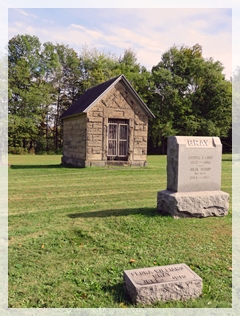
Even if we amass great wealth, make generous donations, or achieve some modicum of fame, chances are that most of us will be forgotten in a few generations. Our last name might remain on a corporate letterhead or, if wealthy enough, we could have a building or stadium named after us (at least for a while). Our headstone may rest in a cemetery, we might be listed in a genealogy chart, or an old letter or picture of us may reside in a box of memorabilia stored in someone’s attic. Nevertheless, we will be long gone and, for the most part, forgotten. For William Dyche, perpetuity lasted only 71 years! How long will it last for us? Even if a great grandchild has our china, a piece of our jewelry or carries our name, our essence will have vanished. We will be little more than a short family story or a faceless name.
Jesus told a parable about the rich man whose land was so productive that he ran out of room to store his crops. Rather than share his excess, he just built bigger barns so he could relax and enjoy his wealth for years to come. Unfortunately for him, he died that very night. A simple parable, it points out the temporal nature of life.
Financial planners often ask their clients, “What will be your legacy?” The rich man in the parable left a legacy of filled barns for someone else to enjoy. Sadly, he forgot the most important thing—his soul. Sometimes we’re so busy thinking about our legacy here on earth that, like the man in the parable, we also forget about our souls. Whether or not we are remembered in this world isn’t really important. The real question is whether or not God will welcome us into His kingdom in the next.
 His cautionary words to the disciples are difficult to understand. How can Jesus, who told us to love our enemies and do good to them, tell us to hate our families? Do we have to despise our relatives if we want to be his disciples? Fortunately, after getting the disciples’ attention with that unusual statement, Jesus followed with a parable about a man who undertook a project without counting the cost and then couldn’t finish what he began. Hating our family is just a hyperbole; it’s a way of saying that anyone who follows Christ must love Him more than anything else. Christ is to be first and foremost in our hearts and minds. In comparison to our love for Jesus, we are to love them less (or “hate” them). To be His disciple, Jesus demands total commitment; we must be willing to give up everything for Him, even if that means the things and people we love. Sadly, when we choose Christ over loved ones, they might perceive our love of Jesus as a betrayal and may even hate us for that choice.
 When writing yesterday’s devotion (“It’s Curtains”), I couldn’t help but feel a brief pang of regret because I never had those conversations with my parents before they died. The thoughts, “Please forgive me. I forgive you. Thank you. I love you,” may have been assumed but never were spoken. I was fifteen when my mother succumbed to cancer. I saw her that day in hospital but, when I walked out that afternoon, I was sure I’d see her again when I visited the following day. I never thought the next time I saw her she’d be lying in a casket. When people would say, “She looks so good,” I wanted to shout at them and say, “She doesn’t look good; she looks dead!” Five years later, I was in the same funeral home and surrounded by many of the same mourners. That time, it was my father’s body lying so still in the front of the room. Two day earlier he’d been hunting pheasants when his heart failed; he died in the middle of a corn field. I’d seen him just a few weeks before that and never thought our farewell was the final one. Did my parents know how much I loved them? Did they know how sorry I was for my failings? Did they know I forgave them for theirs? Did they know how thankful I was for the life they gave me?
 In a “Family Circus” cartoon, written by Bil and Jeff Keane, Dolly wakes up and says, “I hope today is one of those days I never wanna forget.” Amen to that, girl! Isn’t that what we all hope for every day? What will it take for Dolly to have one of those days? What will it take for us to have a day we never want to forget?
 After struggling with the writing of a devotion, it was finally finished. Thankful, I listed its completion in my gratitude journal that night. The next morning, I discovered it was lost—vanished into thin air and nowhere to be found (and believe me, I tried)! Looking back, I probably cut the devotion from my “Work On” file but got distracted and never pasted it into my “To Post” file. Unfortunately, by the time I discovered my error, both files had been saved in versions without the words over which I’d labored so long. When it became clear that those paragraphs truly had vanished into the black hole of my computer, I was annoyed with myself and upset, upset enough to want that thanks entry crossed out in my gratitude journal!
 The book of Daniel was written during the Babylonian captivity. Nebuchadnezzar had assaulted Judah, destroyed Jerusalem and the temple and exiled the people of Judah to Babylon. Jeremiah had prophesized that Jerusalem’s desolation would last seventy years and Daniel realized that their time of exile was nearly complete. After fasting, donning sackcloth, and covering himself with ashes, Daniel passionately prayed and pled with God to return His people to their land.
 Devotions of the Heart