EASTERTIDE

Jesus told her, “I am the resurrection and the life. Anyone who believes in me will live, even after dying.” [John 11:25 (NLT)]
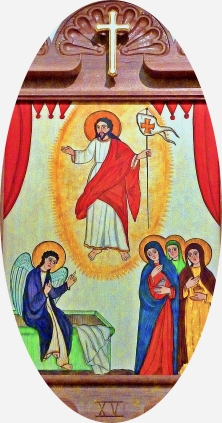
“Happy Easter,” said the Pastor as she welcomed us to worship. She was neither a week late nor four weeks early for Greek Orthodox Easter. While it’s no longer Easter Sunday and all the jelly beans, chocolate bunnies, and hard-boiled eggs have been eaten, it is Eastertide (“tide” just being an old-fashioned word for “season” or “time”). The Christian or liturgical calendar designates Eastertide as the fifty days from Easter/Resurrection Sunday to Pentecost (when we celebrate the outpouring of the Holy Spirit and the birth of the church).

Because it didn’t come by divine revelation, the church calendar isn’t sacred. Scripture doesn’t mandate the celebration of holy days and seasons like Lent, Good Friday, Easter, Advent, and Christmas. Nevertheless, God commanded the Israelites to celebrate specific events in their history and seasons of fasting and feasting tied to Jewish history are found throughout the Old Testament. Although the Christian church calendar isn’t established in Scripture, its basis certainly is.

We don’t even know the exact date of Christ’s birth, death, or resurrection and it wasn’t until 325 AD that Easter’s date was set as the first Sunday after the first full moon on or after March 21. The church (or liturgical) calendar was developed by tradition and church law so that, regardless of their location, all of Christ’s followers could collectively commemorate an act of God in the history of their redemption. People didn’t have ready access to Bibles in the 4th century and the regular celebration of events in the life of Christ and the church helped believers to better understand and remember them.

While liturgical churches such as the Episcopal, Lutheran, Methodist, and Roman Catholic still observe the seasons of the church, many Protestant churches do not. Some non-liturgical churches, however, are beginning to return to the traditional church calendar as a way of combatting the commercialization of our religious holidays. A few years ago, a non-denominational mega-church near our northern home announced, “This year we’re going to observe Lent!” as if it were a new idea rather than one more than 1,500 years old!

Although my neighbors went out and purchased half-price candy the day after Easter, we don’t want to spend the next several weeks dying eggs, making Easter baskets, having egg hunts, or consuming jelly beans and Peeps. Rather than repeating those secular traditions until Pentecost on May 19, Eastertide gives us fifty days to celebrate the meaning of Easter (and seven Sundays to sing the beautiful “alleluias” in Christ the Lord is Risen Today.)

During these next several weeks, let us spend as much time contemplating, appreciating, and celebrating Jesus’ resurrection as we did anticipating, planning, and celebrating His birth last December. After all, Easter is the whole reason for Christmas! Without Jesus’ resurrection, Christmas would simply celebrate the birth of a good man who said some wise things and was killed for his words.

The promise of our salvation didn’t disappear when the last chocolate bunny was eaten; the glorious Easter message is everlasting. Christ’s resurrection brings us love, grace, peace, forgiveness, redemption, and salvation, not just on Easter, but every day of our lives. One day is hardly enough time to celebrate a risen Christ—even fifty days are insufficient to rejoice in our salvation. We should be Easter people all year long.

The resurrection gives my life meaning and direction and the opportunity to start over no matter what my circumstances. [Robert Flatt]

This means that anyone who belongs to Christ has become a new person. The old life is gone; a new life has begun! [2 Corinthians 5:17 (NLT)]

 Copyright ©2024 jsjdevotions. All rights reserved.

THE NEW COVENANT (MAUNDY THURSDAY)

And he took bread, and when he had given thanks, he broke it and gave it to them, saying, “This is my body, which is given for you. Do this in remembrance of me.”  And likewise the cup after they had eaten, saying, “This cup that is poured out for you is the new covenant in my blood.” [Luke 22:19-12 (ESV)]

holy communionToday is Maundy (or Holy) Thursday—the day many Christians throughout the world will observe the institution of the Lord’s Supper/Eucharist/Holy Communion by coming to the Lord’s table. Regardless of what you call this sacrament, Jesus’ mention of a “new covenant” probably will be part of your service. Not a word commonly used today, what is a covenant and how does it differ from a contract?

Both covenants and contracts are binding agreements but, in a contract, the parties negotiate from fairly equal bargaining positions and are free not to sign. Although both parties are expected to abide by its terms, a contract has contingencies. If either party fails to hold up their end of the bargain, the contract is null and void and the relationship ends.

A covenant, however, is not between equals. With no negotiation, it is more like an agreement between the conquering king and the conquered people! While contracts can be amended, covenants are unalterable. In a covenant, the parties agree to hold up their end of the deal even if the other party doesn’t. While a failure on one side or the other will yield consequences, it will not negate the relationship. In Scripture we find covenants between God and Adam, Abraham, Moses, Noah, and David. In them, God promised to provide, protect, and bless his people while they promised to trust and obey him and repent when they didn’t.

God’s standard is perfection but, regardless of how hard we try, we can’t be perfect. As we know from the Old Testament, the people repeatedly failed to keep their promises. In a contractual relationship, that failure would have ended their relationship with God. Fortunately, it was a covenant relationship and, while the Israelites incurred God’s judgment for their disobedience, they never were abandoned. The Hebrew Scriptures promised a new covenant in God’s words to Jeremiah—a covenant uniting God with His people—a covenant of grace in which God fulfilled both sides of the agreement.

When Jesus blessed the bread and wine in that upper room in Jerusalem some 2,000 years ago, a new covenant with God began. Jesus did not negate the law. There was nothing wrong with the law; the problem was with the people who couldn’t abide by it. In the old covenant, people were told what to do (and not to do) to get right with God but, in the new covenant, the getting right with God was done for us by Jesus.

The old covenant required the blood of animals and yearly atonement; the new covenant is for eternity and was satisfied with the sacrifice of God’s only Son. The old covenant was one of the law and works but the new one is one of grace and faith. Instead of the law being written on tablets, it is written on our hearts. The old covenant was signified by circumcision but the new covenant is shown by a change of heart. The old covenant found God in the Temple in Jerusalem but the new finds Him in the temple of the Spirit. The old covenant was one of bondage and the new is one of liberty. The old covenant was established on Mt. Sinai for Israel alone; the new was established on the cross and is for all mankind. It was with Jesus that the old covenant ended and it was with Him that the new covenant began. What was the Last Supper of the old covenant became the First Supper of the new one!

Behold, the days are coming, declares the Lord, when I will make a new covenant with the house of Israel and the house of Judah, not like the covenant that I made with their fathers on the day when I took them by the hand to bring them out of the land of Egypt, my covenant that they broke, though I was their husband, declares the Lord. For this is the covenant that I will make with the house of Israel after those days, declares the Lord: I will put my law within them, and I will write it on their hearts. And I will be their God, and they shall be my people. And no longer shall each one teach his neighbor and each his brother, saying, ‘Know the Lord,’ for they shall all know me, from the least of them to the greatest, declares the Lord. For I will forgive their iniquity, and I will remember their sin no more.” [Jeremiah 31:31-34 (ESV)]

Copyright ©2023 jsjdevotions. All rights reserved.

HE WAS BETRAYED

On the way, Jesus told them, “All of you will desert me. For the Scriptures say, ‘God will strike the Shepherd, and the sheep will be scattered.’ But after I am raised from the dead, I will go ahead of you to Galilee and meet you there.” [Mark 14:27-28 (NLT)]

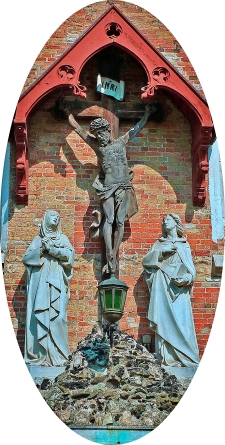
Church of our Lady - Netherlands

In the days leading up to his crucifixion, the people who claimed to love Jesus the most failed him in many ways. We know about Judas—the disciple trusted enough to carry the money bag who betrayed Jesus for thirty pieces of silver. That last night, the deceitful man had the audacity to have his feet washed by the Lord and to drink from His cup! But what of the other disciples? During that same meal, Peter vowed he’d never deny Jesus, even if it meant his death and the rest of the disciples echoed his pledge. Yet, within a matter of hours, those brave disciples would desert Jesus and Peter would deny Him three times. Even though Jesus asked Peter, James, and John to pray and keep watch with him in the Garden of Gethsemane, they fell asleep, not once but twice!

Where were the disciples when the mob shouted for Barabbas to be freed? For that matter, where were all of those people who had been healed or fed by Jesus? Just a few days earlier, a crowd had shouted, “Hosanna! Blessed is he who comes in the name of the Lord!” Where were they? Why were they silent? Instead of calling for Jesus’ freedom, the mob called, “Crucify him! Crucify him!”

The disciples weren’t even there to carry the cross for Jesus; that task fell to Simon, a stranger from Cyrene. Only John, Mary the mother of Jesus, Mary Magdalene, and some other women followers were at the foot of the cross when Jesus was crucified. Disillusioned and fearful for their lives, the other disciples were absent in His dying hours.

Rather than a disciple, it was a dying criminal who attested Jesus’ innocence, showed his faith, and asked the Lord, “Remember me when you come into your Kingdom.” When Jesus took His last breath and died, it was a Roman soldier and not a disciple who declared, “This man truly was the son of God!” The eleven remaining disciples didn’t even help bury their beloved rabbi. That responsibility was taken by Joseph of Arimathea and Nicodemus, members of the Jewish high council and secret followers of Jesus.

The disciples, confused and frightened, failed Jesus both as disciples and as friends. Nevertheless, despite the way they failed Him, Jesus didn’t fail them. Instead, after His resurrection, Jesus greeted them with words of peace and forgiveness. He then opened their minds to understand the Scriptures and charged these men—the same men who once failed Him—with the task of spreading the good news of His resurrection. Jesus knew it is better to be a believer who sometimes fails than not to believe at all.

Be assured, if you walk with Him and look to Him, and expect help from Him, He will never fail you. [George Mueller]

Jesus came and told his disciples, “I have been given all authority in heaven and on earth. Therefore, go and make disciples of all nations, baptizing them in the name of the Father, and the Son and the Holy Spirit. Teach these new disciples to obey all the commands I have given you. And be sure of this: I am with you always, even to the end of the age.” [Matthew 28-18-20 (NLT)]

Copyright ©2024 jsjdevotions. All rights reserved.

DECREASING

He must increase, but I must decrease. [John 3:30 (ESV)]

great blue heronAfter pointing out Jesus as the “Lamb of God,” some of John the Baptizer’s disciples left John to follow Jesus. Later, John’s remaining disciples reported that Jesus was baptizing (it actually was His disciples) and wanted to know whose purification ritual of baptism was valid. With many turning from John to Jesus, the Baptizer’s disciples were confused, concerned, and probably a little envious. Apparently, they forgot that John’s original mission was that of forerunner—the one who would prepare the way for the Messiah and point the way to the Lamb of God. Knowing that he wasn’t the bridegroom but only His friend, the Baptizer humbly affirmed his position by telling his disciples that Jesus must become more prominent while he became less and less important. J.C. Ryle likened the Baptizer’s role to that of a star growing paler and paler as the sun rises until the star completely disappears in the light of the sun. John clearly understood that he was to fade in the light of the Son.

During this time of Lent, I have given thought to John’s words and tried (rather unsuccessfully) to decrease so that Jesus’ presence can increase. It was upon reading the following prayer by John Wesley that I realized how much of me I refuse to surrender. Prepared by Wesley for the early Methodist societies in 1755, the prayer is part of a Covenant Renewal Service in Methodist churches today. Although Wesley’s original, with its “Thee,” “Thy,” and “Thou,” has been updated with “You,” “Your,” and “Yours,” the prayer’s level of commitment remains the same.

I am no longer my own, but Yours. Put me to what You will, rank me with whom You will; Put me to doing; put me to suffering; Let me be employed for You or laid aside for You, Exalted for You, or brought low for You; Let me be full, let me be empty; Let me have all things, let me have nothing; I freely and wholeheartedly yield all things to Your pleasure and disposal. [John Wesley]

These are the words of a man who was willing to decrease so that Jesus would increase—so that God’s light would be visible in his life. A prayer of surrender, Wesley’s words are those of a servant who loves and trusts his master enough to willingly submit in advance to whatever his master demands.

When Jesus called us to take up our crosses, He wasn’t speaking of bravely facing some tragic situation or long-term illness. A cross meant certain death and taking up our cross means dying to ourselves. Surrendering our wants, plans, and desires to Him, taking up our cross is decreasing while He increases! Unlike Wesley, my prayer of, “Do with me whatever You please, give me whatever task you would have me do, send me wherever whenever you want, take all that I have, and give me whatever you choose,” includes the unspoken words, “as long as it’s what I want and isn’t too inconvenient!”

While I may sing the old hymn’s words, “Take my life and let it be consecrated, Lord, to thee,” there are limitations to my offer. God is welcome to my life, my time, my hands and feet, my voice, my skills, my wealth, and my will just as long as it’s on my terms! By the way, Lord, don’t ask me to do manual labor, go without modern conveniences, move, learn a new language, or leave my family!

In The Weight of Glory, C.S. Lewis points out that God doesn’t want most of our time and attention or even all of it; He want us—the whole package—body and soul! There is no part of us that does not belong to Him and upon which he has no claim. He wants to completely fill us with His presence, but that’s only possible if we decrease to make room for Him. It is only when we empty our souls of our own will that He can fill us with His! Let us remember: If we’re too filled with ourselves to make room for His fasts, sacrifices, and responsibilities, then we’re too filled with ourselves to have room for His feasts, gifts, and blessings!

Lord, show me how to decrease so that You might increase!

Then Jesus told his disciples, “If anyone would come after me, let him deny himself and take up his cross and follow me. For whoever would save his life will lose it, but whoever loses his life for my sake will find it. For what will it profit a man if he gains the whole world and forfeits his soul

Copyright ©2024 jsjdevotions. All rights reserved.

SHED THE SHROUD

Then Jesus shouted, “Lazarus, come out!” And the dead man came out, his hands and feet bound in graveclothes, his face wrapped in a headcloth. Jesus told them, “Unwrap him and let him go!” [John 11:43-44 (NLT)]

roseUnlike Lazarus, we haven’t had a four-day encounter with death. Our family didn’t wash us with warm water, anoint us with myrrh and aloe, wrap us in a shroud with herbs and spices, lay us in a tomb, and mourn our passing. Most of us haven’t even endured a months-long coma, flatlined, or been brought back to life with an AED. How does such an experience affect someone? Without a doubt, the man who emerged from the tomb differed from the man who died four days earlier. Did Lazarus return to life with the 1st century equivalent of a “bucket list” of things to accomplish, places to go, things to do, and adventures to have?

When Jesus called Lazarus out of the tomb, the once dead man emerged from the tomb with his face wrapped in a head cloth and his body bound in burial garments. Jesus told the people to unbind him and free him from the trappings of the grave. Something tells me that, after four days in a tomb, Lazarus left behind more than some linen cloth soiled with the detritus of the tomb and death. While we don’t know what he experienced during those four days, He must have returned to life with a new perspective. As he walked into the sunlight he never expected seeing again and inhaled the air he never anticipated breathing again, can you imagine how much he appreciated his new lease on life? Given a second chance, Lazarus probably wasn’t about to bring any regrets, resentment, anger, or guilt with him. Raised from the dead, he probably shed much of his past along with that shroud as he stepped from the tomb’s gloom.

Unlike Lazarus, we haven’t physically died. Nevertheless, we were spiritually dead until we responded to Christ’s call. Now, born again into a new spiritual life, our grave clothes are no longer necessary. Lazarus shed his; have we? Even through we’re reborn in Christ, we tend to carry the detritus and debris of our yesterdays into our new life. After putting on the new clothes of salvation and righteousness, rather than leave our graveclothes behind, we drag along the shroud of the past—a shroud stained with betrayals, anger, disappointment, loss, or hurt and embellished with things like remorse and disgrace. Even when we think we’ve donned the fresh clothes of a new life in Christ, we often tuck a pang of guilt or shame into a pocket. We have trouble believing that we’re forgiven, but we are; that change is possible, but it is; that we have a relationship with the Creator of the Universe, but we do; or that He could possibly love us, but He does! Lazarus shed his shroud; so should we.

As for bucket lists—they seem more a way of denying death than living life to the fullest. I don’t think Lazarus emerged from his tomb with a to-do list of things to accomplish before his next trip to that tomb. I suspect he emerged with a new appreciation for the everyday things of life—his family, the sound of laughter, the embrace of a friend, a sip of cool water, morning dew glistening in the sunlight, sunsets and sunrises, the chirp of a sparrow, worship at the Temple, the taste of a rip fig, a beautiful rose, a buzzing bee, the aroma of fresh baked bread, the earthy smell of rain, and a relationship with Jesus. Death taught Lazarus that he didn’t need more; he just needed to fully appreciate what he already had—Jesus and life!

Lazarus heeded Jesus’ call. When he stepped into the light from that dark tomb, he shed his shroud and embraced his new lease on physical life. When we responded to Jesus’s call, we were given a new spiritual life. Let us leave the despair, doubt, shame, sorrow, and sin behind as we clothe ourselves with the joy of life in Jesus Christ.

And all who have been united with Christ in baptism have put on Christ, like putting on new clothes. [Galatians 3:27 (NLT)]

You have turned my mourning into joyful dancing. You have taken away my clothes of mourning and clothed me with joy. [Psalm 30:11 (NLT)]

Copyright ©2024 jsjdevotions. All rights reserved.

FRUIT OF THE SPIRIT – Part 2

For no good tree bears bad fruit, nor again does a bad tree bear good fruit, for each tree is known by its own fruit. For figs are not gathered from thornbushes, nor are grapes picked from a bramble bush. [Luke 6:43-44 (ESV)]

pomegranateMy son has a beautiful pomegranate tree in his yard but, when he first purchased the property, he didn’t know what it was. Although showy red flowers eventually appeared, it wasn’t until the flowers developed into deep-red globe-shaped fruit that he knew it was a pomegranate. The tree was recognized by its fruit and it is by our fruit that Christ’s followers are recognized.

We tend to think of the Fruit of the Spirit (love, joy, peace, patience, kindness, goodness, gentleness, faithfulness, and self-control) as nine different fruits—like a basket containing an orange, apple, kiwi, pineapple, grape, blueberry, banana, apricot, and mango. The Greek word used by Paul, however, was karpos and it was singular. Rather than describing nine different kinds of fruit, the Apostle was listing nine different characteristics of one fruit—the fruit of God’s grace working in us.

Along with having a delicious flavor that is both sweet and tart, the characteristics of a pomegranate’s fruit include its bright red color, hundreds of juicy edible seeds, being rich in powerful antioxidants called polyphenols, and containing fiber, magnesium, potassium, and vitamins E and K. Just as all of its characteristics are contained in a single pomegranate fruit, all nine of its virtues are contained in the Fruit of the Spirit.  After all, even non-believers can love, exhibit patience, or use self-control at times, but it takes the power of the Holy Spirit to overcome our sin nature and possess love, joy, peace, patience, kindness, goodness, gentleness, faithfulness, and self-control all at the same time! These gracious dispositions should be found in the hearts of all who have the Holy Spirit living in them and they should be evident in the lives of all who claim to follow Jesus!

Fruit, however, has to grow and mature. After planting, it takes three to six years before a pomegranate is mature enough to develop a few small fruits. It takes another three to six years before the tree bears a proper harvest. Even then, the fruit doesn’t appear all at once. After the tree flowers, it takes six to seven months for the fruit to develop and ripen. Being reborn takes only a moment but becoming a Christian takes a lifetime. Like a fruit tree, we need to grow and mature before we bear good fruit and, like the pomegranate, our fruit needs time to ripen.

While my son’s tree produces ripe fruit between August and November, we are expected to bear the Fruit of the Spirit all year long! As with my son’s pomegranate tree, it is by our fruit that we are recognized. It identifies us as followers of Christ and, if our fruit doesn’t look a lot like love, joy, peace, patience, kindness, goodness, faithfulness, gentleness and self-control, there’s a problem! We’re like a diseased plant that bears only rotten fruit or no fruit at all!

Although the Spirit does the planting of this fruit, we are the ones who must tend the garden by weeding out the sin that threatens its health, fertilizing it with God’s word and prayer, and watering it with worship and fellowship. Without staying connected to the Lord, we’ll be like a broken branch from the pomegranate tree—unable to bear fruit. A Christ follower’s fruit comes from a relationship with God through Jesus Christ; it comes from staying connected to the vine.

The branch of the vine does not worry, and toil, and rush here to seek for sunshine, and there to find rain. No; it rests in union and communion with the vine; and at the right time, and in the right way, is the right fruit found on it. Let us so abide in the Lord Jesus. [Hudson Taylor]

Abide in me, and I in you. As the branch cannot bear fruit by itself, unless it abides in the vine, neither can you, unless you abide in me. I am the vine; you are the branches. Whoever abides in me and I in him, he it is that bears much fruit, for apart from me you can do nothing. [John 15:4-5 (ESV)]

Copyright ©2024 jsjdevotions. All rights reserved.