IN THE DARK

And the judgment is based on this fact: God’s light came into the world, but people loved the darkness more than the light, for their actions were evil. All who do evil hate the light and refuse to go near it for fear their sins will be exposed. [John 3:19-20 (NLT)]

sunriseAlthough demons had no trouble recognizing Jesus, the people who were most knowledgeable about Scripture and best knew the Messianic prophecies often seemed blind to what was before them. In fact, even after hearing Jesus speak and watching Him heal, the Pharisees and scribes accused Him of being a demon. Why did they refuse to see what was right in front of them?

Of the people who recognized Jesus as the promised Messiah, only a few were what would have been called religious. The devout Simeon and Anna knew the Messiah when Jesus came to the temple as a baby yet, twelve years later, no one in the temple recognized Him as anything more than a perceptive intelligent boy. Most of the others who recognized Jesus were secular people who knew they were flawed and in need of Him: the woman at the well, the Gentile woman with a demon-possessed daughter, the prostitute who washed His feet, the blind Bartimaeus, the corrupt publicans Zacchaeus and Matthew, Mary Magdalene, the lepers, the adulterous woman, and the paralyzed man and his friends. On that dark Friday, rather than a religious scholar, it was one of the Roman soldiers who’d nailed Jesus to the cross and a thief hanging beside Him who testified to His true identity.

Just as sunlight reveals fingerprints on the window and dust on the table, the Light of the World revealed the sins of the world. Without light, a zircon can pretend to be a diamond, stainless can pass for sterling, and a designer knock-off can be mistaken for the real thing. In the darkness, hypocrisy, deceit and legalism can pass for righteousness, morality and piety. Until it recognizes what it actually is, corruption can call itself integrity, wickedness can say it’s virtue, and arrogance can profess humility. Those unwilling to see their own sinfulness and need for salvation rejected Jesus—the one without sin. Not wanting to see what the Light revealed, they chose to remain in the dark. Those who admitted their sins knew they were in the dark and welcomed the Light. Recognizing their need for Jesus, they accepted Him and received healing, mercy, forgiveness, and everlasting life.
Jesus spoke to the people once more and said, “I am the light of the world. If you follow me, you won’t have to walk in darkness, because you will have the light that leads to life.” [John 8:12 (NLT)]

He came into the very world he created, but the world didn’t recognize him. He came to his own people, and even they rejected him. But to all who believed him and accepted him, he gave the right to become children of God. [John 1:10-12 (NLT)]

Copyright ©2018 jsjdevotions. All rights reserved.

NOT A DRY EYE

You learn more at a funeral than at a feast – After all, that’s where we’ll end up. We might discover something from it. [Ecclesiastes 7:2 (MSG)]

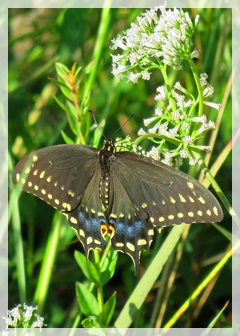
black swallowtail - butterflyAt my age, I’ve attended a fair share of funerals and they’ve run the gamut from full-blown productions complete with video presentations and choirs to a few mourners on a windy ski slope with a bag of ashes. Some ministers knew the deceased well and others couldn’t even pronounce the name correctly. There have been inspiring prayers and eulogies and some with no prayer at all. They’ve taken place in jam-packed churches and nearly empty mortuary chapels. Solomon was correct; there is a lot we can learn at funerals.
I’ve learned how much we miss when we don’t take the time to truly know someone. I discovered more about one woman from her obituary and eulogy than I did from 30 years of socializing with her. Her funeral showed me how little we really know about people we call “friends” and how superficial our friendships can be.

I’ve learned how empty some lives have been. When asked to do the eulogy for a distant family member, I was given a list of the five things of which he was most proud, the high point being a 4-H trophy awarded some seventy years earlier. He made no mention of family, friends, faith, or love. As I looked out over the mourners, there were no friends and only a few family members who attended out of a sense of obligation.

As we released butterflies following the joyous and love-filled celebration of life of another family member, I learned about courage and how much faith, love, family and friends can guide someone in life and through the dark valley of death.

I’ve learned how much a parent’s love and guidance can influence his children after hearing a son speak eloquently at his father’s funeral. I was reminded of how fragile life can be and, upon returning home, called every family member just to tell them I loved them.

I’ve learned that communities can come together with offerings of food, comfort and support and that families can be torn apart by resentment, jealousy, and greed. A funeral not only reminds us all of the inevitability of death, it can teach us how to live. If nothing else, we return home appreciating each day just a little more.

Good and brave men buried Stephen, giving him a solemn funeral—not many dry eyes that day! [Acts 8:2 (MSG)]

Copyright ©2018 jsjdevotions. All rights reserved.

DORMANCY

God, make a fresh start in me, shape a Genesis week from the chaos of my life. Don’t throw me out with the trash, or fail to breathe holiness in me. Bring me back from gray exile, put a fresh wind in my sails! [Psalm 51:10-12 (MSG)]

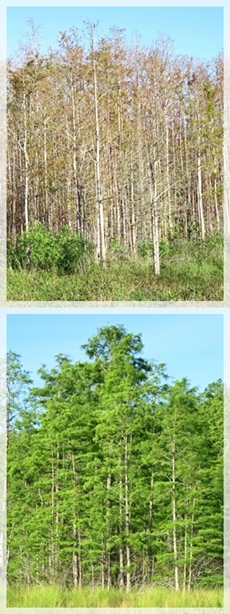
Corkscrew swamp - cypress - dormantEarlier this year, upon seeing the browning and nearly naked cypress trees at the bird sanctuary, the visitor asked if Hurricane Irma had killed them. I explained that the bald and pond cypress weren’t dead, just dormant. Being deciduous, they shed their leaves annually and were just enjoying a much needed rest during the shorter days and dryer conditions of winter. I reassured her that, in a month or so, their bright green needles would return and new growth would sprout from their branches. Today, the forest is verdant throughout the swamp.

While it is possible to force trees to evade dormancy by keeping them inside and controlling the light, temperature and water conditions, it would greatly shorten the plant’s lifespan; they’re not meant to leaf and branch continually. Dormancy is vital for the survival of deciduous trees and the way they withstand unfavorable growing conditions. When better conditions return, the trees wake up and start to bud and blossom again.

While dormancy is good for trees, dormancy is not usually considered a good thing when applied to Christians. A study in Great Britain found that 55 percent of those who identify themselves as Christian never read the Bible, 29 percent never pray, and a third of them don’t even attend church; it called these people “dormant Christians.” When God’s word isn’t growing in our hearts or we fail to bear the Fruit of the Spirit, some people say we’re in “spiritual dormancy.” Superficial, uncommitted, wilting or dying faith like this seems more a case of failure to thrive than dormancy. Just because growth isn’t obvious when a tree is dormant doesn’t mean nothing is happening. Dormancy is when the tree gathers strength, prepares for leafing and branching, and is the best time for pruning in preparation for new growth!

I’ve seen too many people lose their zeal for Christ because they haven’t taken a rest from their busyness for Him to spend time abiding in Him. It’s often when they’ve forgotten to spend time in His rest that their spiritual lives go dead. Sometimes, like trees, we need to retreat into dormancy to rest, do some pruning, and prepare ourselves to take our next steps in God’s ministry. Even Jesus took time away from His ministry for prayer and guidance.

During these next few months, my husband and I will be travelling a great deal. While I remain committed to prayer, worship, study, and journaling, there will be times when writing and posting will be difficult, if not impossible. Last year, I solved this problem with some “summer re-runs.” Knowing how refreshed and enthusiastic I felt upon my return to writing, I think dormancy is a far better term. So, like the cypress trees that go dormant in adverse conditions, I will take a break when circumstances are not conducive to writing. Unlike the trees, however, I won’t change color or shed my needles in preparation for dormancy. Instead, I’ve selected a few old devotions to repost and, with over 1,500 devotions from the last four years, I have plenty from which to choose. Throughout the next few months, they will be scattered in among new ones. So, if you see a devotion you’ve read before, don’t worry; I’m not dead, I’ve just gone dormant!

God, my shepherd! I don’t need a thing. You have bedded me down in lush meadows, you find me quiet pools to drink from. True to your word, you let me catch my breath and send me in the right direction. [Psalm 23:1-3 (MSG)]

I’ll refresh tired bodies; I’ll restore tired souls. [Jeremiah 31:25 (MSG)]

Copyright ©2018 jsjdevotions. All rights reserved.

MORE WAG, LESS BARK!

Finally, brethren, whatever is true, whatever is honorable, whatever is just, whatever is pure, whatever is lovely, whatever is gracious, if there is any excellence, if there is anything worthy of praise, think about these things. [Philippians 4:8 (RSV)]

 My son, sweeten thy tongue and make savory the opening of thy mouth; for the tail of a dog gives him bread, and his mouth gets him blows. [Story of Ahikar]

dogLast month, my husband and I attended a “Sweetheart” dinner at church. The men were in charge of the entire event and there were a few rough spots in the night. Then again, at the risk of being accused of political incorrectness or gender bias, most of the men probably were novices at that kind of event planning. Unlike the men, we women have had decades of organizing (and attending) school parties, PTA fund raisers, charity galas, birthday parties, showers, weddings, anniversary bashes, and other assorted celebrations. In spite of the glitches, there was much that went right and the evening was enjoyable and entertaining. Unfortunately, the woman sitting beside me kept criticizing how things were done—from name tags and table assignments to flowers and dessert. Her nit-picking comments became as annoying as the yapping of a bad-tempered dog and I thought of a bumper sticker I’d recently seen: “Wag More, Bark Less!”

Bad tempered dogs (and people) are nothing new; a similar proverb dates back to 500 B.C. in an Aramaic papyrus found in Egypt called the Story of Ahikar. “Wag More, Bark Less!” may be bumper sticker philosophy, but I wish more people (including me) did just that. After reading the qualifications and concerns of the candidates for our property association board, I was struck by how many were unpleasantly barking and nipping at each other rather than wagging their tails and showing me how well they’d work with one another and our management company. An on-line community newsletter was so filled with bark (and bite) that we stopped subscribing. Rarely are the letters to the editor in the newspaper anything but bark in the way of anger and criticism. While waiting at the bakery counter yesterday, an impatient woman yelled at the harried clerk and stormed away in a huff. Sometimes, it feels like we’re in a kennel full of angry upset dogs—yapping, baying, growling and snarling! Worse, once one dog (or person) starts barking, other dogs (and people) tend to join in the unpleasant clamor.

Like the woman beside me at that dinner, there are times I bark or snarl in disparagement, annoyance or anger rather than wag in happiness, appreciation, or compassion. In his letter to the Philippians, the Apostle Paul reminds us that we are responsible for what we put in our minds. Even in the bleakest of circumstances or worst of conditions, there is some small thing worthy of praise. Our job, as Christians, is to find it and think about it! Fortunately, we have the Holy Spirit to help us in that task. Moreover, as my mother used to say, “If you can’t say something nice, say nothing at all!” Thankfully, the Spirit gives us the self-control to do just that! If we can’t wag, at least we can muzzle ourselves so we don’t bark!

But the fruit of the Spirit is love, joy, peace, patience, kindness, goodness, faithfulness, gentleness, self-control; against such there is no law. … If we live by the Spirit, let us also walk by the Spirit. Let us have no self-conceit, no provoking of one another, no envy of one another. [Galatians 5:22-23, 25-26 (RSV)]

Copyright ©2018 jsjdevotions. All rights reserved.

HE KNOWS OUR NAMES

O Lord, you have examined my heart and know everything about me. You know when I sit down or stand up. You know my thoughts even when I’m far away. You see me when I travel and when I rest at home. You know everything I do. You know what I am going to say even before I say it, Lord. You go before me and follow me. You place your hand of blessing on my head. Such knowledge is too wonderful for me, too great for me to understand! [Psalm 139:1-6 (NLT)]

house sparrowRomper Room, a children’s program that first aired in 1953, was like a televised pre-school/kindergarten class. At the end of every show, the hostess would pick up her magic mirror and recite the words, “Magic Mirror, tell me today, did all my friends have fun at play?” Looking through an open frame shaped like a hand mirror, she’d then call out various children’s names: “I see Johnny had a special day today, Olivia had a special day yesterday, and I see Bonnie, Tammy and Gregory had special days, as well, and Brandon, you know I see you…” For forty years, small children patiently sat in front of their TVs hoping to hear their names called. While that illustrates the naiveté of youngsters back then, it also demonstrates how much we all want to be noticed and recognized.

When the man at the park asked me what kind of bird it was, I identified it as an LBB and explained that meant “little brown bird.” Chances are it was one of the twenty kinds of sparrows around here. Then again, it could have been some sort of wren or finch. Had it been a little larger, it would have qualified as the equally vague BBB (bigger brown bird). As much as I enjoy spotting the peepers in the trees and even taking their pictures when they remain still long enough, I don’t care enough about them to know their names or the songs they sing.

Fortunately, God knows not just our names but all there is to know about us: our hopes, needs, fears, and concerns. There are no LBBs (little boring biddies), LOLs (loud old ladies), BFMs (big fat men), TWAs (teens with attitude), TTs (troublesome tots), CCs (chronic complainers), or PWPs (people with problems) in His kingdom. To God, we all have distinctive names, faces, personalities and voices. Unlike me, He doesn’t need a field guide with our pictures or a CD with our songs to know who we are. Unlike the Romper Room hostess, He doesn’t pretend to have a magic mirror that allows Him to see us or know how we feel. The author of our days, He knows what today was like for us and what tomorrow will bring to us. God not only sees each and every one of us but He sees into us—into our very hearts and souls—and, somehow, He still manages to love and value us as only a father can.

What is the price of two sparrows—one copper coin? But not a single sparrow can fall to the ground without your Father knowing it. And the very hairs on your head are all numbered. So don’t be afraid; you are more valuable to God than a whole flock of sparrows. [Matthew 10:29-31 (NLT)]

Copyright ©2018 jsjdevotions. All rights reserved.


TAKING THE LONG WAY

Tent Rocks - NMDon’t be afraid, I’ve redeemed you. I’ve called your name. You’re mine. When you’re in over your head, I’ll be there with you. When you’re in rough waters, you will not go down. When you’re between a rock and a hard place, it won’t be a dead end—Because I am God, your personal God, The Holy of Israel, your Savior. [Isaiah 43:2-3a (MSG)]

When visiting New Mexico, we often drive from Albuquerque to Santa Fe. The shortest route is north on I-25. If we’re not in a rush, however, the best way is the longer Turquoise Trail, a national scenic byway on the east side of the Sandia Mountains. In theory, this route should only add about a half-hour to the trip but it always takes longer. The whole point of going that way is to enjoy some breath-taking scenery, take a hike in the high desert hills, check out one of the bizarre roadside attractions (like the Tinkertown Museum), visit various art galleries along the trail, and stop for lunch (and more shopping) in the reborn ghost town of Madrid. Sometimes the journey is as important as the destination.

When the Israelites escaped from Pharaoh, God didn’t lead them the shortest way to the Promised Land; His reasoning, however, had nothing to do with sightseeing or shopping. The most direct route would have taken them northeast along a coastal road and directly into Philistine territory. Instead, God led them south southwest into the desert on the eastern edge of Egypt. Although they were armed for battle, the Israelites were anything but ready to face a military conflict. Having been oppressed for generations, rather than a mighty nation, they were a ragtag band of former slaves. While the longer route made sense, God’s next instructions certainly didn’t! He told Moses that Pharaoh’s men would give chase but that the Israelites should turn back and camp in such a way that they were exposed and trapped against the sea. Although God promised this strange tactic would demonstrate his power and glory, I can’t help but think that Moses was shaking in his sandals when reassuring the people that God had everything under control.

If the Israelites weren’t ready to face the Philistines a few days earlier, they were no more ready to face Pharaoh’s mighty army then. In fact, from a logistical point of view, by turning back, the novice warriors moved into an utterly indefensible position. That, of course, is exactly why God arranged it. Whether facing Philistines or Egyptians, the Israelites’ reaction to either would be panic. With the Philistines, they could have fled, even if that meant returning to Egypt. With Pharaoh’s army, however, they had no escape route. Although their sarcastic complaints to Moses revealed their lack of faith, pinned against the sea as they were, they had no choice but to trust in God. Since we know the rest of the story, that trust was well-founded. The people of Israel walked through the Red Sea on dry ground and Pharaoh’s army perished in its waters. After experiencing God’s miraculous deliverance, the Israelites no longer feared Pharaoh. They did, however, fear, trust, and believe in the Lord!

Sometimes God takes us the long way around for a reason; while it may be for the scenery, there’s a good chance it’s to take us away from trouble. On the other hand, sometimes God takes us on detours that seem to make absolutely no sense because they lead us into trials and difficulty. That usually happens when there’s something we need to learn. When we find ourselves between an army and the sea or a rock and a hard place, there’s no need to panic. We just need to trust in the Lord.

And Israel looked at the Egyptian dead, washed up on the shore of the sea, and realized the tremendous power that God brought against the Egyptians. The people were in reverent awe before God and trusted in God and his servant Moses. [Exodus 14:30-31 (MSG)]

Copyright ©2018 jsjdevotions. All rights reserved.