ALL FOR THE GOOD

And we know that God causes everything to work together for the good of those who love God and are called according to his purpose for them. [Romans 8:28 (NLT)]

“Blessed are You, Lord our God, King of the Universe, the True Judge,” is a blessing often said by Jews when they undergo a death or tragedy. “This is all for the good,” or “Blessed is the true judge,” is often said by other Jews in response to their tragic news. Rather than being about God’s final judgment of a person, these words remind them that only God can judge whether events are good or bad. To illustrate this point, the Talmud has a story about the second century sage, Rabbi Akiva. One night, the rabbi, along with his rooster and donkey, arrived in a village. When no one would give Akiva a place to stay, the rebbe said, “All that God does, He does for the good.” He then walked to a field outside of town, set up camp, and lit his lantern. That evening, a gust of wind knocked over the lantern breaking it, a fox came and ate the rooster, and a lion came and killed the donkey. In spite of all that, Akiva said, “All that God does, He does for the good!” Just before dawn, marauders came and attacked the village but, camped in the field without light, crowing rooster or braying donkey to reveal his presence, the rabbi remained safe.

The Talmud explains this story by saying that we must bless God for the bad news that comes our way in the same manner we bless Him for the good things that befall us. Indeed, when Scripture tells us we are told to love God with our whole heart, soul and strength it doesn’t mention any exceptions for circumstances we don’t like. While it’s easy to love God with our entire being when all is good, we must also love Him that same way in our suffering, sorrow and misfortune. Rest assured, in the long run, whatever happens to us is for our good. That, however, does not mean everything that happens to us will be good. Indeed, even when we don’t know why, pain, grief and adversity are blessings. All that God does, He does for the good! Blessed be the true judge.

God judged it better to bring good out of evil than to suffer no evil to exist. [Saint Augustine]
Can anything ever separate us from Christ’s love? Does it mean he no longer loves us if we have trouble or calamity, or are persecuted, or hungry, or destitute, or in danger, or threatened with death? … And I am convinced that nothing can ever separate us from God’s love. Neither death nor life, neither angels nor demons, neither our fears for today nor our worries about tomorrow—not even the powers of hell can separate us from God’s love. No power in the sky above or in the earth below—indeed, nothing in all creation will ever be able to separate us from the love of God that is revealed in Christ Jesus our Lord. [Romans 8:35,38-39 (NLT)]

Copyright ©2018 jsjdevotions. All rights reserved.

ONE OF THE BEST DAYS

Not that I was ever in need, for I have learned how to be content with whatever I have. I know how to live on almost nothing or with everything. I have learned the secret of living in every situation, whether it is with a full stomach or empty, with plenty or little. For I can do everything through Christ, who gives me strength. [Philippians 4:11-13 (NLT)]

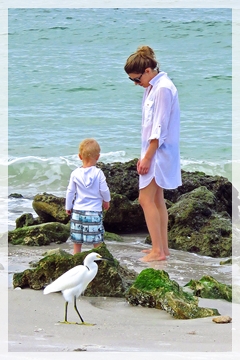
clam pass - naplesThe weatherman declared it to be “one of the ten best days of summer” and I thought of his words throughout the day. How many of those ten days have we already had this summer? What if, not knowing it was one of the ten best days, I missed it? Could I have been blinded to its beauty by the routine obligations, boring chores, petty annoyances, and minor frustrations of everyday life?

When reading the list of his ordeals in 2 Corinthians, is would seem that the Apostle Paul probably missed enjoying most of the best days of every season. He faced death many times and endured several imprisonments, countless beatings (three times with rods), and numerous whippings (five times with 39 lashes which was the maximum punishment allowed). The victim of stoning once, Paul also was adrift at sea for a day and night and shipwrecked three times. Not only was Paul weighted down with his concern for the early church but he also had a “thorn” in his flesh, quite likely a chronic ailment, that had tormented him for fourteen years. Since he lived another nine to twelve years after writing the Corinthians, that thorn probably continued to plague him and more trials and troubles certainly followed. All in all, Paul travelled about 15,000 miles on land and sea and endured sleepless nights, hunger, thirst and cold, faced hazards from bandits and even his own people, and spent between five and six years of his life imprisoned before being beheaded by the Romans between 64 and 67 AD. He endured all of this to proclaim the gospel and yet Paul never complained about missing out on any of the “best” days because he knew the secret of living in every situation—of making every day his best day.

We shouldn’t need a weatherman to tell us it’s one of the ten best days and we certainly don’t need good weather for the day to qualify. In fact, every day should qualify as one of the ten best days of whatever season it happens to be. Paul, a man who endured horrible ordeals both physically and emotionally for the church, knew that best days had nothing to do with circumstances but everything to do with attitude. He tells us to be joyful, to pray, and to give thanks to God in all circumstances (and not just on the good days). With an attitude like his, in spite of his sufferings, every day Paul experienced must have been one of his best. I’d venture to say that most of us suffer far less than did the Apostle and yet, instead of starting the day cheerfully saying, “Good morning, Lord!” many of us grumble, “Good Lord, it’s morning!” Let this day be one of your ten best; after all, you don’t know how many more remain!

Always be full of joy in the Lord. I say it again—rejoice! [Philippians 4:4 (NLT)]

Always be joyful. Never stop praying. Be thankful in all circumstances, for this is God’s will for you who belong to Christ Jesus. [1 Thessalonians 5:16-18 (NLT)]

Copyright ©2018 jsjdevotions. All rights reserved.

FAREWELLS

DAISIESJesus said, “Don’t let your hearts be troubled. Trust in God, and trust in me. There are many rooms in my Father’s house; I would not tell you this if it were not true. I am going there to prepare a place for you. After I go and prepare a place for you, I will come back and take you to be with me so that you may be where I am. You know the way to the place where I am going.” [John 14:1-4 (NCV)]

“Why can’t they be happy for us,” my daughter-in-law plaintively asked many years ago. “We’re going to where we want to be. This is our dream!” I certainly understood about her friends’ reaction to their news. My son, his wife and their two children (my precious grands) were moving to California. Instead of living a mile from us, they’d be over 2,000 miles away! I was no different from her friends except that, since taking Mother-in-Law 101, I’d mentally duct-taped my mouth and managed to silence my protests.

I felt her words in my heart. Why couldn’t I be happy for them? I was so blinded by my loss that I couldn’t see their gain: a beautiful new house, an ideal climate, a super school, and their dream location of surf, sand and sunshine. I asked God to change my heart: to take the sadness and replace it with gladness and to take my self-pity and replace it with encouraging words and enthusiasm. I knew this wasn’t the last time we’d see each other; after all, we only would be a plane ride apart.

It’s been several years since their move. When I see how happy they are in California, I can’t believe I ever allowed my sorrow at their departure blind me to their joyous arrival in a new location. Besides, my husband and I now have a wonderful place to visit.

Many of us are at the age when our friends and family are departing, not to live across the country, but to move from this world into the next. Why is it so difficult to be happy for them? That final move is the best one yet for them. They are leaving a place of pain, sin, anxiety, and sorrow and going to a new home: one where there is peace and joy and love. Moreover, they’re going to a place where, eventually, we all want to be! It’s just so difficult to stop focusing on our loss to see our loved one’s gain: a home in heaven – no pain, no tears, and the presence of God! Remember, this won’t be the last time we see them!

Heavenly Father, when our loved ones leave us, let it be less about us and more about them. Please lessen our sorrow at their departure and increase our joy at their destination.

Death is an incident, not an end. It is a transition for a Christian, not a terminus. [Billy Graham]

He will wipe every tear from their eyes, and there will be no more death or sorrow or crying or pain. All these things are gone forever. [Revelation 21:4 (NLT)]

Copyright ©2018 jsjdevotions. All rights reserved.

CROWNING GLORY

Gray hair is a crown of glory; it is gained by living a godly life. [Proverbs 16:31 (NLT)]

The glory of the young is their strength; the gray hair of experience is the splendor of the old. [Proverbs 20:29 (NLT)]

GrandmaGrey hair may be a crown of glory and the splendor of old age, but that’s about all the splendor and glory I see in advanced years. As my mother-in-law approaches her 102nd birthday, there is little about her quality of life that I consider glorious or splendid. Her sparkling personality, vigor and enthusiasm, along with her hearing, visual perception, ability to reason, and memory are vanishing. Occasionally a spark of her old self resurfaces but, for the most part, the essence of the woman who has been a mother to me for over fifty years has disappeared.

When I join my mother-in-law for meals at her senior residence, along with gray hair, I see plenty of stooped, shuffling, and incapacitated people. While speaking with them, rather than words of wisdom, I often hear the words of confused and failing minds. While writing about fear yesterday, I realized that, while I’m not afraid of old age, I am afraid of the infirmities that can come with it.

Fear may lie about plenty of things but he doesn’t lie when he tells me I’m getting old. The mirror, arthritis, my worsening eyesight, and my less than sharp memory tell me that every day. Fear, however, doesn’t stop at telling me I’m old. When I walk into a room and forget why I went there or fail to recall someone’s name, he whispers “dementia.” When my knees scream or my back aches, he flashes an image of an old woman hunched over a walker. If I need a magnifying glass to read directions or a small flashlight to scan a menu, he tells me it’s only a matter of time before I’m blind as a bat. Fear, however, doesn’t know what the future holds and neither do I.

My life expectancy at birth was almost 70 years of age. Having passed that milestone, I took an online test to determine my expected expiration date. Based on my zip code, marital status, and present health and weight, it’s a high probability that I’ve got twenty-five more years. Rather than finding that number reassuring, I find it terrifying. I don’t want to require help to bathe or dress and I don’t want to give up hikes through the woods or riding a bike. I don’t want there to be a time when I can’t read my Bible, remember the verses I’ve worked so hard to memorize, or do a crossword puzzle or Sudoku. I don’t want to need Depends, use a wheelchair, or forget my children’s names. I want to stay the way I am now but, short of dying today, that’s not likely to happen. Moreover, what I want doesn’t matter. Time will take its toll on all of us and, for some, that toll will be great. All we can do is take care of ourselves the best we can and trust the rest to God. As long as He gives us breath, He has a purpose for us. Our job is to live purposefully, thankfully, and joyfully all the days He’s given us.

As for my mother-in-law, in spite of her loss of vitality and mental faculties, she remains cheerful, pleasant and friendly (and she looks fabulous). Her younger tablemates tell me she’s an inspiration to them. Indeed, when I think about it, she’s an inspiration to me. She is facing the ailments and indignities that come with advanced age with faith, grace, and love. With God’s power, I can do the same. I will make the most of today, send fear packing, and let God worry about my tomorrows!

God never said that the journey would be easy, but He did say that the arrival would be worthwhile. [Max Lucado]

My health may fail, and my spirit may grow weak, but God remains the strength of my heart; he is mine forever. Psalm 73:26 (NLT)]

That is why we never give up. Though our bodies are dying, our spirits are being renewed every day. [2 Corinthians 4:16 (NLT)]

Copyright ©2018 jsjdevotions. All rights reserved.

UNCHANGING

Look up at the skies, ponder the earth under your feet. The skies will fade out like smoke, the earth will wear out like work pants, and the people will die off like flies. But my salvation will last forever, my setting-things-right will never be obsolete. [Isaiah 51:6 (MSG)]

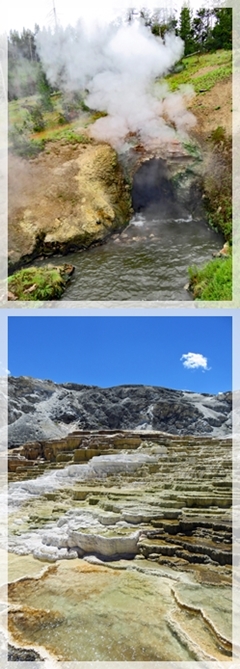
Dragon's mouth springs - Mammoth Hot springs - yellowstone

The unstable, ever-changing, and even violent nature of this world in which we live is evident throughout Yellowstone Park. It’s disconcerting to see hot mud shoot out of a cavern, to smell sulphur and feel the hot spray as a geyser erupts, and to stand in the steam and hear the booming belch as water surges out of a hot spring. Yellowstone is actually a super-volcano that last erupted some 640,000 years ago and smaller eruptions of lava have occurred as recently (geologically speaking) as 70,000 years ago. The park is what geologist Robert Smith calls “a living, breathing, shaking, baking, caldera,” and those geothermal wonders that attract visitors are fueled by magma as hot as 1,500 degrees that lies just a few miles beneath the earth’s surface.

The abundant geothermal activity and the 1,000 to 3,000 small earthquakes that occur there every year mean that the park is always changing. For example, when my husband visited the park as a boy, there was no Quake Lake west of Yellowstone and the Steamboat Geyser had been dormant for nearly fifty years. A massive earthquake in 1959 created the lake and the geyser awoke in 1961. Since then, it’s been erratic in its activity but, after four years of dormancy, it began erupting again in March of this year. Shooting nearly boiling water up 345 feet, it has erupted ten times since then. The travertine terraces of Yellowstone’s Mammoth Hot Springs are like living sculptures and continually change shape as over 500 gallons of hot water are discharged every minute and two tons of calcium carbonate are deposited there every day. Even the beautiful Yellowstone canyon, the result of wind, water and earthquakes, speaks of change as the Yellowstone River continues to erode the bedrock. Fire also has changed the landscape; over 70,000 acres of lush forest that existed when we visited there a few years ago became nothing but charred remains in 2016.

In Yellowstone’s dynamic and unsettled landscape, even the ground around the thermal features is unstable and can collapse. Then again, you don’t need to be in Yellowstone to realize how nature is an unpredictable, ever-changing, and often dangerous force. That Thai soccer team discovered how quickly a dry cave can fill with water in a flash flood, residents on the island of Hawaii saw their lives change in May when Kilauea began erupting and sent lava over the streets and through their neighborhoods. Texans, Floridians, and Puerto Ricans certainly can attest to the power of last year’s hurricanes. Hurricanes, tornadoes, tsunamis, floods, drought, earthquakes, hail, thunderstorms, volcanic eruptions, blizzards, avalanches, sinkholes, lightning and fire: we all are vulnerable to disaster from the changing and volatile nature of this world in which we live.

Yellowstone is a vivid reminder of how the forces of nature can change the world as we know it: rock erodes, mountains crumble, geysers appear and disappear, volcanoes erupt, forests burn and ground can collapse. I take comfort in the knowledge that, while nothing in this world is constant and forever, God remains our everlasting and unchanging bedrock. The same yesterday, today, and forever, He is our firm foundation.

Consider what you owe to His immutability. Though you have changed a thousand times, He has not changed once. [Charles Spurgeon]

I love you, God—you make me strong. God is bedrock under my feet, the castle in which I live, my rescuing knight. My God—the high crag where I run for dear life, hiding behind the boulders, safe in the granite hideout. I sing to God, the Praise-Lofty, and find myself safe and saved. [Psalm 18:1-3 (MSG)]

Copyright ©2018 jsjdevotions. All rights reserved.

WHEN GOD REMODELS

And I am sure of this, that he who began a good work in you will bring it to completion at the day of Jesus Christ. [Philippians 1:6 (ESV)]

tiger swallowtailMany years ago, we did some major remodeling on our lake house. The original structure was gutted: carpets ripped up, paneling pulled off, decks knocked down, stairs demolished, walls cut open, and our landscaping ruined. Filled with fear and misgivings, I stared at the gaping hole in the hillside and what was left of the original dwelling. The architect/builder kept reassuring me that, having drawn the plans, he knew how everything would eventually fit together. Me? I just saw the ruined house, a deep pit and piles of dirt. I hadn’t expected this devastation; it had seemed so simple on paper. How this mess was ever going to become the house we’d pictured, I didn’t know. I simply had to trust the builder and leave it in his hands. Seven months later, I stood in the same spot, thrilled with the final result; it was better than I’d ever expected!

Life can be like that remodeling project. Change can be unpleasant; at times, it may even look downright ugly and hopeless. We can rest easy when God is in charge; we’ll find that all will be good in its proper time. When God is finally finished, everything will make sense. We have to trust Him and not judge His work before it’s complete. He is a master architect and builder; let Him do His job!

Father, thank you for the beauty and joy you can salvage from our messed up lives. Help us trust your plan and timeline; give us patience and faith as we grow and change into the people you want us to be.

Imagine yourself as a living house. God comes in to rebuild that house. At first, perhaps, you can understand what He is doing. He is getting the drains right and stopping the leaks in the roof and so on; you knew that those jobs needed doing and so you are not surprised. But presently He starts knocking the house about in a way that hurts abominably and does not seem to make any sense. What on earth is He up to? The explanation is that He is building quite a different house from the one you thought of – throwing out a new wing here, putting on an extra floor there, running up towers, making courtyards. You thought you were being made into a decent little cottage: but He is building a palace. He intends to come and live in it Himself. [C.S. Lewis, “Mere Christianity”]

Now to him who is able to do far more abundantly than all that we ask or think, according to the power at work within us, to him be glory in the church and in Christ Jesus throughout all generations, forever and ever. Amen. [Ephesians 3:20-21 (ESV)]

For we are his workmanship, created in Christ Jesus for good works, which God prepared beforehand, that we should walk in them. [Ephesians 2:10 (ESV)]

Copyright ©2018 jsjdevotions. All rights reserved.