
But if we confess our sins to him, he is faithful and just to forgive us our sins and to cleanse us from all wickedness. [1 John 1:9 (NLT)]
 It was late Saturday night when one of our pastors glanced at the next day’s church program and saw that Sunday’s sermon was titled “Epithet.” Since he wasn’t speaking about insults on social media but about the way we’ll be remembered when we’re gone, it should have read “Epitaph.” After spending the next hour trying to figure out a way to tie epithets into epitaphs, he realized it made more sense to own up to his spelling error, which he did at all three services.
Life gives us an abundance of opportunities to make mistakes and, sometimes, it seems as if we never miss one! We mishear, misinterpret, misjudge, misread, misspeak, misspell, misunderstand and, yes, we sin. We take wrong turns, say the wrong things, and believe the wrong person. Sometimes, that wrong person is an over-confident self. Overly confident, the pastor didn’t proofread, the builders of the Titanic didn’t provide enough life boats, and Napoleon thought he could successfully invade Russia in the winter.
Like the pastor, as much as we hate to do it, we need to own our mistakes and admit our responsibility for them. Sometimes, we can make the best of them, in which case they cease being mistakes. For example, while 3M’s Patty Sherman was trying to develop a rubber that wouldn’t deteriorate when exposed to jet fuel fumes, she made a mistake and spilled a few drops of one failed test batch on her shoe. Later, seeing that those spots were clean while the rest of her shoe had gotten stained and dirty, she made the most of that mistake with a product we call Scotchguard!
Sometimes, we can fix our mistakes. When KFC discovered their motto “Finger-lickin’ good!” became “Eat your fingers off!” in Chinese, they quickly corrected their clumsy translation. Sometimes, though, we just plow on ahead in the face of our errors. The Leaning Tower of Pisa started to lean five years after construction began but, rather than admit and correct the problem, building continued for another for 192 years. They kept compensating by making the uphill side shorter but, because mistakes don’t correct themselves, the tower kept leaning.
Like that learning tower, many of our mistakes are ones with which we must live. Hopefully, we learn from our errors as I imagine NASA did when they accidentally taped over their video of the moon landing. Rather than dwelling on our mistakes, we have to move out of the land of “what if” into the land of “what is.” This, however, is where we encounter the hardest part of making a mistake: forgiving ourselves.
Consider the mistakes of Judas and Peter: Judas sold Jesus for thirty pieces of silver and Peter denied Him three times. Realizing Jesus would die for his betrayal, could Judas have been trying to undo his mistake by giving back the blood money? Filled with remorse and unable to change what had been done, he killed himself. I can’t help but wonder what would have happened if only Judas had waited three days. I know Jesus would have forgiven Him. Think of the testimony Judas could have given if he’d forgiven himself and waited as did Peter. Like Judas, Peter betrayed Jesus but, unlike him, he forgave himself, lived with his mistake, and was in the room when Jesus appeared! Think of the powerful testimony Peter did give!
We have a choice about even our most grievous mistakes. Like Peter, we can live with them, forgive ourselves, accept God’s forgiveness, and move on with our lives in service to Him. Or, like Judas, we can hold on to them and refuse to forgive ourselves. Our guilt may not take our lives but it will take our peace, joy, self-confidence, hope, and even our faith in a forgiving God. We’re told we must forgive to be forgiven; it would seem that command means forgiving ourselves as much as it means forgiving others. Let our guilt be washed away!
Finally, I confessed all my sins to you and stopped trying to hide my guilt. I said to myself, “I will confess my rebellion to the Lord.” And you forgave me! All my guilt is gone. [Psalm 32:5 (NLT)]
And since we have a great High Priest who rules over God’s house, let us go right into the presence of God with sincere hearts fully trusting him. For our guilty consciences have been sprinkled with Christ’s blood to make us clean, and our bodies have been washed with pure water. [Hebrews 10:21-22 (NLT)]
Copyright ©2019 jsjdevotions. All rights reserved.
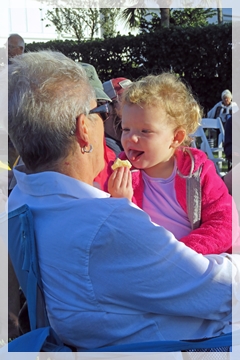 As we sang carols at the beach Christmas Eve, Sarah’s grand sat on her lap while finishing off a holiday cookie. By the time the little one was done with the cookie and cuddling her gram, Sarah’s shirt was a wrinkled mess of frosting, crumbs and cookie drool. I couldn’t help but think of the gospel story of parents bringing their children to Jesus for a blessing. Even in the first century, I imagine little children meant grubby hands, sticky fingers, and runny noses. From what we know of Jesus, though, I picture him welcoming those children onto His lap along with all of the mess that came with them. Perhaps some even left drool on his robe.
 In writing about the Sinner’s Prayer yesterday, I wondered if, by saying it, a new believer gets the false impression that his responsibility ends with a prayer when, in fact, it has just begun! Justification takes only a moment but sanctification takes a lifetime. Addressing the guilt of our sins, justification is when, by the grace of God, we are made righteous through God’s grace and our faith. It’s as if we’re guilty criminals, standing in God’s courtroom, and God pardons us. Telling us our debt to society has been paid, He sets us free. While it’s easy to walk out of the courthouse, it’s not so easy to alter the behavior that led to our life of crime. Like any felon, we need to change our ways, which is where sanctification comes in. Rather than the reformation of a criminal, it is the transformation of a sinner.
 “He will deliver us from our troubles or carry us through them. Either way, we will be free of them eventually.” How easily these words can be uttered until, of course, those troubles apply to us. Had Job’s friends been Christian and said those words, I don’t think they would have been any more comforting than what was said. While true, they won’t bring back the amputated limb or cancerous breast, pay the staggering medical bills, tuck the motherless child in bed at night, change the diagnosis of Parkinson’s or schizophrenia, or bring back an abused child’s innocence. While true, those words can’t wipe the tears of a mother holding her stillborn baby, the husband watching his wife vanish into dementia, or the man whose body is in mutiny because of ALS.
 “Over 1 million served,” was the sign Ray Kroc posted at his first McDonald’s franchise in 1955. That number became 100 million in 1958 and was 1 billion in 1963. When the number of burgers served surpassed the 99 billion mark in 1994, operators were told to change their signs to “Billions and Billions Served!” Executives at McDonald’s claim they no longer keep track of how many are served but I don’t believe it! Someone there knows exactly how many of those hamburgers have been sold, along with the number of Egg McMuffins and chocolate shakes.
