
As the deer longs for streams of water, so I long for you, O God. I thirst for God, the living God. When can I go and stand before him? Day and night I have only tears for food, while my enemies continually taunt me, saying, “Where is this God of yours?” [Psalm 42:1-3 (NLT)]
 Not so long ago, it was hard to face my computer with any enthusiasm. Every beginning led to a dead end or took me down a rabbit hole of confusion. The paragraphs over which I’d struggled had come to nothing and my hours at the keyboard seemed an exercise in futility. It’s as if I had little scraps of useless fabric but couldn’t find a way to quilt them together. I wondered where God was when I so desperately needed His guidance.
The best place to go when feeling hollow or hopeless is God’s word and Psalms is where I usually begin. David certainly had plenty of times of downheartedness and he wasn’t afraid to express his exhaustion, frustration, or despair and yet there always seems to be a ray of hope in his words. I turned to Psalm 42 and, having hit a “dry spell,” I knew what the psalmist meant when comparing himself to a deer panting for water and thirsting for God. Like him, I felt like I was dying of thirst.
It was the psalm’s mention of enemies with their taunts of, “Where is this God of yours?” that really hit home. I don’t share David’s flesh and blood enemies but all of us share a common unseen enemy: the doubt and anxiety that comes from spiritual depression.
The palmist asks why God has forgotten him and I think we all know that feeling. While I can get it when I’m staring at an empty page, that sense of desolation may visit others as they wait for the return of a prodigal, sit in a hospital room, endure chronic pain, look at the empty chair once occupied by a spouse, or have too much month left at the end of their money. We’ve all had times when it feels like God has turned a deaf ear to our prayers or has closed His eyes to our situation.
“Where is this God of yours?” is the enemy’s voice. Wanting us to lose faith or wallow in despair, he causes us to question God’s presence in our lives. God hasn’t forgotten about us; even the psalmist, as depressed as he was, acknowledges that God pours out His unfailing love each day. Nevertheless, sometimes, it feels as if God is looking the other way. Feeling defeated, discouraged, lonely, weary, or insecure, it’s easy to forget that our feelings can’t always be trusted. God, however, always is steadfast and trustworty!
In a gentle reproach, the psalmist asks why he is so downcast and reminds himself of the hope he has in God. That we don’t sense God’s presence, feel His love, see His hand, or hear His voice doesn’t mean that our loving God isn’t there. When asked, “Where is this God of yours?” let us never forget that He dwells, not just in heaven above, but also in our broken spirits. There always will be dark valleys to traverse but we are never alone; we have hope in God and, for that, we praise him.
A loss of the present sense of God’s love is not a loss of that love itself; the jewel is there, though it gleams not on our breast; hope…expects the promised boon though present providence stands before her with empty hands. [Charles Spurgeon]
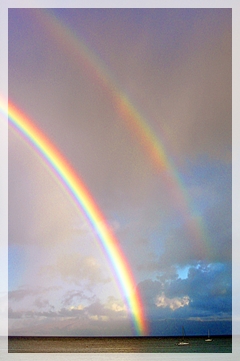 The most obvious way God speaks is through the Bible. Sometime, however, He whispers to us in the “Aha!” moments. Serendipitous, they are God’s love notes that gently remind us of His presence, His love for us, and the magnificence of His creation. While they vary from person to person, I tend to find them in things like butterflies dancing among the flowers or a double rainbow after a spring storm.
 Because of my foot surgery, I was stuck in an air boot (and “air” definitely does not mean “light as air”) for five weeks. Weighing just a little over three pounds, it felt more like thirty by the end of each day. Wearing a cumbersome boot that never quite matched the height of any of my shoes took its toll on me. Eventually, my foot didn’t hurt as much as did my knee, hip, and back from hobbling along in my heavy unmatched footwear. Carrying extra loads of anger, resentment, worry, heartache, guilt, or regret can weigh us down in much the same way that boot affected my body and gait. Instead of walking with confidence and strength, we limp along in fear, discomfort and doubt. The difference, of course, is that there was purpose to my burdensome boot but there is no purpose in being saddled with emotional baggage. Jesus asks us to give Him our burdens; with Him in our lives, we don’t have to carry any extra weight in our hearts.
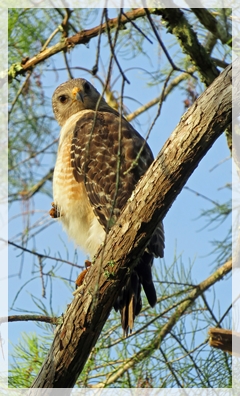 Seeing a red-shouldered hawk perched up in a nearby tree, I focused in on it only to see him suddenly duck his head to avoid being attacked by small bird and then drop again as another tiny bird swept down at him. Those two gnatcatchers boldly harassed the hawk as it kept bobbing and weaving to dodge them. Fiercely territorial, gnatcatchers are unafraid to confront predators and, apparently, the hawk was infringing on their territory. Eventually, the hawk admitted defeat and flew off to another tree. I later asked one of the Audubon docents why the large hawk didn’t fight back against the tiny birds and was told that the hawk knows it can’t win. Being so small, the fast and agile gnatcatcher easily can out maneuver the bigger bird. For the hawk, the energy spent trying to catch the gnatcatcher isn’t worth it; fleeing makes more sense than staying. After settling in another tree not far away, the hawk spotted a crayfish. After sweeping down to catch it, he returned to his new perch and enjoyed a peaceful breakfast (without any annoying gnatcatchers).
 But the wisdom from above is first of all pure. It is also peace loving, gentle at all times, and willing to yield to others. It is full of mercy and the fruit of good deeds. It shows no favoritism and is always sincere. And those who are peacemakers will plant seeds of peace and reap a harvest of righteousness. [James 3:17-18 (NLT)]
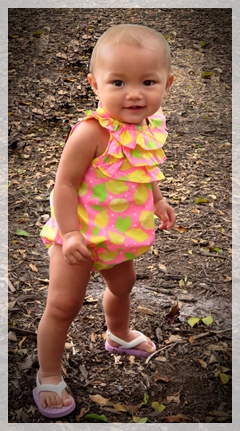 Watching a friend’s video of her grandbaby’s first steps, I thought back to my children’s first faltering steps. They teetered and tottered, often fell, got up, and fell again. Eventually, the wobbly legs of my eldest became the confident legs that take him down mountain slopes on a snowboard, the awkward steps of my daughter became the graceful ones of a dancer in toe shoes, and the child who took forever to walk now runs marathons. It took time and maturity, however, before they could carry themselves with such strength and assurance.
 Devotions of the Heart