THE ARK

giraffeThen God said to Noah, “Leave the boat, all of you—you and your wife, and your sons and their wives.  Release all the animals—the birds, the livestock, and the small animals that scurry along the ground—so they can be fruitful and multiply throughout the earth.” Genesis 8:15-17 (NLT)]
The National Geographic Photo Ark is on display at our local zoo. This travelling exhibition features large-scale animal portraits taken by Joel Sartore, a man on a quest to photograph all of the world’s animals. Sartore has photographed a little more than 9,800 of the 1.2 million species of animals that have been identified by zoologists so far.

Attributing human traits or emotions to non-humans is anthropomorphism and I admit being guilty of it as I viewed Sartore’s amazing photographs. An embarrassed-looking mandrill with its hand covering his mouth seemed to be politely concealing a burp. With his cocked head and puzzled expression, a white arctic fox looked perplexed. The Sumatran rhino’s wistful look made me wonder if he knew there are less than 100 like him on the planet. Clearly unaware that he also is an endangered species, the giant panda looked content and rather pleased with himself. The young chimp appeared to be proudly flexing his biceps, as do toddlers when they want to show how big and strong they are. The Sumatran tiger lay regally, his head erect with paws crossed in front of him as if the photographer had posed him for his royal portrait. A black-footed ferret seemed forlorn, as if he knew that only a few hundred of his species still live in the wild. Perhaps my favorite photo was that of a bashful Brazilian porcupine on his hind legs. Looking a bit anxious, he was scrunched over a bit, legs squeezed together, with his front paws tucked down between his legs. He looked just like a toddler who desperately needs to go potty!

The purpose of the National Geographic Photo Ark is to use “the power of photography to inspire people to help save species at risk before it’s too late.” Although ours is a small zoo with only 70 species and just 52 of Sartore’s photographs on display, the amazing diversity in God’s creation was evident in both the enclosures and photographs. Sadly, many animals had words like “endangered” or “at risk” beside their names. God entrusted mankind with the task of looking after His amazing creation and we haven’t done a very good job of that.

The extinction of various species has always existed (i.e. dinosaurs) but it is increasing at an alarming rate. If the current trend continues, it is estimated that one in every three animal species on earth now will have disappeared by the end of this century. Following the flood, God vowed to never again destroy all living things. He won’t have to; we seem to be doing that on our own!

As we left the zoo, I thought about my anthropomorphic view both of Sartore’s photos and the zoo’s residents. Perhaps God gave us the tendency to attribute human emotions to animals so that we’d connect with them. It’s when we connect that we begin to care. Martin Buber said that, “An animal’s eyes have the power to speak a great language.” While I’m not sure exactly what Buber meant, the eyes I looked at told me to care.

Scripture is filled with admonitions to care for animals; domestic animals were not to be overworked or treated cruelly and Jesus told us that God knows when even a single sparrow falls to the ground. What does God think when an entire species ceases to exist? All of creation belongs to Him and we are little more than tenant farmers responsible for its care. When God gave us dominion over the earth, He expected us to behave conscientiously and we will be held accountable for the way we’ve tended His world. Are we good stewards or have we become exploiters? Will our zoos become the arks of the future and the only place God’s beautiful creatures will exist? Noah once saved the animals; can we do anything less?

It is folly to think that we can destroy one species and ecosystem after another and not affect humanity. … When we save species, we’re actually saving ourselves. [Joel Sartore]

The Lord God placed the man in the Garden of Eden to tend and watch over it. [Genesis 2:15 (NLT)]

Look, the highest heavens and the earth and everything in it all belong to the Lord your God. [Deuteronomy 10:14 (NLT)]

Copyright ©2019 jsjdevotions. All rights reserved.

LEAPING OVER A WALL!

deerFor it is you who light my lamp; the Lord my God lightens my darkness. For by you I can run against a troop, and by my God I can leap over a wall. This God—his way is perfect; the word of the Lord proves true; he is a shield for all those who take refuge in him. [Psalm 18:28-30 (ESV)]

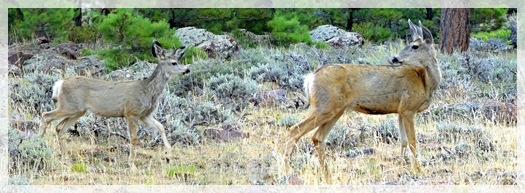
We’d been driving down a remote mountain road when we spotted a herd of deer in front of us. After leaping over the fence on our left, they crossed the road and trotted off into the forest on our right. One, however, stopped on the side of the road. Turning her head and flicking her tail, she stared across the road at where she’d just been. There, on the other side of the fence, we saw one lone fawn, struggling to leap over the obstacle. Perhaps looking for an easier way across the road, he kept pacing back and forth along the fence line. Several times he approached the fence, but never quite took the necessary leap. Meanwhile, unwilling to leave her youngster behind, the doe patiently stood across the road. Perhaps it was the way she flagged her tail that finally convinced him he could do it. In one great leap, the little deer made it over the fence, trotted across the road to his mother, and off they sped to join the rest of the herd.

I wondered why this fawn was unable to clear the fence when the other youngsters had leapt over it so easily. Perhaps, having strayed or lagged behind the others, he didn’t realize he needed a running start. Maybe, when he saw the fence, he allowed fear to stop him in his tracks. Fortunately, his mother’s presence eased his fears and gave him strength and courage enough to leap over it. As the doe did for the fawn, God’s presence in our lives eases our fears. It is His presence and power that enables us to vault over the hurdles in our lives.

Thank you, Lord, for never abandoning us. Don’t ever let us lose sight of you. Help us stay close to our brothers and sisters in Christ so we can learn from them and follow their examples. Encourage and strengthen us so we never allow fear to keep us from following wherever you lead.

If the Lord be with us, we have no cause of fear. His eye is upon us, His arm over us, His ear open to our prayer – His grace sufficient, His promise unchangeable. [John Newton]

For who is God, but the Lord? And who is a rock, except our God?—the God who equipped me with strength and made my way blameless. He made my feet like the feet of a deer and set me secure on the heights. [Psalm 18:31-33 (ESV)]

Copyright ©2019 jsjdevotions. All rights reserved.

SHEEP, SNAKES, AND DOVES

rat snakeLook, I am sending you out as sheep among wolves. So be as shrewd as snakes and harmless as doves. [Matthew 10:16 (NLT)]
Matthew tells of Jesus calling the disciples together, giving them the authority to cast our evil spirits and heal all kinds of illness, and then sending them out to announce that the Kingdom of God was near. Preparing them for persecution, Jesus said they would be as sheep to the wolves. Helpless against predators like wolves, sheep also were used in religious sacrifice.  Jesus made sure the disciples understood they would encounter opposition, danger, trials and floggings by likening them to these vulnerable sacrificial animals.

Nevertheless, not wanting them so naïve that they became perpetual victims or so timid they couldn’t accomplish their mission, Jesus then told the disciples to be as shrewd as snakes. We rarely think of these reptiles as canny or perceptive but, when we consider the snake Eve met in Genesis, the simile makes more sense. That cunning serpent certainly had a way with words as he convinced Eve to sin. Imagine what he could have accomplished if, instead of deception, he’d used his skill with words for good rather than evil! Jesus wasn’t telling the disciples to deceive but it would appear that He was telling them to use their wits.

There are other parallels between snakes and the disciples’ instructions. Snakes, being cold-blooded, adjust their body temperature by moving out in and out of the sun and shade to find a safe and comfortable resting place. While Jesus wasn’t suggesting hiding under a rock, He did tell the disciples to find a hospitable place to stay and, if a place wasn’t welcoming, to go elsewhere (as a snake does when the temperatures gets inhospitable). Unless attacked, most snakes are not aggressive; they prefer slithering away to a confrontation. Just as snakes know how to evade trouble, the disciples were told to do the same. Nevertheless, like a snake, they were to stand their ground and defend themselves when threatened. Rather than using venom, however, they were to defend themselves with the words of the Spirit.

Immediately after telling the disciples to be like snakes, Jesus told them to be as harmless as doves. Like sheep, doves were vulnerable and sacrificial animals but, even in 1st century Palestine, they were a symbol of peace and love. The story of the dove returning to Noah’s ark caused the Jews to associate the dove with peace. Because of Greek and Roman mythology, it also symbolized love and devotion and, because the Spirit of God descended like a dove at Jesus’s baptism,  it also signified the Holy Spirit to His early followers. As Jesus’s representatives, the disciples were to find a balance between prudence and self-preservation on the one hand and compassion, peace and love on the other.

In the free world today, we don’t face floggings; the wolves are far more subtle. I think of a friend who would never demean the ethnicity, culture or sexual preferences of her co-workers yet she frequently finds herself the object of their ridicule for her Christian beliefs. She has to be both a snake and a dove in her response to them as do the few conservative Jewish and Christian students in my grands’ California high school. Their free-thinking anything-goes classmates have disparaged their belief in God, purity, right and wrong, sin, and the Bible’s truth. While we don’t risk imprisonment, as Christians, we may still find ourselves targets with our beliefs mocked, challenged, or threatened in subtle ways. Jesus did not send us out as sheep to the slaughter but as ministers of His word. Through the power of the Holy Spirit, we can avoid confrontation while fearlessly and skillfully standing our ground with love and peace.

You will stand trial before governors and kings because you are my followers. But this will be your opportunity to tell the rulers and other unbelievers about me. When you are arrested, don’t worry about how to respond or what to say. God will give you the right words at the right time. For it is not you who will be speaking—it will be the Spirit of your Father speaking through you. [Matthew 10:18-20 (NLT)]

Copyright ©2019 jsjdevotions. All rights reserved.

BEWARE THE GNATCATCHERS!

Don’t worry about anything; instead, pray about everything. Tell God what you need, and thank him for all he has done. Then you will experience God’s peace, which exceeds anything we can understand. His peace will guard your hearts and minds as you live in Christ Jesus. [Philippians 4:6-7 (NLT)]

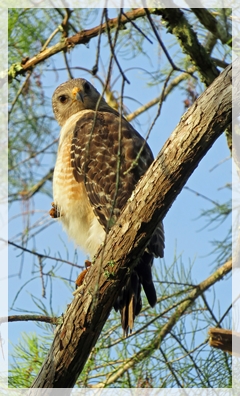
red-shouldered hawkSeeing a red-shouldered hawk perched up in a nearby tree, I focused in on it only to see him suddenly duck his head to avoid being attacked by small bird and then drop again as another tiny bird swept down at him. Those two gnatcatchers boldly harassed the hawk as it kept bobbing and weaving to dodge them. Fiercely territorial, gnatcatchers are unafraid to confront predators and, apparently, the hawk was infringing on their territory. Eventually, the hawk admitted defeat and flew off to another tree. I later asked one of the Audubon docents why the large hawk didn’t fight back against the tiny birds and was told that the hawk knows it can’t win. Being so small, the fast and agile gnatcatcher easily can out maneuver the bigger bird. For the hawk, the energy spent trying to catch the gnatcatcher isn’t worth it; fleeing makes more sense than staying. After settling in another tree not far away, the hawk spotted a crayfish. After sweeping down to catch it, he returned to his new perch and enjoyed a peaceful breakfast (without any annoying gnatcatchers).

“Surely, there’s a devotion of some kind in this!” I thought. Seeing those tiny birds harass the hawk (who was more than 100 times their weight) seemed like a David versus Goliath moment. The more I thought about it, however, I thought the hawk was the innocent party. He hadn’t provoked the birds; he was just minding his own business and looking for breakfast when those birds started pestering him. What the gnatcatchers were doing is called “mobbing.” When birds mob, they make a distress call that attracts other birds (even different species) to join in the harassment. If the hawk hadn’t moved, chances are more birds soon would have joined in hounding and harassing him.

Since another word for harassing is “worrying,” I wondered if those gnatcatchers might be like the worries that seem to come at us from out of nowhere to vex, torment, and distress us. Like mobbing birds, worry calls its pals anxiety, fear, and apprehension to join in troubling us. The gnatcatchers kept the hawk from doing his work (finding breakfast) and worry keeps us from moving ahead, as well. Realizing those birds were not going to disappear, the hawk wisely moved away from them. Often, we’re not that smart; we remain smack dab in the middle of worry and allow it to continue attacking and pecking at us. While the hawk only needed to fly to a nearby tree, we need fly to God, thank Him for His goodness, ask Him for help, and leave our concerns with Him. “You can pick what you ponder,” says Max Lucado. We can perch ourselves in the midst of worry or we can perch ourselves in the promises of God.

Whether or not we worry, our problems will remain. Worry, however, accomplishes nothing. We may not have a lot of power over our problems, but we do have power over our thoughts. Like the hawk, we need to stop perching in the worry zone and get on with our lives, whether that involves catching crayfish in the swamp or giving our concerns to God and working at finding a solution to our problems!

Your problem is not your problem; it is the way you think about it. [Max Lucado]

And now, dear brothers and sisters, one final thing. Fix your thoughts on what is true, and honorable, and right, and pure, and lovely, and admirable. Think about things that are excellent and worthy of praise. Keep putting into practice all you learned and received from me—everything you heard from me and saw me doing. Then the God of peace will be with you. [Philippians 4:8-9 (NLT)]

Copyright ©2019 jsjdevotions. All rights reserved.


SMELL THE FLOWERS/HEAR THE MUSIC

This is the Lord’s doing, and it is wonderful to see. This is the day the Lord has made. We will rejoice and be glad in it. [Psalm 118:23-24 (NLT)]

As a friend’s father used to say, “I couldn’t have made the day any better myself!” The temperature was perfect, the humidity had dropped, the pink of the sunrise tinged the early morning sky, and the aroma of jasmine made every breath a pleasure. When I looked one way, I still could still see the full moon and, when I looked the other, I saw the golden fire of the rising sun. Like a mirror, the lake reflected the clouds and colorful sky. Mocking birds were singing their joyful songs, rabbits were munching the grass, squirrels were chasing one another, ducks effortlessly glided through the water, and a few woodpeckers were tapping on the palms. It seemed like God had given me the beautiful morning as a special birthday gift. Of course, I know He didn’t do it just for me but it felt that way. I was especially appreciative of these little everyday things because I knew it would be my last walk for many weeks; the following day I was having foot surgery and faced a long recovery. As I tried to gather in the morning’s memory to keep me content for the next several weeks of inactivity, I wondered why I didn’t appreciate every morning as much as that day’s.

We’re often so busy rushing through life that we ignore its many unexpected blessings. Back in 2007, violin virtuoso Joshua Bell sat at the entrance to a Washington D.C. metro station during rush hour. The famed violinist played his 1713 Stradivarius (reportedly purchased for $3.5 million) for about 45-minutes. Just three days prior, Bell had performed before a full house in Boston’s Symphony Hall (where moderately good seats cost $100). This day 1,097 people passed by him but only seven paused long enough to listen. The unnoticed street musician received a total of $32.17 from 27 passersby. This experiment wasn’t an anomaly. Back in 1930, a similar one was conducted when violin virtuoso Jacques Gordon, dressed in beggar’s attire and using another prized Stradivarius, gave a curbside concert on Chicago’s Michigan Avenue. Hundreds of busy people rushed by him as his beautiful music fell on deaf ears. The musician’s take was $5.61.

If we don’t have a minute to stop and listen to one of the finest musicians in the world, what else are we missing? Do we take the time to perceive beauty and value the day’s gifts? I wonder how many other equally wonderful mornings I’ve sped through without stopping to delight in God’s glory both in the sky and here on earth. I treated that morning special because I knew it would be the last of such mornings for several weeks. In actuality, we never know what morning will be our very last one! Every day is a beautiful day simply because God made it. Let us seize it with praise and thanksgiving and never miss an opportunity to stop and smell the jasmine or listen to the music!

Seize life! Eat bread with gusto, Drink wine with a robust heart. Oh yes—God takes pleasure in your pleasure! Dress festively every morning. Don’t skimp on colors and scarves. Relish life with the spouse you love Each and every day of your precarious life. Each day is God’s gift. It’s all you get in exchange For the hard work of staying alive. Make the most of each one! Whatever turns up, grab it and do it. And heartily! This is your last and only chance at it, For there’s neither work to do nor thoughts to think In the company of the dead, where you’re most certainly headed. [Ecclesiastes 9:7-10 (MSG)]

Copyright ©2019 jsjdevotions. All rights reserved.

BEYOND OUR UNDERSTANDING

How great is our Lord! His power is absolute! His understanding is beyond comprehension! [Psalm 147:5 (NLT)]

Trust in the Lord with all your heart; do not depend on your own understanding. [Proverbs 3:5 (NLT)]

Koreshanity - Cellular CosmogonyJust north of us is a state park that once was home to a group called the Koreshan Unity. In 1894, Dr. Cyrus Teed, known as the Prophet Koresh, brought about 250 of his followers to the banks of the Estero River where they hoped to establish a “New Jerusalem.” The Koreshans believed that the Bible needed prophets to interpret it and that Teed was the seventh in a line of biblical prophets. As the designated prophet, Teed would reveal everything about the universe that Jesus failed to explain. Taking verses out of context from both testaments of the Bible, the Koreshans believed in reincarnation, communal living, heaven and hell, immortality, and celibacy.

The most curious belief of the Koreshans was that of Cellular Cosmogony: that the earth is a hollow shell about 8,000 miles in diameter and that the entire universe exists on the inside of this shell. Although the earth’s surface appears convex, Teed claimed that was an optical illusion and the earth’s surface actually was concave. Picture a globe but, instead of having the land and sea on the outer side, they are on the inner side; instead of life existing on the outer surface, it exists on the inside of the shell. The universe rotates inside the earth’s shell rather than the earth rotating in the universe and the sun is a giant electromagnetic battery in the middle of the sphere. Rather than gravity, centrifugal force is what holds us down.

Teed felt that God had revealed to the first six prophets (Adam, Enoch, Noah, Moses, Abraham, and Jesus) only what they (and their followers) were capable of understanding. As the most evolved of the prophets, Teed believed that God would reveal everything to him and, once God had done so, Teed would then usher in the age of Koreshanity.

For Teed, living on the inside of a hollow sphere meant that the universe and everything in it was knowable and finite—all wrapped up in a hollow sphere. Pictures of the earth from space easily tell us his Cellular Cosmogony is wrong and Scripture tells us he was in error with his theology—Jesus had the last word, not Teed! His biggest mistake may have been the same one we often make ourselves: wanting the world and God to be limited, explainable, and understandable.

Although Jesus and Scripture have given us all we need to know, there still remains much that we’ve not been told or that we’ll never understand about God, our existence, eternity, and the universe. None of us truly comprehend how God could speak the universe into existence, can know what we want before we know it ourselves, or see our yesterdays, todays, and tomorrows all at the same time. No prophet can give us a satisfactory explanation as to why bad things happen to good people or evil people prosper while the righteous suffer. How can we possibly truly understand God’s grace, His unlimited love for us, or how God can be one Being containing three persons while remaining only one God? That God is infinite, having neither beginning nor end, is mind boggling!

A universe that is contained in a shell would be far less baffling than one that is continually expanding and infinite in scope! We all want to think that God is understandable, life makes sense and everything is explainable but it isn’t. In spite of Scripture (and even science), there is much that remains incomprehensible and will remain that way during our lifetimes. Teed tried to limit God and His creation to make the inexplicable explainable. God and our existence, however, can’t be nicely wrapped up in a neat package or a closed universe. The good thing for us is that, while fully understanding God may be impossible, knowing, trusting and loving Him is not!

Oh, how great are God’s riches and wisdom and knowledge! How impossible it is for us to understand his decisions and his ways! … For everything comes from him and exists by his power and is intended for his glory. All glory to him forever! Amen. [Romans 11:33,36 (NLT)

Copyright ©2019 jsjdevotions. All rights reserved.