
OUT OF FEAR

turkey vulturesBut if you refuse to listen to the Lord your God and do not obey all the commands and decrees I am giving you today, all these curses will come and overwhelm you… The Lord himself will send on you curses, confusion, and frustration in everything you do, until at last you are completely destroyed for doing evil and abandoning me. [Deuteronomy 28:15,20 (NLT)]

In writing about the mezuzah last week, I learned that 4,649 laws govern every aspect of its writing. Each of the 713 letters must be perfectly shaped, written on handmade specially processed parchment made from a kosher animal, inscribed in black ink formulated from a specific recipe, with a unique quill pen, by a qualified scribe. Why so many rules to fulfill a requirement that was only a few words in Scripture?

The fourth commandment about the Sabbath is the longest one but pretty straightforward: make it a day of rest rather than work. Although Scripture referred to conducting business, field labor, treading in a winepress, loading animals, traveling and kindling fire as forbidden work, it never provided an all-inclusive list of prohibited activities. To further clarify the commandment, work was classified into thirty-nine categories of forbidden activity. To obey perfectly, however, more interpretation was needed. Since reaping (clearly field labor) was forbidden, what if someone climbed a tree and accidentally broke a branch or rode an animal and detached a stick to hit it? Since an accidental sin was still a sin and, technically, breaking a branch was reaping, those activities were prohibited, as well.

I’ve often given the Bible’s Pharisees, Sadducees, and scribes grief over their pettiness regarding the law. After studying Deuteronomy 28, however, I’m beginning to understand how the system of laws governing the conduct of the Jewish people became so complex. After listing the blessings for obedience, Moses laid out the many curses for the Israelites’ disobedience to God and those curses are far more extensive than the blessings. They include everything from wasting diseases, plagues, captivity, inflammation, boils, military defeat and scorching heat to becoming food for scavenging birds, madness, swarms of insects, starvation, and cannibalism. It’s not a pretty picture Moses paints as he warns the people to obey all the words of the law.  After reading those curses, it’s easy to see how fear of punishment led to legalism and why the minutiae of the law became more important than a relationship with the giver of the law. Fearful of punishment and striving for absolute obedience, the Jews wanted to cover every eventuality.

Although the law pointed out sin, what the people didn’t understand was that the law, no matter how intricately interpreted or followed, could not keep people from sin. We must never make the mistake of thinking we can reach a level of perfection good enough for God; the Israelites couldn’t and neither can we. In actuality, the law revealed that people are sinful and can never attain righteousness through obedience to it; no matter how carefully they try, they will always fall short. Righteousness is attained only through faith in Jesus Christ.

Several weeks ago, I received the following “wisdom” in my email: “Love God and do as you please.” A paraphrase of St. Augustine’s words, it is not carte blanche to sin. Rather, if we genuinely love God with all our being, we will want to do only what pleases Him. We don’t please him to avoid captivity or pestilence or to work our way into His good graces; we please Him out of love. We don’t do it on our strength, but through the power of the Holy Spirit. As for me, that seems a whole lot easier than having the Sabbath quandary of whether or not I can turn off the alarm clock, open an umbrella, or pick up the button that fell off my jacket.

Once and for all, I give you this one short command: love, and do what you will. If you hold your peace, hold your peace out of love. If you cry out, cry out in love. If you correct someone, correct them out of love. If you spare them, spare them out of love. Let the root of love be in you: nothing can spring from it but good. [St. Augustine]
Love does no wrong to others, so love fulfills the requirements of God’s law. [Romans 13:10 (NLT)]

Copyright ©2018 jsjdevotions. All rights reserved.

MEZUZAHS

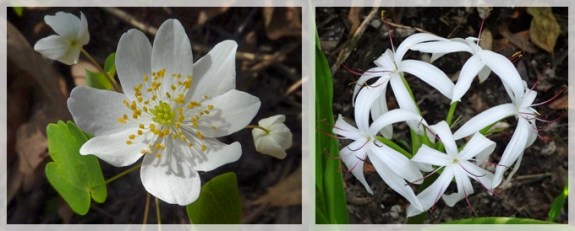
rue anemone - swamp lilyWrite them [God’s words] on the doorposts of your house and on your gates, so that as long as the sky remains above the earth, you and your children may flourish in the land the Lord swore to give your ancestors. [Deuteronomy 11:20-21 (NLT)]

After unlocking the door, he reached up to the small metal case on the right side of the door post, touched it, and brought his fingers to his lips. My friend is Jewish and inside the box he touched was a mezuzah—a parchment (called a klaf) upon which the words of Deuteronomy 6:4-9 and 11:13-21 are hand-written.

Like the tefillin worn during prayers, the mezuzah serves as a reminder of God’s continual presence and the covenant He made with His people. For the Jew, it’s like God saying, “As you enter this house and as you leave it, remember me, your heritage, and all that I’ve taught you.” When touched upon entry, the mezuzah is a reminder that the home is a holy place and, when touched upon exit, it is a reminder of how one should act when out in the world. Observant Jews place a mezuzah on nearly every exterior and interior doorway (bathrooms excepted) as a constant reminder of God as they walk throughout the house. The mezuzah also tells anyone passing through the doorway that it is a Jewish household: a home that serves one God and operates by a special set of traditions, rituals, and principles.

As Christians, we don’t affix mezuzahs to our doorposts but there certainly are times I wish we had a sign by the door that said, “Jesus lives here!” It would remind all who pass through the door (including me) that ours is a home that serves Jesus and operates by His principles. While it should be obvious to anyone that Christ is our king, I wonder if it is as obvious as it should be. I’m not talking about crosses or pictures of Jesus on our walls, Bibles on the bookshelves, or Scripture verses on pillows. Is every room in our house filled with the Fruit of the Spirit? Are love, joy, peace, forbearance, kindness, goodness, faithfulness, gentleness and self-control evidenced in all of our interactions? Is there mercy and forgiveness in our dealings? Is the presence of Christ sensed and is God acknowledged in all we say and do? It’s those things, not décor, that identify a home where Jesus lives.

Thinking about touching the mezuzah upon entry and exit, I wonder what it would be like if, every time we came in the doorway, we paused for a brief moment of prayer, thanking God for our safe arrival, asking Him to help us leave the worries and troubles of the day at the threshold, and praying to be filled with His wisdom, love and patience. What if, every time we left our houses, we also paused for a brief moment of prayer, asking God for safe travel and the guidance of the Holy Spirit in all we say and do?

There are hundreds of rules regarding the mezuzah: everything from what size room requires one and the height of its placement to the form of the letters in the script and the way the scroll is to be rolled. Although Jesus freed us from the Old Testament laws, the purpose of the law has not diminished—both in our houses and out, we must always remember the Lord our God and all that He has done (and continues to do) for us.

Listen, O Israel! The Lord is our God, the Lord alone. And you must love the Lord your God with all your heart, all your soul, and all your strength. [Deuteronomy 6:4-5 (NLT)]

Copyright ©2018 jsjdevotions. All rights reserved.

LIVING WATER

Medicine LakeJesus replied, “If you only knew the gift God has for you and who you are speaking to, you would ask me, and I would give you living water. … But those who drink the water I give will never be thirsty again. It becomes a fresh, bubbling spring within them, giving them eternal life.” [John 4:10,14 (NLT)]
When in Canada last summer, we came across a strange body of water called Medicine Lake; although it looks like a lake, it really isn’t. It’s where the Maligne River backs up before disappearing into several underground pipelines. The cave system draining this river is one of the most extensive in the world. Every spring, the runoff from melting glaciers and snow fills the river with water much faster than it can drain and, as the water backs up, the river becomes a lake. As the summer progresses, the inflow slows and the water level gradually lowers until, in autumn, it once again looks like a river. The disappearing water resurfaces far away in lakes and rivers throughout the Canadian Rockies and eventually ends up in the Pacific Ocean. Medicine Lake is like a bathtub without a stopper that is being filled faster than it can drain; once the faucet’s flow slows down, the tub’s water level lowers but it never quite empties.

On the other hand, the bogs near our northern home are more like bathtubs with drains so gunked up from hair, soap and other yucky stuff that the water can’t empty. Typically, rain and snow are the only source of a bog’s water. Formed when a lake fills with debris, a bog has little or no drainage and the water that enters it stays there. Without movement, the bog’s water becomes stagnant, gets a foul odor, and can become a breeding ground for insects, bacteria, parasites and disease. Thinking of these two bodies of water, I wondered if I’m like Medicine Lake or a bog. Like the lake, do I spread God’s blessings or, like the bog, do I keep them all to myself? The water that feeds both starts clear and fresh, but only water that flows (as it does in the lake) remains that way.

Jesus said He gives us living water, the Holy Spirit, so that we’ll never thirst again. For the water to remain fresh and sweet, however, we can’t allow it to become stagnant; it must flow in and through us and, like the water from Medicine Lake, spread far and wide. Like those underground streams, we must be His pipelines, not just of our blessings, but of the fruit of the Holy Spirit. Only when Jesus’ living water pours through us can we bring life to the world. Are we stagnant cisterns or flowing pipelines with rivers of living water flowing from our hearts?

Jesus stood and shouted to the crowds, “Anyone who is thirsty may come to me! Anyone who believes in me may come and drink! For the Scriptures declare, ‘Rivers of living water will flow from his heart.’” (When he said “living water,” he was speaking of the Spirit, who would be given to everyone believing in him. [John 7:37-39a (NLT)]

The Lord will guide you continually, giving you water when you are dry and restoring your strength. You will be like a well-watered garden, like an ever-flowing spring. [Isaiah 58:11 (NLT)]

Copyright ©2018 jsjdevotions. All rights reserved.

PEACE ON EARTH

Suddenly, the angel was joined by a vast host of others—the armies of heaven—praising God and saying, “Glory to God in highest heaven, and peace on earth to those with whom God is pleased.” [Luke 2:13-14 NLT)]

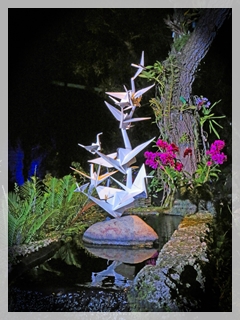
Naples botanic gardenWhile visiting a church recently, the pastor announced a new security precaution: ten minutes after the service started, the outside doors would be locked from the inside and no one could enter the building. Yesterday afternoon, another church offered a four hour class for their congregation. Led by a private security company, topics included ways to identify threats, how to develop layers of security, and techniques for conflict resolution. While talking with my daughter about a recent school shooting in her area, I learned that my grand’s school has regular “lock-down” drills in preparation for such an attack. Is no place safe from violence?
In 1947, the Bulletin of the Atomic Scientists created what is known at the Doomsday Clock. Designed to show the world how close it is to destroying itself with technology, the clock was originally set to 7 minutes before midnight with midnight being catastrophe—the end of the world as we know it. After the Soviet Union tested their first atomic bomb in 1949, it was reset to three minutes before the hour and, by 1953, it was down to two minutes. I was in first grade at the time; rather than “lock-down” drills, we had air-aid drills and practiced ducking under our desks in case a bomb was dropped. In 1991, with the end of the Cold War, the clock’s hands were set back to seventeen minutes before midnight. Since 2007, disruptions from climate change have figured into the calculations. This past year, the clock was set to only two and half minutes until midnight. Locking down a church or school, ducking under a desk, or building a bomb shelter won’t protect any of us if the minute hand reaches the twelve.

The world is in turmoil; we’re no closer to peace now than two thousand years ago. We live in a divided and troubled world and it grows more brutal daily. It’s no longer just atomic bombs that threaten us—cyber warfare, biologic weaponry, thoughtless rhetoric, fake news and catastrophic weather events all contribute to the danger. Where is this peace on earth we sang about these last several weeks?

Scripture tells us wars and violence will continue (and even get worse) until Jesus returns and establishes true lasting peace. Indeed, the end times appear to be on the horizon but what are we to do until then? I suppose we’ll continue having lock downs, going through metal detectors, getting luggage x-rayed and handbags searched, securing church doors, and meeting with security companies but that’s merely trying to stay safe. It’s not enough.

When we accepted Jesus, His Holy Spirit brought a fruit basket as a house-warming gift. In it we find peace along with several other qualities that will help us be peaceful: love, joy, patience, kindness, goodness, faithfulness, calmness and self-control. We all got the same beautiful basket and, as Christians, we’re all capable of letting His peace rule our hearts, actions and words. While our behavior may not move the hands of that clock backward, we might be able to make our little corner of the world a kinder, gentler, and better place.

Over two thousand years ago, the angels sang, “Peace on earth.” Let our lives continue that song as we move into this new year. Heavenly Father, let there be peace on earth, and let it begin with me.

And let the peace that comes from Christ rule in your hearts. For as members of one body you are called to live in peace. And always be thankful. [Colossians 3:15 (NLT)]

Copyright ©2018 jsjdevotions. All rights reserved.

ANGELS IN DISGUISE

Therefore, angels are only servants—spirits sent to care for people who will inherit salvation. [Hebrews 1:14 (NLT)]

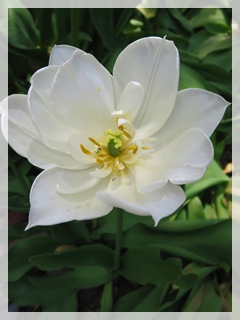
dubble tulip“I’m the answer to Pastor’s prayers,” said the woman lightheartedly as she sat down next to me at Bible study. Having seen on Facebook that he was praying for more people at Bible study, she felt the urge to come. Her comment caused me to think about the way God uses us to answer people’s prayers.

I was looking at the vast array of allergy medications when another woman joined me. While perusing the shelves, we discussed the merits of various brands. She then said, “I see from your cross, you’re a Christian, so you’ll understand. I know I should be thankful in all things but I’m just having an awful time with this one.” She went on with her grievance that severe allergies had suddenly attacked her at sixty years of age. I sympathized since, like her, I never suffered from allergies until my senior years. “Perhaps,” I suggested, “we should be thankful that we haven’t had to suffer from them since youth!” We talked a little about gratitude and God and joined one another in a quick prayer. When done, she said, “Thanks; I needed that!”

A stranger approached me at church and asked if a certain pastor had arrived. After telling her not yet, something made me pause and ask if there was anything I could do for her. Replying that she needed someone with whom to pray, I offered. She shared her concerns and we laid them before God in prayer. We chatted briefly and I gave what comfort and guidance I could (along with a big hug). I then offered to find the pastor but she said, “No, you were just what I needed.”

I think of a friend who, when he discovered a loved one was using drugs, was devastated. The next day, he had lunch with a business acquaintance who asked what was troubling him. As my friend poured out his concerns to a man he barely knew, the businessman shared his own story of addiction and gave some much needed and excellent advice. He was just what was needed.

Were those mere coincidences or were they orchestrated by God? That first woman didn’t have to come to Bible study. In response to the woman with allergies, I easily could have said, “That’s too bad,” and finished my shopping. As for the woman who needed someone with whom to pray, after telling her the pastor wasn’t there, I could have gone about my business. That businessman didn’t have to ask my friend about his troubles and he certainly didn’t need to share a very private part of his own life. By responding to someone’s need, had we become answers to their prayers?

Although angels are God’s messengers and spiritual beings, I wonder if we humans might also act as His messengers and be given opportunities to answer people’s prayers. Rather than ministering spirits, we are ministering mortals. Although we have bodies and angels don’t, there is a bigger difference between God’s holy messengers and us. God’s angels have unquestioning obedience to His commands; we, on the other hand, often ignore Him and the opportunities and tasks He sets before us. God’s angels are sent by Him to help believers—but so are their brothers and sisters in Christ. Could you be an earthly angel in disguise? Could you be the answer to someone’s prayers?

Yes, praise the Lord, you armies of angels who serve him and do his will! [Psalm 130:21 (NLT)]

Copyright ©2017 jsjdevotions. All rights reserved.

THE DASH

For everything there is a season, and a time for every matter under heaven. [Ecclesiastes 3:1 (ESV)]

I read of a man who stood to speak at the funeral of a friend.
He referred to the dates on the tombstone
from the beginning…to the end.
He noted that first came the date of birth
and spoke of the following date with tears,
but he said what mattered most of all
was the dash between those years. [Linda Ellis]

clock - ChicagoAfter scrutinizing the website for the umpteenth time in a futile search for the perfect gift for my daughter-in-law, I closed the iPad and announced, “What a waste of time! This is why God created checks and gift cards!” I remembered last Friday when both Linda Ellis’s poem “The Dash” was read and the recently deceased David Cassidy was mentioned. The former Partridge Family heartthrob’s last words were: “So much wasted time.” Indeed, too much time is wasted in unproductive activities or agonizing over what, in actuality, are trivial matters. Searching the same website, over and over, and expecting to find something different was certainly one of those.

Last Friday morning, I made better use of my time; after looking at a photo of a friend’s niece, I prayed for her. This two-year old, bald from undergoing chemotherapy for stage 4 cancer, was asleep in her mother’s arms and doesn’t understand that the chemicals making her so miserable are a last ditch effort to destroy the cancer that has ravaged her body. Later that day, I attended a Celebration of Life for a man who, less than a week earlier, set out for an afternoon ride on his motorcycle never knowing that would be his final ride in life. Absent from that memorial service were our senior pastor and his wife. They’d been in a car accident earlier in the day. Like the toddler and the motorcyclist, they never expected what came hurtling into their lives. One child is fighting for her life, one man lost his life, and one couple escaped with their lives.

Many of us might say we have too little time but the quantity of time granted us and our loved ones, whether just days or several decades, is exactly the right amount of time and has been determined by someone far greater than we are. The way we spend those precious moments, however, is our choice alone. Unfortunately, David Cassidy had it right: “so much wasted time.” When the book of Ecclesiastes tells us there is a season for everything, wasting time is never mentioned as one of them. We can fritter away our minutes in all sorts of futile ways—anger, nitpicking, regret, lethargy, worry, complaint, conflict and fretting are just a few—or we can use them generously, joyfully, thankfully and with love.

This week we celebrate my mother-in-law’s 101st birthday; her dash has been long and well spent. While she has been blessed with exceptional longevity, last Friday was a reminder that we all have expiration dates and none of us know that day. In many cases, it will be far sooner than expected. The dates we are here, however, are not as important as how we spend the time between those dates. How will we spend our dash?

So teach us to number our days that we may get a heart of wisdom. [Psalm 90:12 (ESV)]

Copyright ©2017 jsjdevotions. All rights reserved.