
Then the rich man said, “O Father Abraham, then please send him to my father’s home—for I have five brothers—to warn them about this place of torment lest they come here when they die.” But Abraham said, “The Scriptures have warned them again and again. Your brothers can read them any time they want to.” The rich man replied, “No, Father Abraham, they won’t bother to read them. But if someone is sent to them from the dead, then they will turn from their sins.” But Abraham said, “If they won’t listen to Moses and the prophets, they won’t listen even though someone rises from the dead.” [Luke 16:27-31 (TLB)]
A land of contradictions, a spectacular pageant, a world incomprehensible…a wonderful gift to men from a benign God—all this and more. [Olin Wheeler, 1914]
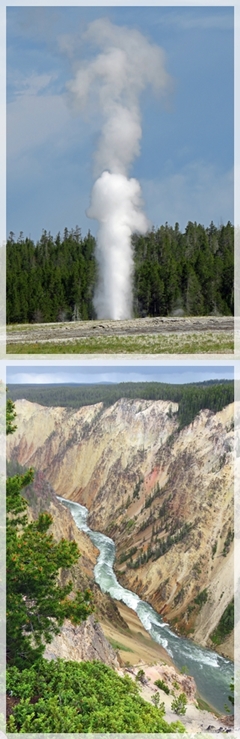
Although Native Americans have existed in the Yellowstone area for as long as 11,000 years, it took three major expeditions before the American public finally believed that the wonders in what is now Yellowstone National Park actually existed. The earlier descriptions of “fire and brimstone,” huge waterfalls, exploding geysers, boiling mud pots and other strange features of the region were met with unbelief until William Jackson’s photographs and Thomas Moran’s paintings from their 1871 Yellowstone expedition were presented to Congress. Once people had visual proof of the area’s bizarre geothermal wonders, they finally believed and Yellowstone became our nation’s first national park.
Indeed, having recently toured this park that sits on atop of the largest super-volcano in North America, I can understand how unbelievable those first mountain men’s stories must have seemed. In my wildest dreams, I couldn’t have imagined either the beauty or the strangeness of Yellowstone—colored travertine terraces, mud volcanos, steaming caves, a 24-mile long canyon, over 200 waterfalls, and more than 10,000 geysers and hot springs. Other worldly, it is something that truly must be seen to be believed.
Jesus told the Pharisees a parable about two men: the unrighteous rich man who died and went to a place of torment and the beggar Lazarus who died and went to a heavenly banquet. The rich man wanted to send Lazarus back to warn his brothers to change their ways. His request was denied since, like him, his brothers had ignored the warnings found in the Law and the Prophets so they wouldn’t be convinced by someone returning from the dead. Indeed, even though Jesus did return from the dead, there are many who do not believe.
We often wonder what heaven and/or hell will be like. Jesus didn’t mince any words when he spoke of the final judgment and it doesn’t sound pleasant. When the Apostle John was given a glimpse of heaven, his words in Revelation seem almost as incomprehensible to us as the words the mountain men used to describe Yellowstone’s bubbling mud pots and hissing fumaroles were to nineteenth century Americans. Father Abraham didn’t send back Lazarus and no one is going to return from death with photographs or paintings to prove what happens when we take our last breath.
Words can’t adequately describe Yellowstone and the few Biblical descriptions of both heaven and hell don’t do them justice, either. Nevertheless, like the rich man’s brothers, we have all the information we need in Scripture. As the American public learned in 1871, just because we can’t imagine something doesn’t mean it isn’t there!
 A friend of ours has several jewelry stores in Colorado. When he opened a store in a posh resort town, he priced his goods as he always has: reasonably. To his chagrin, plenty of wealthy shoppers came into his shop but no purchases were made. After three days of disappointment, he re-tagged everything with higher prices. The following day, instead of leaving empty-handed, most shoppers left carrying pricy purchases (and they continue to do so today). Apparently, his rich customers believe affordable means second-rate or shoddy and that quality only comes with an exorbitant price tag.
 Although demons had no trouble recognizing Jesus, the people who were most knowledgeable about Scripture and best knew the Messianic prophecies often seemed blind to what was before them. In fact, even after hearing Jesus speak and watching Him heal, the Pharisees and scribes accused Him of being a demon. Why did they refuse to see what was right in front of them?
 After his baptism, as Jesus came up out of the water, the heavens were opened and he saw the Spirit of God descending like a dove and settling on him. And a voice from heaven said, “This is my dearly loved Son, who brings me great joy.” [Matthew 3:16-17 (NLT)]
 At times, we can find reading the Bible rather disturbing. For me, Peter calling Lot “righteous” is upsetting; this man offered up his virgin daughters to be raped by a mob! Abraham’s willingness to hand over Sarah to other men’s lust is equally disquieting. Those are, however, real stories about real people and, among other things, they reflect the low status of women in the ancient world. The Bible’s words may have been God-breathed and intended for people of all times and places but they were penned by men thousands of years ago for their contemporaries and their words reflect a very different culture.
 Devotions of the Heart