WOULD I? COULD I?

God blesses those who are persecuted for doing right, for the Kingdom of Heaven is theirs. [Matthew 5:10 (NLT)]

As they stoned him, Stephen prayed, “Lord Jesus, receive my spirit.” He fell to his knees, shouting, “Lord, don’t charge them with this sin!” And with that, he died. [Acts 7:59-60 (NLT)]
old world wisconsinHis testimony enraged the Jewish high council and he was taken from the city and stoned to death. Stephen was the first of the Christian martyrs but clearly not the last. We’ve all been horror-stricken by the recent news from Egypt where ISIS thugs attacked Coptic Christians on their way to a remote monastery. According to witnesses, the men were told their lives would be spared if they recited the shahada, the Islamic declaration of faith. When they refused to do so, they were gunned down. Since December, more than 100 Coptic Christians have died in Egypt in four different attacks. On Palm Sunday, two of their churches were bombed leaving forty-four dead. It’s not easy being a Christian in Egypt.

Apparently, it’s not that easy in India, either. Last winter, Bartu Urawn and his wife were forced to stand all night in a freezing pond. When they refused to renounce their Christian faith after being immersed in the frigid water for seventeen hours, they were beaten. Although his wife survived, Urawn died as a result of the torture. A decade ago, Christianity was embraced by ten families in this remote Indian village. Unfortunately, in the years that followed, seven of those families caved into threats and returned to their indigenous tribal religion. The Urawns, however, remained faithful to Jesus.

After watching the news of the Egyptian attack last night, my husband asked how I would respond in a similar situation. I wondered. Would I choose to be a martyr? I’d like to think I would. Like the Urawns, could I endure hours of torture and still stay true to Christ? I’d like to think I could. What if, rather than saving my life, renouncing Christ meant I could keep my children from suffering torture or death? Now it’s getting harder to know the answer. Could I watch them suffer? How could I live with myself in either scenario? Perhaps I’d find an excuse for verbally abandoning Jesus by telling myself that they were just empty words from my mouth and my heart didn’t mean them. I’m not so sure God would see it that way and it doesn’t much sound like something Jesus would do. These are not easy questions and, hopefully, I’ll never be forced to ask them. Nevertheless, the uncertainty of my answers indicates the level of my faith and it’s nowhere near as strong as I thought it was. Jesus told us to pick up our crosses and follow him; let us never forget that the cross was an instrument of torture and He was walking to Calvary. We have been called to share in His suffering and persecution should not deter us.

Living here in the United States, we’re not likely to be threatened with torture or death for our Christian faith. We don’t risk our lives by reading the Bible or gathering in worship and prayer. Perhaps, rather than wondering if we would stand up to ISIS soldiers or an angry mob of non-believers, we should ask ourselves how well we stand up to the world in which we live. Although we may never have to choose between Jesus and our physical survival (or that of our loved ones), there are plenty of opportunities every day to forsake Him in far more subtle ways. If we’re not walking in His footsteps and led by His Holy Spirit, we’re denying Him. There’s more than one way to lose one’s soul.

 I will not deny Christ…I will continue to believe until my last breath. [Bartu Urawn]

Then Jesus said to his disciples, “If any of you wants to be my follower, you must give up your own way, take up your cross, and follow me. If you try to hang on to your life, you will lose it. But if you give up your life for my sake, you will save it. And what do you benefit if you gain the whole world but lose your own soul? Is anything worth more than your soul? [Matthew 16:24-26 (NLT)]

Copyright ©2017 jsjdevotions. All rights reserved.

THE SWEET AROMA

Let Christ’s word with all its wisdom and richness live in you. Use psalms, hymns, and spiritual songs to teach and instruct yourselves about God’s kindness. Sing to God in your hearts. Everything you say or do should be done in the name of the Lord Jesus, giving thanks to God the Father through him. [Colossians 3:16-17 (GW)]

honeysuckleI’m in the midst of reading a series of seven children’s fantasy novels, The Chronicles of Narnia, by C.S. Lewis. Some of them, like The Lion, the Witch and the Wardrobe, I read as a girl but others are new to me. The world of Narnia is a world to which one wants to return again and again and I’m enjoying my visit ever so much. C.S. Lewis, however, was much more than a writer of fantasy, non-fiction and poetry; he was a well-known lecturer, a brilliant scholar and a renowned Christian apologist.

Because of his tremendous faith and knowledge of Scripture, there is much more to his fiction than first meets the eye. Intentionally (and probably unintentionally), Biblical truths and Christian themes are woven throughout all of his writing. Lewis was so aware of God, so steeped in Biblical knowledge, and so in tune with the Holy Spirit, that I don’t think he could have written any other way, even if he’d wanted to do so. His faith emanated from him the same way a honeysuckle blossom emits a sweet aroma. His writing reflects what all of us are asked to do—share Jesus. Lewis’ knowledge of Scripture, his insight into the Holy Spirit’s ways and the enemy’s wiles, his love of Christ, his faith in a God who is good even when life isn’t, and his awareness of God’s presence in all circumstances are evident in his stories and yet there is nothing sermon-like about them. The adventures of the Pevensie children in Narnia brought them closer to a great lion by the name of Aslan and those same adventures can bring the reader closer to someone who (as Lewis suggested) arrived at the same time as Father Christmas, was the son of the Great Emperor, gave himself up to be killed by wicked people, came to life again, and is often spoken of as a lamb.

While we’re not likely to teach at Oxford or Cambridge, write over 70 books, sell 100 million copies of anything we might write or be asked to explain Christianity on a radio show, we are asked to share our faith. If Biblical truths become a part of us, they will become second nature and will be evident in all that we say or do. We don’t have to become theologians or write a best-seller; we just have to emit the sweet aroma of Christ in our lives.

I believe in Christianity as I believe that the Sun has risen, not only because I see it but because by it I see everything else. [C.S. Lewis]

But I thank God, who always leads us in victory because of Christ. Wherever we go, God uses us to make clear what it means to know Christ. It’s like a fragrance that fills the air. To God we are the aroma of Christ among those who are saved and among those who are dying. [2 Corinthians 2:14-15 (GW)]

Copyright ©2017 jsjdevotions. All rights reserved.

A HOLY OBJECT

And the King will say, “I tell you the truth, when you did it to one of the least of these my brothers and sisters, you were doing it to me!” [Matthew 25:40 (NLT)]

Next to the Blessed Sacrament itself, your neighbour is the holiest object presented to your senses. If he is your Christian neighbor, he is holy in almost the same way, for in him also Christ vere latitat [“is truly hidden”]—the glorifier and the glorified, Glory Himself, is truly hidden. [From “The Weight of Glory” by C.S. Lewis]

deerI found an odd synchronicity in my morning’s reading. The verse for the day was Matthew 7:12, the Golden Rule: “Do to others whatever you would like them to do to you.” Following that was a story by Christian author and speaker Lysa Terkeurst. She wrote about speaking to a group when a woman walked up on stage, stood next to her, and then leaned into her. Standing before an audience of 6,500 women, unsure of what to do, the author simply put her arm around the woman and continued speaking. The woman later said she needed God and thought if she got close enough to the Christian speaker, she just might feel Him. The third portion of my reading included the above selection from C.S. Lewis’ writings.

Lewis’ words caused me to pause and reflect. We revere the bread and wine when partaking in Holy Communion but do we revere our fellow Christians that much, not just when sharing the elements but whenever we share time with them? The Communion of Saints is not just that sacrament of bread and wine so fundamental to our Christian worship; it is our fellowship with all believers—past, present and future.

When we abide in Christ, His Holy Spirit abides in us and God takes up permanent residence in our bodies. While I know the Holy Spirit lives within me, I hadn’t considered His presence in the person next to me at church or Bible study. When I do to others, do I realize that I am doing so to Christ? When I speak with them, do I speak as I would to Christ? That woman who came and stood next to Lysa Terkeurst recognized Christ within her. Do I recognize Christ in others and draw close to them so to be nearer to Jesus? Do I value fellowship with Christians as much as I do Holy Communion? Do I honor and revere my church family much as I do those holy elements of bread and wine? Do I cherish time with my neighbor as I would with Christ? Do I truly understand that we are united with one another, not just by church membership or our common beliefs and goals, but by the same Spirit that lives within each of us? When I look at the faces of fellow believers, do I see the face of Jesus? More important, when they look at me, who do they see? Would anyone lean into me to come closer to the Lord?

I am praying not only for these disciples but also for all who will ever believe in me through their message. I pray that they will all be one, just as you and I are one—as you are in me, Father, and I am in you. And may they be in us so that the world will believe you sent me. I have given them the glory you gave me, so they may be one as we are one. I am in them and you are in me. May they experience such perfect unity that the world will know that you sent me and that you love them as much as you love me. [John 17:20-23 (NLT)]

Copyright ©2017 jsjdevotions. All rights reserved.

TECHNICALITIES (Passover – Part 2)

Sin is no longer your master, for you no longer live under the requirements of the law. Instead, you live under the freedom of God’s grace. [Romans 6:14 (NLT)]

great egret - breeding loresSince Jews are prohibited from possessing any food products containing leavening (chametz) during Passover, a Muslim Arab-Israeli man in Abu Ghosh now owns most of the bread, pastries and beer in Israel. As they have for many years, Israel’s two chief rabbis sold all of the leaven food from state-owned companies, the prison system, and the national emergency stores to him. He symbolically purchased the chametz for the duration of Passover by making a small down payment. Having promised to pay an enormous sum at the end of Passover, at week’s end he will tell the rabbis that he can’t pay up, the deal will be canceled, his down payment returned, and Israel again will own its yeast-laden products. Here in the U.S., some Jewish families “sell” their chametz to non-Jewish friends and then put the food in an out-of-the way cupboard. Technically, while still on their property, it’s not really theirs because they’ve “leased” the cupboard to the Gentile buyer. After Passover, the lease expires and the food is sold back to its original owner. While this may circumvent the law, I’m not sure it’s what God had in mind when He commanded, “There must be no yeast bread or any yeast at all found within the borders of your land during this time.” [Exodus 13:7]

Finding ingenious ways to sidestep rules and regulations is not limited to Judaism; we all do it. Technically, we’re not texting while driving—we’re texting while stopping at a red light! In principle, the dog is on a leash even when he’s dragging it on the ground or carrying it in his mouth. In 2007, a Minnesota bar got around the smoking ban by using a technicality in the law that allowed actors to smoke in their roles. The bar announced their staging of a continuous improvisational play. Every customer of the bar would be an actor taking a role in the “play” and, therefore, smoking was permitted! Teenagers have a special knack for getting around parental and school rules. It’s part of their make-up to think outside the box to outwit authority. Mankind will find every technicality, loophole, ambiguity, and grey area to circumvent laws and regulations.

Imagine God’s frustration while watching his children sidestep and disobey His law. A covenant of law requires complete obedience and, frankly, try as we might, we just can’t make the cut. We see rules and regulations as an infringement and prohibitions seem to increase our desire to do just that thing. Fortunately, rather than a covenant of law, Christians are under a covenant of grace and freed from the Old Testament rules and regulations. In grace, our salvation doesn’t come from following rules or doing the right thing and God accepts the less than perfect. It is our sincere belief rather than our faultless behavior that saves us. We have no need for sidestepping, semantics, and technicalities because obedience to rules is not what gives us eternal life and sin won’t cause us to lose it. Grace, however, is not license to sin; it is a license to live as God intended and follow the spirit of His law through the power of the Holy Spirit.

So now there is no condemnation for those who belong to Christ Jesus. And because you belong to him, the power of the life-giving Spirit has freed you from the power of sin that leads to death. The law of Moses was unable to save us because of the weakness of our sinful nature. So God did what the law could not do. He sent his own Son in a body like the bodies we sinners have. And in that body God declared an end to sin’s control over us by giving his Son as a sacrifice for our sins. [Romans 8:1-3 (NLT)]

Copyright ©2017 jsjdevotions. All rights reserved.

LIVING WATER

ibis - corkscrew swamp sanctuary
Jesus replied, “Anyone who drinks this water will soon become thirsty again. But those who drink the water I give will never be thirsty again. It becomes a fresh, bubbling spring within them, giving them eternal life.” [John 4:13-14 (NLT)]

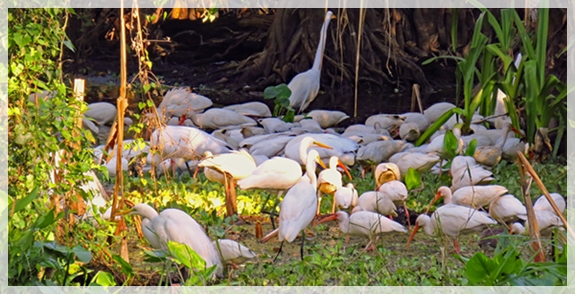
For a state that receives over 55-inches of rain a year, the words “Florida drought” seem an oxymoron. Nevertheless, southwest Florida is in moderate drought and the water in the swamp is receding at record pace. The dry down of the swamp concentrates fish into the shallow water that remains and they become easy prey for the wading birds. There is a feeding frenzy as hundreds of birds (and several alligators) gather to enjoy a virtual buffet table lined with fish, frogs, and crayfish. The water in the swamp sustains these beautiful birds and, when it evaporates, they will fly elsewhere. I watched in awe as the birds vied for spots in the diminishing lakes and thought about the importance of water.

About 60% of the human body is made up of water and every living cell needs it to function. It lubricates joints, regulates temperature, flushes waste, and carries nutrients through the body. We can last three weeks without food but we can last only three to five days without water (and as little as three to four hours in extreme heat). Once deprived of water, the cells and organs of the body start to deteriorate. Water in our bodies is the difference between life and death.

Jesus offers us living water and His water truly is the difference between life and death. The water in the swamp is not living water – with no springs, it’s really just a large cistern that collects rain and will eventually evaporate. When the water is gone, only some vultures eating the scraps will remain. The living water offered by Jesus is never-ending; it is poured out in all seasons and will never disappear. Unlike the birds, we don’t have to fight for our spot in the pond or, like the Samaritan woman, come to the well. All we have to do is ask for the living water of eternal life. One drink of His Holy Spirit and we’ll never thirst again.

I find it ironic that some of the last words spoken by the man who offered living water were, “I am thirsty.” [John 19:28] Dehydrated by the torture He’d endured, was it just His dry mouth that led to those words? Did He thirst for the end of His pain and suffering? Or did He make a final demonstration of His humanity by speaking words that showed how much he thirsted for fellowship with God? Let us gather at His table, drink deep of His love, wash in His forgiveness, and never thirst again.

O God, you are my God; I earnestly search for you. My soul thirsts for you; my whole body longs for you in this parched and weary land where there is no water. [Psalm 63:1 (NLT)]

As the deer longs for streams of water, so I long for you, O God. I thirst for God, the living God. When can I go and stand before him? [Psalm 42:1-2 (NLT)]

Copyright ©2017 jsjdevotions. All rights reserved.

HOUSE OF LOST DREAMS (Part 2 – Redeemed)

For he has rescued us from the kingdom of darkness and transferred us into the Kingdom of his dear Son, who purchased our freedom and forgave our sins. [Colossians 1:13-14 (NLT)]

This means that anyone who belongs to Christ has become a new person. The old life is gone; a new life has begun! [2 Corinthians 5:17 (NLT)]

Castle-chillon-lake-genevaAs for the “House of Lost Dreams,” about which I wrote yesterday—almost overnight, where once a dilapidated ruin stood, a beautiful house now stands. The roof tiles are repaired and clean, the house is freshly painted, the overgrown yard tamed, and a “For Sale” sign stands in the yard.

That “For Sale” sign tells me the people who redeemed and refurbished the house saw it not as a home but as an opportunity for profit. They certainly had their work cut out for them; the interior was probably infested by insects and animals and covered with mold. This hot humid climate is brutal to abandoned property and within three years a house can become irreparable. I imagine the house now looks as beautiful inside as it does from the road but I wonder if the changes were only cosmetic. What about the mold deep in the drywall and wood? Is there dry rot in the framework? Are there cracks in the foundation or stucco? What about termites? Did the contractor paint over mold rather than replace wood and drywall? Did he cut corners to increase his profit? Unfortunately, not all rehabbers are ethical and honest. I only hope that the “House of Lost Dreams” doesn’t become a nightmare for whoever eventually buys it.

In our northern community, Habitat for Humanity has started buying up foreclosed abandoned properties and rehabbing them into homes for Habitat recipients. We recently toured one of those Habitat homes while it was still a work in progress. It had been stripped down to its bare bones. Drywall, furnace, appliances, cabinets, and wiring were gone—all that remained was the frame. It is now being rebuilt with new materials by volunteers and the home’s new owners who will purchase it with sweat equity and monthly payments.

Rebuilt from the ground up—that’s pretty much what happens to us when Jesus redeems us. Of course, he doesn’t have to deal with bankers and title companies but He pays off our debt to God, assumes ownership of us, and moves right in. His is not a slap-dash skin-deep surface repair (as I suspect of the Florida house) because He is making a home fit for a King! Like the Habitat builders, He takes his time while repairing and restoring us. Although He doesn’t gut us or strip us of our wiring, He’s not about to let any mold, filth, defective parts, or pests remain. He cleans up the mess, fixes what’s broken, patches the holes, pulls out the weeds, and plants a spiritual fruit tree in the garden.

Although some homes are too far gone for even the best rehabber or most devoted Habitat group, none of us are too far gone for Jesus. He doesn’t care how long we’ve been neglected, how broken-down we are, how cracked our foundation or how rotten our core. Once redeemed, He restores us. He’ll never abandon or sell us and, as a plus, He gives us our own personal handyman in the way of the Holy Spirit!

And I am certain that God, who began the good work within you, will continue his work until it is finally finished on the day when Christ Jesus returns. [Philippians 1:6 (NLT)]

Copyright ©2017 jsjdevotions. All rights reserved.