
For everyone has sinned; we all fall short of God’s glorious standard. Yet God, in his grace, freely makes us right in his sight. He did this through Christ Jesus when he freed us from the penalty for our sins. [Romans 3:23-24 (NLT)]
 Although my husband attended law school, there is one law he never knew until he became a father: the Toddler Property Law. Starting out with the basic premise of “What’s mine is mine!” it then defines exactly what is meant by “mine.” The toddler defines “mine” as the following: it’s mine if I like it; if I think it’s mine, it is; if it’s yours, it’s mine; if I can take it from you, it’s mine; if I had it but put it down, it’s still mine; if you had it but put it down, then it’s mine; and, if it is broken, it’s yours.
If we ever doubted the existence of original sin, we only need to watch a few toddlers at play to see that we are born into this world with sinful natures. Granted, the toddler doesn’t exhibit vanity or pride or practice sorcery, watch porn, get drunk and disorderly or commit adultery, but he sure knows a lot about greed, selfishness, coveting, hitting, defiance, anger, and the attachment to worldly goods (especially if made by Fisher-Price or Melissa & Doug).
Since I have difficulty following the various theological arguments and isms regarding original sin, I’m not going to define it or expound on how it came to be. Nevertheless, I don’t need a theologian to tell me that it’s not necessary to teach a toddler how to be a selfish grabby little beast but we do have to teach him how to share. I don’t think we’re born defective; after all, we were created in God’s image. Nevertheless, we were given that troublesome thing called free will which means we have the capacity to choose between right and wrong. Simply put, we sin because we can.
C.S. Lewis posits that Satan gave Adam and Eve the idea that “they could be like gods” and “be their own masters.” Without the theology, that’s pretty much the toddler mind set; he thinks he’s the master of the universe, the world revolves around him, and all that he wants is his. Sadly, some of us never grow out of thinking that way.
I don’t think God is holding me responsible for Adam and Eve’s poor choices; He doesn’t have to! Long ago, I started making plenty of my own poor decisions. If we didn’t have a tendency or predisposition to sin, you’d think someone (other than Jesus) could have remained sinless in all of this time! One reading of Scripture, however, tells us no one seems to have been able to keep perfectly the moral standards and precepts set by God. For example, Abraham, a man who walked with God, was a liar and a coward and David, said to be “a man after God’s own heart,” was an adulterer and murderer. Under mankind’s own power, we don’t appear to have the ability to stop sinning even when we want to do so.
Christianity tells us that we are unable to overcome the power of sin without the power of the Holy Spirit. That power comes by turning to Christ and relying on his sacrifice to atone for our sins. It’s only when we admit that we are helpless in the face of sin and that our sin has separated us from God, that we see the need for a savior and understand why Jesus (the perfect sacrifice) died for us. It is only through God’s grace that we finally have the power to renounce the sin of the world.
The beautiful thing about God’s grace is that when we sin (and try as we might not to do so, we will), God has enough grace to shower us with His undeserved mercy again and again. He gives us yet another chance to grow in godliness and His Spirit will empower us to do just that.
 Last Thursday night’s Bible study had been as inspiring as Easter Sunday’s sermon. As we walked out of the building, I confided to my friend that there was no way I could follow such brilliant preaching. You see, our pastor was taking a much needed vacation and I would be doing the preaching for the next two Sundays. Afraid I couldn’t possibly fill his shoes or touch people’s hearts the way he does, I asked, “How can I possibly compare to him?” My friend wisely answered, “You don’t!” He reminded me to be myself and let the Holy Spirit do the rest.
 A business friend took us upstairs at his corporate center and then turned out all of the lights. With blackout curtains covering the windows, we were in complete and utter darkness. As our eyes adjusted to the dark, we saw glowing strips marking the perimeter of the room and around the door. A luminous exit sign was above the door and the doorknob was marked with a glowing circle around it. In spite of the blackness, we easily found our way to the door. When we opened it, another glowing sign warned us “Caution—watch your step.” Although the stairwell was pitch black, we weren’t frightened because the hand railing, baseboards, and edges of every stair were marked with glowing strips and another exit sign, outlined door, and marked doorknob indicated the way out of the dark stairway. That luminous greenish light safely guided us even when we couldn’t see where we were going.
 The faithful love of the Lord never ends! His mercies never cease. Great is his faithfulness; his mercies begin afresh each morning. I say to myself, “The Lord is my inheritance; therefore, I will hope in him!” [Lamentations 3:22-24 (NLT)
 But the wisdom from above is first of all pure. It is also peace loving, gentle at all times, and willing to yield to others. It is full of mercy and the fruit of good deeds. It shows no favoritism and is always sincere. And those who are peacemakers will plant seeds of peace and reap a harvest of righteousness. [James 3:17-18 (NLT)]
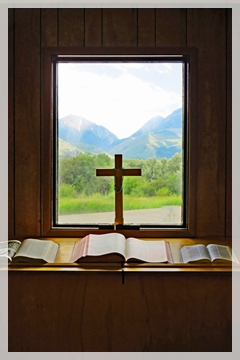 Before the incarnation of Christ, God dwelt first in the tabernacle and then in the temple. The innermost room of the temple was called the “Most Holy Place” and it was in this inner room that God’s glory was said to dwell. This was where the Ark of the Covenant was kept and where the high priest came with a sacrifice to atone for his and the nation’s sins every year. With the incarnation of Jesus, God no longer dwelt in the temple but in the flesh of His son and, for a brief time, God actually walked among His people. Yet, when Jesus lived as a man, only a few people at a time could be in His presence. With His death, there is no yearly atonement ritual because Jesus atoned for our sins once and for all. Moreover, because of His resurrection, ascension, and the presence of the Holy Spirit, it is possible for countless people, everywhere, to be in His presence at the same time. Once we become believers, the Holy Spirit moves into our hearts and each one of us, as members of Christ’s church, become part of His body and the temple of God.
 Devotions of the Heart