
No one who is tempted should ever be confused and say that God is testing him. The One who created us is free from evil and can’t be tempted, so He doesn’t tempt anyone. [James 1:13 (VOICE)]
 When the Apostle James tells us that God can’t be tempted by evil, we wonder how Jesus could be tempted to sin while in the wilderness. Christians agree that Jesus never sinned but some question whether He actually could. They hold the “impeccability” position: because Jesus was God, sin was impossible and He couldn’t have been tempted. Others hold the “peccability” position: because Jesus was a man, he could sin and was tempted. Still others, recognizing His dual nature, say that, as a man, Jesus could be tempted to sin but, as a divinity, He couldn’t.
Jesus was both God and man in one person. Rather than ceasing to be God while on earth, He added humanity to His being. At the same time, He was both divine and mortal, impeccable and peccable, immortal and mortal, infinite and finite. He didn’t have a multiple personality disorder with dueling personas; His fully divine nature was united in perfect harmony with his fully human one. While Jesus’ human nature was tempted by evil, His divine nature was not. Nevertheless, the temptation was real!
When in the wilderness, Satan tempted the hungry Jesus to make bread from stones. As the One who later fed a multitude with a boy’s lunch, we know Jesus could easily have done it; but He didn’t. Satan then tempted Jesus to prove himself by jumping off the highest point of the Temple. We know that the One who walked on water and passed unseen through an angry mob didn’t need angels to bring Him to safety. Jesus could have transported Himself safely to the ground effortlessly; but He didn’t. Finally, Satan tempted Jesus by offering Him kingdoms and glory if only He’d worship the enemy. We know the One who returned the dead to life, healed the sick, and turned water into wine didn’t need Satan to give Him kingdoms and glory. With a snap of His fingers, the One who was there at creation was capable of performing such an extraordinary spectacle that all of Jerusalem would have knelt immediately in worship; but He didn’t. When I look at those temptations, I see Satan tempting the Jesus to use His divine power to take the easy way out of the struggle and suffering that lay in His future as a man.
Satan left Jesus after that but his departure was temporary. He lay in wait for the next opportunity and I suspect he frequently tempted Jesus to take the easy way. As God, Jesus could be anywhere He wanted but, as a man, He had to walk to get there. God never gets tired, hungry, or thirsty but Jesus the man did When we look at the miracles done by Jesus, there was a unique purpose to each one and, while they helped to establish His identity, none were done to make His life easier. He deliberately chose to meet the challenges of life as a vulnerable human not an invincible God. Jesus never took a shortcut as God!
Satan is merely a fallen angel and was no match for the divine nature of Jesus. Satan, however, can overpower man and it was as a man that Jesus had to defeat him! Satan wanted to prove that no man could be obedient to God’s will but, by living as a man and resisting temptation, Jesus did just that. Out of love for us, Jesus defeated Satan by living sinlessly as a man and by dying as a man at Calvary.
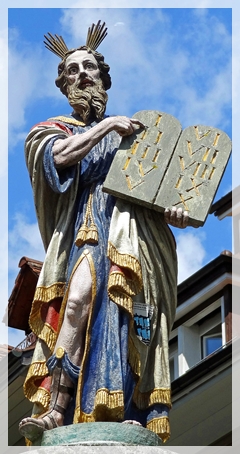 In Scripture, the number forty often appeared in the context of preparation, judgment, or testing. The rain poured down upon Noah for forty days and nights. After spending forty years in Egypt and another forty as a shepherd, Moses twice spent forty days with the Lord on Mt. Sinai. The Israelite scouts spent forty days exploring the land of Canaan and, because the people lost heart and rebelled at their report, they spent an extra forty years wandering the wilderness (one year for each day the men explored). Jonah warned Nineveh their destruction would take place in forty days, Ezekiel lay on his right side for forty days because of Judah’s sins and, before being slain by David, Goliath taunted Saul’s army for forty days.
 I can’t understand why a young mother lies on her deathbed when an elderly Alzheimer’s victim whose mind is long gone remains in this world. I will never comprehend why one person suffers a debilitating disease for years and another person breezes through life with nary an ache or pain. I wonder how a young family can be wiped out in a car accident when the drunk driver who caused the crash survives without a scratch. I will never grasp why some people are in such despair that they take their lives while others bravely fight to take each breath. I don’t know why one child is born with multiple birth defects when his sibling is the picture of perfect health or why one child is abused and another one is cherished. Life often seems incredibly unfair!
 Were I not a believer, I don’t think I’d find the concept of eternal life very comforting. While Jesus made it clear there is an afterlife, He also spoke of the destinations awaiting us in that afterlife. In the gospel of Luke, we find Him telling the parable of the rich man and the beggar named Lazarus. [16:19-31] Indifferent to the plight of the destitute and diseased Lazarus, the rich man lived a life of indulgence and luxury while Lazarus lay outside his gate, hoping for just a few scraps from the rich man’s table.
 Bereft that the people of Israel had rejected Jesus, Paul’s words are some of the saddest ones found in the epistles. I can see the tears in his eyes and hear the anguish in his voice as he dictated them to Tertius, his scribe. Young’s Literal Translation translates Paul’s words as having “great grief and unceasing pain in my heart.” Although he knows that nothing could cut him off from Christ, Paul says he’d be willing to sacrifice himself for his people if it were possible. That’s not just his life he’s offering; the word he used was anathema, meaning he was willing give up his salvation. If it would save the people of Israel, he would be delivered over to the wrath of God for eternal destruction: to spend an eternity in Hell!
 We know little about Jesus’ childhood and young adulthood. Born in Bethlehem, He was circumcised and given His name eight days later. Forty days after His birth, Mary and Joseph took Him to the Temple in Jerusalem in accordance with the command to consecrate every firstborn male to God. Sometime after that, He received gifts from the Magi, His family fled to Egypt, and they returned to Nazareth after Herod died. That’s all we know of His childhood until He was twelve and the precocious youngster stayed behind in Jerusalem to discuss spiritual matters with the teachers there. After Mary and Joseph found Him in the Temple courts, He dutifully returned home to Nazareth with them. Although we know that Jesus learned Joseph’s construction trade and that he started his ministry around thirty, we know nothing of the years between twelve and thirty except that He was obedient to His parents and “grew in wisdom and stature and in favor with God and all the people.” [Luke 2:52]
 Devotions of the Heart