
When they call on me, I will answer; I will be with them in trouble. I will rescue and honor them. [Psalm 91:15 (NLT)]
 When we moved to our small Midwestern town over fifty years ago, we paid our utility bills at the local drugstore and I longed for the “good old days” when we sold our northern home recently. Trying to update our information and go completely paperless, I attempted to access our various accounts on line, meaning I had to remember (or create) a wide variety of user names and passwords. If I managed to sign in, I’d get to the security questions and discover that my favorite color or dessert is not what I thought it was! Once past that hurdle, I had to prove I wasn’t a robot by deciphering those squiggly letters and numbers (a near impossibility)!
When I couldn’t accomplish my task on line, I’d resort to a phone call. It would be answered with a computerized voice offering a list of options, none of which ever seemed quite right. Another robotic voice would then ask a series of questions (“to better serve your need.”) Eventually, after being put through several programmed interrogations, I’d be put on hold. When I wasn’t being told how important my call was, I was subjected to a loop of horrible music and advertisements for additional services (along with the helpful suggestion that I go to the company’s website which, of course, I had already tried.) Occasionally, a voice would tell me how much longer I would be in the queue before an operator would be available. When I took the option of having them call me back, the call never came! Once, after holding for what seemed an eternity, I got disconnected! When I finally spoke with a real person, it was often someone in a distant land whose accent baffled me as much as mine baffled his. We’ve all been in similar situations. We cry out, “Is there no one there who can hear me, who understands my problem, who cares, or who can help?”
Thank you, God, for never requiring me to log on to your heavenly site. Thank you for not requiring an account number, a user ID, a password, or a security question. You always know who I am, where I am and what it is that I need. Thank you for being available 24/7, never putting me on hold, and always returning my call. Thank you for understanding me, even better than I do myself. Thank you for speaking softly yet clearly to me. Thank you for never passing me off to someone else and, most especially, thank you, God, for never dropping my call!
And He knows my name. Every step that I take,
Every move that I make, Every tear that I cry,
He knows my name. When I’m overwhelmed by the pain
And can’t see the light of day, I know I’ll be just fine
‘Cause He knows my name – He Knows my Name! [The McRaes]
I will answer them before they even call to me. While they are still talking about their needs, I will go ahead and answer their prayers! [Isaiah 65:24 (NLT)]
Copyright ©2019 jsjdevotions. All rights reserved.
 “I love you,” said my grandson to his mother; “I love you more,” was her quick reply. They went back and forth, each claiming to love the other most, until one said, “I love you to the moon and back!” Of course, they’re echoing the sentiments found in Sam McBratney’s delightful book Guess How Much I Love You. In it, every time Little Nutbrown Hare tells his father how much he loves him, Big Nutbrown Hare responds with an even larger amount of love. As he’s being tucked into his bed of leaves, the sleepy youngster thinks he’s finally out-distanced his dad when he says he loves him all the way to the moon. His father kisses him goodnight and, with a smile, whispers, “I love you right up to the moon—and back!” Since the moon’s distance varies with its orbit, the distance to the moon and back varies from around 443,362 to 505,244 miles. Even that measurement, however, isn’t correct; we can no more quantify a father’s love for his son than we can our Heavenly Father’s love for His children.
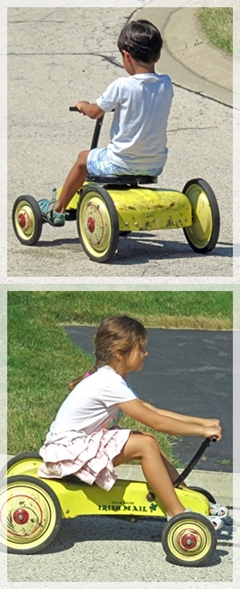 The thing I’ll miss most when we move to southwest Florida permanently is easy access to my grandchildren. This summer I’ve relished watching the little guys frolic in the sprinkler, race their scooters down the sidewalk, climb the monkey bars, decorate the driveway with colored chalk, and play bags with their cousins. They insisted on helping in the kitchen, offered to set the table, listened intently to every story read to them, and never tired of endless games of Crazy-Eights and Kings’ Corners. Their squeals of delight at the holiday fireworks and when they mastered riding the Irish Mail (where they pumped with their arms and steered with their feet) were music to my ears. They asked endless questions and pondered every answer. Wanting to please us, they even were obedient. Seeing their unbridled enthusiasm, energy, and desire both to learn and please, I wondered why I wasn’t like that. After all, God wants us to be like children.
 I showed the antique dealer the old silver tray we’d found at an antique store many years ago. Having just read Stephanie Kallo’s novel Broken for You, I’d been drawn to it. Hers was a story of secrets and redemption that told of how two women salvaged their brokenness, first by smashing priceless antique porcelain pieces that had been stolen from Jews during the Holocaust, and then by repurposing the fragments into beautiful mosaics. The novel was an homage to the beauty of broken people and broken things. The tray’s handle had been damaged and soldered back on and I imagine much of the silver plate had worn off its top. It was, however, a thing of beauty because it had been artistically covered with broken pieces of antique painted china. The dealer told me that artists often come into her shop looking for chipped pieces of decorative porcelain. Because they plan on breaking it to use in jewelry or mosaics like my tray, they don’t mind chips or cracks.
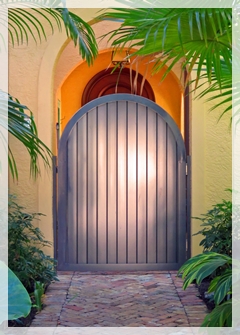 Her neighbors probably thought she’d lost her mind when she sent her boys out to ask for empty containers. Shutting the door certainly kept out the creditors, naysayers, and doubters along with any talk of unbelief that could hinder the widow’s faith. That closed door shut out interruptions, distractions, anxieties, and whatever else that might have kept the widow from focusing on God. Because that shut door even kept out Elisha, there was no mistaking who was responsible for the flowing oil: God!
 Devotions of the Heart