
“Go down to the potter’s shop, and I will speak to you there.” So I did as he told me and found the potter working at his wheel. But the jar he was making did not turn out as he had hoped, so he crushed it into a lump of clay again and started over. Then the Lord gave me this message: “O Israel, can I not do to you as this potter has done to his clay? As the clay is in the potter’s hand, so are you in my hand.” [Jeremiah 18:2-6 (NLT)]
 In January, there will be an Empty Bowls event in our town. Attendees will purchase a bowl and then fill it with soup and bread donated by local restaurants. The money raised will help feed the more than 36,000 food insecure people in our county. To make that event possible, 4,500 one-of-a-kind bowls are made by local potters. Then, with the help of local volunteers, the bowls are painted and fired. Recently, several of us from church gathered to decorate some of those bowls. While we painted, I thought about the potters who made our bowls—how they formed and reformed their creations until they were just right. Varying in shape and size, no two bowls were exactly the same and, by the time they are painted, each will have a personality of its own. When their purchasers are done eating soup from them, they will be put to different uses. The ones embellished with paw prints or bones probably will be used by pets, and the others may be used for popcorn, nuts, cereal, loose change, or even soup!
In words found in Jeremiah and Isaiah, we see God portrayed as the potter and mankind as His clay (rather fitting since Adam was made from dust on the ground and clay comes from the ground). Picture God forming us in His heavenly pottery shop. As with the bowls we painted, each of His creations would be carefully crafted and one-of-a-kind. While our bowls were made of the same kind of clay, God would choose the best type of clay for each one of us. For those who will be severely tested in life, He would chose a clay that withstands high heat but, for those who will have to be especially adaptable, He would chose a clay that is more easily worked.
Once He’d selected the type of clay, God would knead and shape us. While the bowls we painted were all thrown on a potter’s wheel, God might choose to pinch us into shape, or roll long threads of clay and layer them. For one person, He’d combine flat slabs of clay but, for another, He might select a unique mold or use His wheel. No matter the technique chosen, God would continue shaping and re-shaping us until we were formed the way He wanted us. If we got lopsided, He’d prop us up and, if we tore, He’d put us back together. Because clay is malleable and capable of change, God can continue to fine-tune His creations. We might not enjoy all of that pinching, squeezing, molding and scraping, but it is for our own good.
The parallel ends here because the bowls we painted, having been dried and fired, couldn’t be reshaped. God, however, is never done working on us and we continue to be a work in progress until our dying day. Nevertheless, I picture Him with a paintbrush, making each of us beautiful in our own unique way. Moreover, just as the bowls we painted couldn’t complain that, rather than being painted with flowers they wanted polka dots or preferred candy apple red to sour apple green, we really have no voice in how our potter formed and embellished us. God is sovereign over his people; the creation doesn’t get to argue with the Creator!
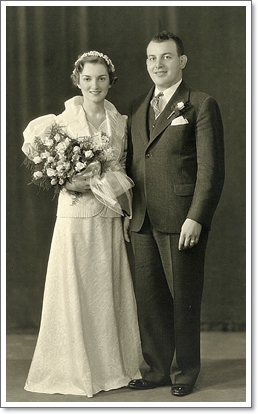 As I sorted through the papers that my mother-in-law had saved through the years, I came to a letter written to her in 1936 by her soon to be mother-in-law, Hattie. Hoping the young couple liked the mixer she’d given them, Hattie sent best wishes for a “long happy wedded life.” Wondering why such a mundane letter had been saved for 83 years, I read on. “May there be lots of love, joy and contentment in your home,” she continued, “forgiving each other as God forgives you.” Praying that my in-laws would have a long and “sweet contented life,” Hattie signed the letter “One who wishes you well in everything, Mother.”
 When we moved to our small Midwestern town over fifty years ago, we paid our utility bills at the local drugstore and I longed for the “good old days” when we sold our northern home recently. Trying to update our information and go completely paperless, I attempted to access our various accounts on line, meaning I had to remember (or create) a wide variety of user names and passwords. If I managed to sign in, I’d get to the security questions and discover that my favorite color or dessert is not what I thought it was! Once past that hurdle, I had to prove I wasn’t a robot by deciphering those squiggly letters and numbers (a near impossibility)!
 “I love you,” said my grandson to his mother; “I love you more,” was her quick reply. They went back and forth, each claiming to love the other most, until one said, “I love you to the moon and back!” Of course, they’re echoing the sentiments found in Sam McBratney’s delightful book Guess How Much I Love You. In it, every time Little Nutbrown Hare tells his father how much he loves him, Big Nutbrown Hare responds with an even larger amount of love. As he’s being tucked into his bed of leaves, the sleepy youngster thinks he’s finally out-distanced his dad when he says he loves him all the way to the moon. His father kisses him goodnight and, with a smile, whispers, “I love you right up to the moon—and back!” Since the moon’s distance varies with its orbit, the distance to the moon and back varies from around 443,362 to 505,244 miles. Even that measurement, however, isn’t correct; we can no more quantify a father’s love for his son than we can our Heavenly Father’s love for His children.
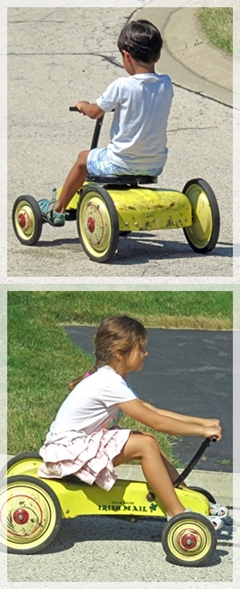 The thing I’ll miss most when we move to southwest Florida permanently is easy access to my grandchildren. This summer I’ve relished watching the little guys frolic in the sprinkler, race their scooters down the sidewalk, climb the monkey bars, decorate the driveway with colored chalk, and play bags with their cousins. They insisted on helping in the kitchen, offered to set the table, listened intently to every story read to them, and never tired of endless games of Crazy-Eights and Kings’ Corners. Their squeals of delight at the holiday fireworks and when they mastered riding the Irish Mail (where they pumped with their arms and steered with their feet) were music to my ears. They asked endless questions and pondered every answer. Wanting to please us, they even were obedient. Seeing their unbridled enthusiasm, energy, and desire both to learn and please, I wondered why I wasn’t like that. After all, God wants us to be like children.
 Devotions of the Heart