PROMISES MADE AND PROMISES KEPT

God is not a man, so he does not lie. He is not human, so he does not change his mind. Has he ever spoken and failed to act? Has he ever promised and not carried it through? [Numbers 23:19 (NLT)]

New England asterWith just 31,164 verses in the entire Bible, a Canadian schoolteacher named Everett R. Storms questioned claims that it held around 30,000 promises. During his 27th reading of the Bible in 1956, the inquisitive Mr. Storms compiled a list of all Scripture’s promises. Given that the books of prophecy are filled with promises (Isaiah, Jeremiah, and Ezekiel have over 1,000 each) and the psalms are steeped in promises, no wonder it took 18 months to complete this massive task! When finished, Storms had recorded 8,810 promises: 7,487 of which were made by God to man and 290 by man to God. Other promises were made by one man to another, by God the Father to God the Son, by angels to people, by man to an angel, by an evil spirit, and by Satan (all nine of which were lies).

While we’d like to lay claim to all 7,487 promises made by God to man, we must be cautious. Many of those promises were made to a specific person or in a specific situation. Although God’s promise to Noah that floodwaters would never again kill all life and destroy the earth is a promise for all of mankind, His promises to Abraham of fame, land, a son, and countless descendants were specific to him. God has not failed us if, unlike Abraham, we are without fame, property or children.

Moreover, many of God’s promises have conditions that test our obedience, require our trust, or act as a warning and those promises can’t be claimed without meeting the conditions. God promises us the desires of our heart in Psalm 37 with the conditions that we delight ourselves in Him and His character, commit everything we do to Him, and trust in Him. [37:4-5] When the Apostle James writes of the blessings and “crown of life” promised by God, the conditions include perseverance through trials by those who love Him. [1:5] In Romans, we find God’s promise of the free gift of eternal life, but it includes a warning that the “wages of sin” are death! [6:23] Unlike a legal document, God’s promises aren’t concealed or hidden in legalese; if there are conditions, they are spelled out clearly and any consequences are well defined.

What of those 290 promises made by man to God? After God promised His blessings to Israel if they obeyed Him and kept His covenant, they responded: “We will do everything the Lord has commanded.” [Exodus 19:8] Sadly, their well-intentioned promise was repeatedly broken. As flawed mortals, we continue to be unable to live up to our promises to God. Fortunately, because He is a God of grace and true to His Word, we can live our lives depending upon His promises to us.

I can’t name the 7,487 promises God made to man. Nevertheless, during Lent, I compiled a far shorter list of verses with God’s promises to serve as an anchor of my faith. I know that He promises to give us wisdom if we ask, to provide a way out of temptation, and to finish the good work He began in us. He promises that our belief in Jesus gives us eternal life, that our salvation is secure, and that nothing can separate us from His love. God promises that He can turn every circumstance around for our long-range good, that He’ll never leave or forsake us, and that He will return! Without a doubt, what God promises will come true!
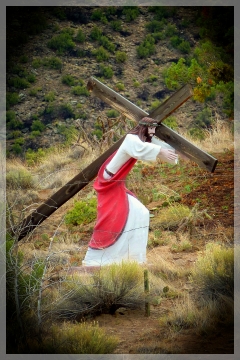
So God has given both his promise and his oath. These two things are unchangeable because it is impossible for God to lie. Therefore, we who have fled to him for refuge can have great confidence as we hold to the hope that lies before us. [Hebrews 6:18 (NLT)]

Copyright ©2020 jsjdevotions. All rights reserved.

HE DIDN’T HAVE TO TAKE IT! – Easter Monday

When the devil had finished tempting Jesus, he left him until the next opportunity came. [Luke 4:13 (NLT)]

penitente morada Abiquiui NMWhen asked about the temptation of Christ, we probably think of Satan’s three temptations in the wilderness. Since the gospels don’t mention other specific temptations, it’s easy to think that Jesus, unlike the rest of us, was only tempted three times. “He left him until the next opportunity came,” wrote Luke and, while reading the four gospel accounts of the crucifixion during Holy Week, I know He had to have been sorely tempted that awful last day. Right up to the end, Satan must have been at His side, whispering into his ear and reminding Him that He didn’t have to take the abuse—after all, He was God!

Satan just was warming up with his temptations during Christ’s forty days in the wilderness. When Jesus prayed so hard He sweat blood in Gethsemane, that wasn’t because He was afraid to suffer and die. That was Jesus resisting Satan as the enemy made false promises, cast doubt on His mission, and tried to keep Him from the cross.

I can’t believe Satan went down without a fight and it was in the hours following Jesus’s arrest that he must have made a determined last ditch effort to thwart God’s plan of salvation. It may have been a man’s body suffering the unspeakable abuse that horrifying Friday but, inside the bruised and bloody flesh, it was God! He’d fed a multitude with a few scraps, turned water into wine, cast out demons, healed lepers, and stilled a storm. Jesus didn’t lose His power when He was arrested; He deliberately chose not to use it!

When Jesus was wrongly accused and false witnesses testified before the high court, when the people who’d hailed Him just a few days earlier called to crucify him, or when the crowd ridiculed Him as His tortured body hung on the cross, could the One capable of giving hearing to the deaf been tempted to strike them all mute? Jesus was there when an angel of the Lord killed 185,000 Assyrian soldiers outside of Jerusalem’s walls. As He was being spit on, slapped, beaten with fists, hit on the head with a reed stick, flogged with a lead-tipped whip, and mocked with a crown of sharp thorns, surely Satan invited Jesus to do something similar to His taunters and abusers. Could the One who gave sight to the blind have been tempted to take away the sight of the soldiers as they gambled for his robe or knelt in mock worship? As they nailed His hands to the cross, could the One who’d cast demons into swine been tempted to kill the men who were torturing Him? Jesus was God. He existed before time, space, matter and energy began and, up to His very last breath, the One who could walk on water could have freed Himself, stepped off that cross, healed his wounds, and destroyed every last one of the soldiers and onlookers with just a thought. But, He didn’t!

Perhaps it was my familiarity with the crucifixion story (and the fact that I know the good news that follows) but I don’t think I truly grasped the anguish of Christ until I read all four gospel accounts in one sitting. I knew He suffered a gruesome tortuous death but I didn’t see how tempting it would have been for Him not to do so! Perhaps resisting the temptation to quit and punish His abusers was even harder than enduring the pain of the cross.

How long would you hold your hand over a burning flame when all you had to do was pull it out of the fire? Would you do it for people who reviled and berated you? Jesus didn’t have to suffer and die for us; He chose to do so out of love. I, for one, can’t comprehend a love that great! Thank you, Jesus!

He personally carried our sins in his body on the cross so that we can be dead to sin and live for what is right. By his wounds you are healed. [1 Peter 2:24 (NLT)]

Now, most people would not be willing to die for an upright person, though someone might perhaps be willing to die for a person who is especially good. But God showed his great love for us by sending Christ to die for us while we were still sinners. [Romans 5:7-8 (NLT)]

Copyright ©2020 jsjdevotions. All rights reserved.


THE MAUNDATUM – Maundy Thursday

oxeye daisyIf any of you wants to be great, he must be your servant. If any of you wants to be first, he must be the slave of all. That’s how it is with the son of man: he didn’t come to have servants obey him, but to be a servant – and to give his life as “a ransom for many.” [Matthew 20:26b-28 (NTE)]

When my coed grand arrived in Florida last December, she wanted to celebrate going from boots to sandals with a pedicure. Although I enjoyed the comfy chair with its rolling massage, the warm whirlpool bathing my feet, the technician massaging the knots in my feet and calves, the exfoliating and buffing, and having someone else clip and paint my nails, I was incredibly uncomfortable with the whole thing (which is why I usually do my own pedicures). Even though I’d scrubbed my feet before arriving, was paying for the service, and liked being pampered, having someone wash my feet and tend to my toes seemed too intimate for me. I felt awkward being served in such a personal way.

My discomfort brought to mind that of the disciples on that Thursday evening so long ago when Jesus washed their feet in the upper room. Unlike mine, the men’s feet were filthy from walking sockless in sandals along unpaved dirt roads littered with animal waste, garbage, and the contents of people’s chamber pots. While the washing of feet was usually the job of the lowest servant, if no servant was present, people usually washed their own feet. Luke tells us the disciples argued that night about who would have the most prestige in the Kingdom. Perhaps it was then that Jesus, their rabbi, the guest of honor, and truly the greatest among them, removed his robe and, dressed like a slave, took on the menial task of washing their filthy feet—a task none of them were doing for themselves, one another, or Him.

If I’m uncomfortable with a pedicure, I can only imagine the discomfort of the disciples as their teacher humbly knelt before them, bathed their filthy calloused feet in the basin, and dried them with the towel at his waist. Not wanting to see his teacher perform such a menial task, Peter even objected and then, in typical Peter manner, told Jesus to wash his hands and head as well!

Today is Maundy Thursday, a day Christians throughout the world remember Jesus washing the disciples’ feet, the breaking of bread and drinking of wine during their Passover supper, Judas’ betrayal, Jesus’ prayers in Gethsemane, His arrest in the garden, and Peter’s betrayal. While many Christians observe this day with the sacrament of Holy Communion, most have no idea how this day got its name. “Maundy” comes from the Latin maundatum for commandment; after being translated into the French mande it was anglicized into “maundy.” This day is named for the mandate or command Jesus gave to his disciples after performing His extraordinary act of humility by washing the men’s feet. This new commandment (maundatum novarum ) was to love one another as Jesus loved them.

Maundy Thursday is a day for more than remembering the Last Supper. It is a day to remember Jesus’ lesson that we must serve others in the same way He did: as a lowly servant who willingly served with humility and love. As He loved us, so we must love one another, not just today but every day.

Love consecrates the humblest act
and haloes mercy’s deeds;
it sheds a benediction sweet
and hallows human needs.
Love serves and willing stoops to serve;
what Christ in love so true
has freely done for one and all,
let us now gladly do!
[“Love Consecrates the Humblest Act” (Silas B. McManus)]

Well, then: if I, as your master and teacher, washed your feet just now, you should wash each other’s feet. I’ve given you a pattern, so that you can do things in the same way that I did to you. … I’m giving you a new commandment, and it’s this: love one another! Just as I have loved you, so you must love one another. This is how everybody will know that you are my disciples, if you have love for each other. [John 13:14-15,34-35 (NTE)]

Copyright ©2020 jsjdevotions. All rights reserved.

NOT WHAT THEY WANTED – Palm Sunday

For the Lord will remove his hand of judgment and will disperse the armies of your enemy. And the Lord himself, the King of Israel, will live among you! At last your troubles will be over, and you will never again fear disaster. On that day the announcement to Jerusalem will be, “Cheer up, Zion! Don’t be afraid! For the Lord your God is living among you. He is a mighty savior. [Zephaniah 3:15-17 (NLT)]

He came into the very world he created, but the world didn’t recognize him. He came to his own people, and even they rejected him. [John 1:10-11 (NLT)

blue jayWith palm branches waving, the people greeted Jesus as he entered Jerusalem. News of Jesus’ miracles, especially the resurrection of Lazarus, had spread through town. They shouted “Hosanna!” at the man they thought would overthrow the Romans, establish peace in the nation, and retake David’s throne. Expecting a political liberator rather than a spiritual savior, they wanted deliverance from the Romans rather than redemption from sin—a conquering king rather than a suffering servant. More concerned about the here and now than the forever after, they wanted power and might rather than love, peace, humility, forgiveness or eternal life. Jesus, however, didn’t come to change their circumstances; He came to change their lives and, when He didn’t give them what they wanted, they rejected Him.

I sometimes wonder if we do the same. Are we fair-weather followers like the people of Jerusalem? Those cries of “Hosanna!” became calls to crucify Him when the miracles stopped. Like them, do we turn away from God when He doesn’t fulfill our expectations? If God delivered Shadrach, Meshach and Abednego from a fiery furnace, why won’t He deliver us from cancer, marital problems, or debt? God answered Elijah’s prayers with rain, so why won’t He answer ours with an end to this pandemic? He freed Peter from his prison cell, so why won’t he free us from debt, pain, or addiction? When God doesn’t deliver what we want, do we turn our backs to Him as did the people of Jerusalem? Let’s remember that while Shadrach, Meshach and Abednego were delivered from the furnace and Peter escaped from prison, not everyone got what they wanted: Stephen was stoned, John beheaded, Isaiah sawn in half, and James slain with a sword.

When God doesn’t meet our expectations, we may start to doubt. Instead of believing that God is good, we ask, “What good is God?” We don’t have to earn God’s love with our works and yet we expect Him to prove His love through His blessings. Our faith cannot be tied to His fulfillment of our desires and expectations; it must be tied to His word. His business is transforming us and not our circumstances.

Let’s never confuse our desires with God’s promises. He will always deliver what He’s promised—peace, love, forgiveness, salvation, the Holy Spirit, eternal life, His grace, and sufficiency. Whether they recognized Him or not, when Jesus arrived in Jerusalem, God was fulfilling His promises and meeting their greatest need: deliverance, not from the Romans, but from sin. God continues to be true to His word today. He will always deliver what He’s promised but, like that itinerant rabbi from Nazareth riding on a donkey through the streets of Jerusalem, often it is not what we expect or think we want!

Understand, therefore, that the Lord your God is indeed God. He is the faithful God who keeps his covenant for a thousand generations and lavishes his unfailing love on those who love him and obey his commands. [Deuteronomy 7:9 (NLT]

God is not a man, so he does not lie. He is not human, so he does not change his mind. Has he ever spoken and failed to act? Has he ever promised and not carried it through? [Numbers 23:19 (NLT)]

Copyright ©2020 jsjdevotions. All rights reserved.

DAY IS DONE

sunsetGod makes a huge dome for the sun—a superdome! The morning sun’s a new husband leaping from his honeymoon bed, The daybreaking sun an athlete racing to the tape. That’s how God’s Word vaults across the skies from sunrise to sunset, melting ice, scorching deserts, warming hearts to faith. [Psalm 19:4-6 (MSG)]

Being an early riser, I’m often out walking as the sun rises. Each new day brings amazing new opportunities and, while the mocking birds loudly sing their praises and the mourning doves coo their peaceful song, I thank God for yet another day on this side of the grass. While the morning’s soft pastels are beautiful, it’s the sunsets in our part of the world that are spectacular.

Our Florida lanai faces west and every evening, shortly before sunset, we try to stop whatever we are doing to admire the western sky. We breathe in deeply of God’s glory and majesty as He paints the heavens. We considered turning sunsets into something like an Olympic event and awarding points to God for each day’s sunset. The vibrant red ones that make the sky look as if it’s on fire might get nine or even ten points while a gray one having just a bare hint of pink might get only a two. After discussing it, however, we realized that sunsets, regardless of their colors, are truly magnificent and a cause for thanksgiving. Every sunset, no matter how colorful or dull, is a gift from God deserving of a perfect score and a reason for rejoicing. Sunsets mean we’ve made it safely through yet another day. They bring closure; we know that the day and whatever came with it, both good and bad, is over and done. But they also bring the promise of tomorrow and the wonderful possibilities that will come with a new day. Even our very last sunset will bring the assurance of dawn on the other side: it will be a time when we’ll truly see the Son.

Looking at the sun setting in the west, I recall my years at summer camp when I’d hear the solemn call of the trumpet at sunset and I silently sing the words to “Taps.” Indeed, all is well and I can safely rest because God is near. Tonight, at sunset, wherever you happen to be, pause, if only for a moment, and thank God for the privilege of one more blessed day.

Day is done, gone the sun,
From the lakes, from the hills, from the sky.
All is well, safely rest, God is nigh.
Thanks and praise for our days,
‘Neath the sun, ‘neath the stars, ‘neath the sky.
As we go, this we know, God is nigh.
[Horace Lorenzo Trim]

Far and wide they’ll come to a stop, they’ll stare in awe, in wonder. Dawn and dusk take turns calling, “Come and worship.” [Psalm 65:8 (MSG)]

Copyright ©2020 jsjdevotions. All rights reserved.

WHAT VALUE A LIFE?

And do not fear those who kill the body but cannot kill the soul. Rather fear him who can destroy both soul and body in hell. Are not two sparrows sold for a penny? And not one of them will fall to the ground apart from your Father. But even the hairs of your head are all numbered. Fear not, therefore; you are of more value than many sparrows. [Matthew 10:28-31 (ESV)]

sparrowAs the economy tanks and COVID-19 spreads, we hear economists and politicians speak of making a cost-benefit analysis to determine the cost of a prolonged shutdown of business and industry with millions out of work versus the cost of hundreds of thousands (or millions) of people dying. How do we put a price tag on life, especially if the life is ours or that of someone we know and love?

By reducing the human body into its basic elements, DataGenetics concluded that the grand total of materials in a typical human body is a meager $160. I suppose that means the larger the body, the more valuable it is. FinanceDegreeCenter found that all our body’s organs (hair, blood, bone marrow, heart, liver, kidneys, etc.) could be worth up to $45 million when sold on the black market. That value, however, would depend on our nationality, health, blood type, age, and the purchaser’s urgency of need. According to the New York Times, the Environmental Protection Agency values a life at $9.5 million, which is their benchmark for determining whether to clean up a toxic waste site.

Does our value change with age? Is a baby’s life more worthy of saving than that of a seventy-year-old? During the George W. Bush administration, the lives of people over 70 were valued at 67% that of younger people when calculating the cost-benefit of regulating soot emissions from power plants. Although AARP’s backlash put an end to that model, could appraising all ages equally devalue the lives of young people? Along with considering the deceased’s age, juries in wrongful death law suits consider things like income, quality of life, and earning potential. Their valuations can range from several hundred thousand dollars to several million.

How can any society assess the trade-off between economic well-being and anyone’s life? What is the value of one person? What is an acceptable number of fatalities? Yet, when we look at the dire economic consequences of a total shut-down, we find economists warning that making people poorer (with the resulting loss of food, shelter, essential services, mental health, medical care, opportunities, and sanitation) also has severe health consequences for the entire nation.

I’m neither economist nor politician and I can’t imagine doing a cost-benefit analysis between lives lost and a tanked economy. I’m thankful that the tough choices they are facing are not mine to make. Let us continue to lift in prayer our nation’s leaders and policy makers so that they will be guided by God’s wisdom in making the difficult decisions necessary in the days ahead. Although we hope that medical research and decisive government action will quickly put an end to this crisis, our ultimate hope lies in God.

As for any person’s value—all I know is that, from conception to death, the life of each and every person is cherished by God. He doesn’t value us by size, health, race, nationality, age, works, sex, income, potential, or even religion. Having formed us and breathed His life into us, God values each one of us as if we were His only child. We are so precious to Him that Jesus suffered and died for us—not for our economy but for our salvation! Every life is worthy of the salvation offered by Jesus—even that of a repentant thief who had but a few hours left to live as he hung on a cross beside Jesus.

Because of God’s enormous love for us, let us face today, tomorrow, and all of the days to follow with faith, hope, and love!

What is your only hope in life and death?
That I am not my own, but belong with body and soul, both in life and in death, to my faithful Saviour Jesus Christ. He has fully paid for all my sins with his precious blood, and has set me free from all the power of the devil. He also preserves me in such a way that without the will of my heavenly Father not a hair can fall from my head; indeed, all things must work together for my salvation. Therefore, by his Holy Spirit he also assures me of eternal life and makes me heartily willing and ready from now on to live for him. [Heidelberg Catechism]

For God so loved the world, that he gave his only Son, that whoever believes in him should not perish but have eternal life. [John 3:16 (ESV)]

Copyright ©2020 jsjdevotions. All rights reserved.