LIVING WATER (John 4:1-42 – Part 1)

“Everyone who drinks this water,” Jesus replied, “will get thirsty again. But anyone who drinks the water I’ll give them won’t ever be thirsty again. No: the water I’ll give them will become a spring of water welling up to the life of God’s new age.” … The woman said, “Give me this water! Then I won’t be thirsty any more, and I won’t have to come here to draw from the well.” [John 4:13-15 (NTE)]

Taos NMJesus was never one to follow man-made rules and, when He spoke with the woman at the well, He broke several. Jewish tradition considered it beneath any man’s dignity to publicly speak with a woman. Rabbinical writing taught: “Let no one talk with a woman in the street, no not with his own wife.” That a rabbi like Jesus did such a thing was scandalous. Those same writings considered women incapable of religious instruction with these words: “Rather burn the sayings of the law than teach them to women.” Jesus speaking of God with a Samaritan woman just made it more outrageous! But, we know from His interactions with women like Martha, Mary, and Mary Magdalene that Jesus wasn’t much for rabbinic tradition so His speaking with this Samaritan woman shouldn’t surprise us.

There’s one thing, however, that seems unlike Jesus in his encounter with this woman when, knowing she’s unmarried, He asks her to get her husband. She admits to having no husband but that’s not the whole truth. Jesus exposes her five previous marriages and her living with a man not her husband. The woman had to have been mortified that a stranger knew of her sordid history. While it’s possible she’d been widowed five times and was living with her brother, that seems highly unlikely. A Jewish man could divorce his wife with the slightest provocation but five marriages reflect badly on her character as do her living arrangements. Since she was drawing water at the hottest part of the day rather than the cool evening (when the village women normally would), she appears to be an outcast who’s gone from one man to another. Jesus never shamed the woman caught in adultery so why would He put this nameless woman on the spot when He knew her disgraceful history?

Prior to being asked about her husband, the woman told Jesus she wanted the living water about which He spoke. Her request was for earthly convenience rather than eternal life. It was then that Jesus inquired about her husband. His knowledge of her secrets established His credibility as a prophet and ultimately identified Him as the Messiah. Recognizing Jesus only as a prophet, she asked Him to clarify the dispute between Judah and Samaria as to the right place to worship. Jesus answered that the time had come when the location didn’t matter because true worshipers would worship the Father in spirit and in truth. She then realized that Jesus was the Messiah, the source of the living water she so desperately sought.

Jesus asked the woman about her husband so she would face her sins and own up to her immorality. It is only with a humble heart that we can come to Jesus and His question was the woman’s moment of humility. Salvation comes to those who confess and repent of their sins, but the woman had to acknowledge those sins before she could repent. The living water only comes to those who know they are spiritually thirsty and salvation only comes to those who see the need for a Savior!

If we say that we have no sin, we deceive ourselves and the truth is not in us. If we confess our sins, he is faithful and just, and will forgive us our sins, and cleanse us from all unrighteousness.  If we say that we have not sinned, we make him out to be a liar, and his word is not in us. [1 John 1:8-10 (NTE)]

Copyright ©2020 jsjdevotions. All rights reserved.

HE EXISTS

Then God looked over all he had made, and he saw that it was very good! And evening passed and morning came, marking the sixth day. [Genesis 1:31 (NLT)]

The Lord is good to everyone. He showers compassion on all his creation. [Psalm 145:9 (NLT)]

tri-colored heronPeople often argue against God’s existence because of evil and suffering. With so much that is wrong in the world, they question how there could there be a god. Christian apologist C.S. Lewis was once an atheist who reasoned that such a cruel and unjust world proved the absence of God until he questioned where he got the idea of what was good or evil, just or unjust. He realized that something cannot be wrong or evil unless there is standard for what is right or good. In a universe with no God, there would be no standard for justice or injustice, good or evil, right or wrong: simply personal preferences. That standard, Lewis realized, is rooted in God. As a result, the very argument he used against God’s existence provided Lewis with proof of His presence!

Nevertheless, acceptance of God’s existence in a world with evil leads people to question how this loving God of ours could allow so much of it in the world. Unable to see how a loving, good and powerful God can coexist in world so filled with pain and suffering, people often ascribe any evil that befalls to God but none of the good. Granted, bad things happen but, if they’re used as evidence against a good God, then all of the good things that occur must be considered as evidence for Him!

The preponderance of the evidence tells us that there are more years of rain than drought, more harvests than famine, more fair weather days than hurricanes, more love than hate, and pandemics are not a regular occurrence. On a more personal level, I’ve encountered evil, injury and pain and, if I were asked to make a list of the suffering in my life, I could. But, if asked to record the good things I’ve experienced, I couldn’t—simply because there would be far too many to list! I’ve avoided more accidents than I’ve been in, favorable circumstances have aligned more often than not, more good people than bad have touched my life, my joys outweigh my sorrows, and God has accompanied me through every dark valley I’ve traversed. Moreover, I’d probably have to cross off most (or all) of the items on the list of bad things because God redeemed them by bringing good out of the pain and suffering.

When life feels anything but good, it’s easier to focus on evil and suffering than to remember that God is good. Yes, we live in a fallen world but it’s not the world God intended; our good God did not create evil and suffering. When man chose to disobey in Eden, both moral and natural evil entered into what was a perfect world. God may allow evil but it is our free will that has made it possible. We can’t hold God responsible for our mistakes.

Non-believers and believers alike wrestle with how a good loving God can allow the presence of evil and suffering. Nevertheless, the existence of suffering doesn’t negate God. In fact, it is God’s existence that gives meaning to our pain and suffering! We’ll never fully understand it. Nevertheless, when I think about those two lists and all that God has done for me, I know that God exists and that He is good!

God judged it better to bring good out of evil than to suffer no evil to exist. [Saint Augustine]

For this is how God loved the world: He gave his one and only Son, so that everyone who believes in him will not perish but have eternal life. [John 3:16 (NLT)]

Whatever is good and perfect is a gift coming down to us from God our Father, who created all the lights in the heavens. He never changes or casts a shifting shadow. [James 1:17 (NLT)]

Copyright ©2020 jsjdevotions. All rights reserved.

IT’S A PROMISE!

Jenny Lake - Grand TetonsIf we are unfaithful, he remains faithful, for he cannot deny who he is. [2 Timothy 2:13 (NLT)]

When I first read the above verse in a daily meditation book, I felt reassured; even if I’m unfaithful to Jesus, He’ll remain faithful to me. Wondering if my interpretation was correct and suspecting the verse might have been taken out of context, I looked at the preceding lines: “If we die with him, we will also live with him. If we endure hardship, we will reign with him. If we deny him, he will deny us.” [2:11-12] Probably part of an early Christian hymn emphasizing the believer’s union with Christ, when put in context with, “If we are unfaithful, he remains faithful, for he cannot deny who he is,” we have a different meaning. Paul was echoing Jesus’ own words of warning: “But everyone who denies me here on earth, I will also deny before my Father in heaven.” [Matthew 10:33] Jesus cannot deny who He is; if we deny Him, He will remain faithful to His word and deny us.

But what of Peter? He denied Jesus three times and Jesus certainly didn’t deny him! Again I looked to the context: “If we die with him, we will also live with him. If we endure hardship, we will reign with him.” Rather than speaking of Christ followers who may have a temporary failing like that of Peter, Paul is speaking of those who have rejected Jesus and denied Him, as did Judas. When Peter denied knowing Jesus that night so long ago, he hadn’t stopped loving the Lord or having faith in Him. Yes, he failed Jesus but let us remember that God’s grace is greater than our human weaknesses. We all have unwavering faith until it is tested and, like Peter, we may fail when it is sorely tested. God, in His mercy forgave Peter, and He will forgive us.

Rather than words of cheer, Paul’s words are a serious warning for those who reject Jesus as Lord! Jesus can’t be false to himself. For the unbelieving and unfaithful, Christ will remain true to his word; no matter their works or virtue, if people have denied Him, He will deny them. Just as Jesus makes good on all of his promises, He’ll follow through on his threats, as well. Not so comforting a thought after all!

Since no man is excluded from calling upon God, the gate of salvation is open to all. There is nothing else to hinder us from entering, but our own unbelief. [John Calvin]

Anyone who believes and is baptized will be saved. But anyone who refuses to believe will be condemned. [Mark 16:16 (NLT)]

Everyone who acknowledges me publicly here on earth, I will also acknowledge before my Father in heaven. But everyone who denies me here on earth, I will also deny before my Father in heaven. [Matthew 10:32-33 (NLT)]

Copyright ©2020 jsjdevotions. All rights reserved.

THE BOSS’S SON

Who, though in God’s form, did not regard his equality with God as something he [Jesus] ought to exploit. Instead, he emptied himself, and received the form of a slave, being born in the likeness of humans. And then, having human appearance, he humbled himself, and became obedient even to death, yes, even the death of the cross. [Philippians 2:6-8 (NTE)]

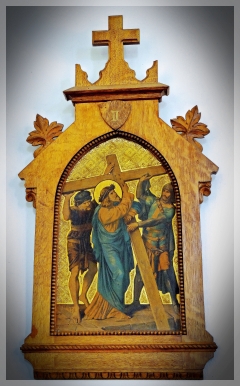
station of the cross II

My son is the third generation to run the family business. Although he is now its CEO, he didn’t begin that way. As his father had done before him, he started by sweeping floors and emptying trash.

The business expanded when my husband purchased a company in another town. With manufacturing processes that were unfamiliar, our son needed to learn new fabrication procedures and started working in the new facility. When he began, only his supervisor knew his relationship to the business’s new owner. He may have been the boss’s son but, to everyone else, he was just Jim, the new guy on the line. In his work shirt and steel-toed shoes, he looked like everyone else, kept the same hours, followed the same rules, and made the same money. What he didn’t do was pull rank or take advantage of his identity.

Although our son originally thought he could learn everything he needed by reading about it, a few days operating the machinery and getting his hands dirty told him there was nothing like first-hand experience! Now that he’s the boss, his employees recognize that he understands and appreciates the challenges they face in doing their jobs.

I tell this story to help us understand what it was like when Jesus put on human flesh and lived as a man. Clothed in work clothes, my son looked like every other hourly employee on the line. Although Jesus is often depicted with a halo, when He was clothed in human flesh, there was no halo and He looked like any other man. Instead of giving up coat and tie for overalls, Jesus gave up His immortal perfect form and took on the aches, indignities, and illnesses that come with a mortal body.

Just as my boy remained the boss’s son but gave up any status or privileges that came from that, Jesus remained God’s son but gave up the benefits that came with His divinity. Of course, Jesus gave up far more than did my son! He set aside the glory of heaven for life on earth and relinquished the divine life He had in heaven to be an itinerant rabbi in Galilee. Even though equal with His Father, Jesus chose to submit to Him as an earthly son does to his father.

Just as our boy never stopped being the boss’s son, Jesus remained fully God while fully man. Just as his co-workers didn’t know our boy’s real identity, people had trouble recognizing Jesus as God’s Son. While my son did what he did so he could learn the family business, Jesus did what He did to take away the sins of the world. Our son may have humbled himself by starting at the bottom but Jesus humbled himself by deliberately choosing to die a torturous death as a criminal on the cross!

My son knows what it means to be one of his employees and he’s a better boss because of it. Jesus knows what it’s like to be human and we are better because of that! Jesus knows what it is to hurt, be disappointed, suffer, struggle, get tired, thirst, feel hungry, bleed, hope, love and die. Because He lived as one of us, we can come to Him confidently and without fear; instead of condemnation, we will receive God’s grace and mercy!

Well, then, since we have a great high priest who has gone right through the heavens, Jesus, God’s son, let us hold on firmly to our confession of faith. For we don’t have a high priest who is unable to sympathize with our weaknesses, but one who has been tempted in every way just as we are, yet without sin. Let us then come boldly to the throne of grace, so that we may receive mercy, and may find grace to help us at the moment when we need it. [Hebrews 4:14-16 (NTE)]

Copyright ©2020 jsjdevotions. All rights reserved.

CLEAN GARMENTS

If God is for us, who can ever be against us? Since he did not spare even his own Son but gave him up for us all, won’t he also give us everything else? Who dares accuse us whom God has chosen for his own? No one—for God himself has given us right standing with himself. Who then will condemn us? No one—for Christ Jesus died for us and was raised to life for us, and he is sitting in the place of honor at God’s right hand, pleading for us. [Romans 8:31-34 (NLT)]

star jasmine

Around 520 BC, the prophet Zechariah revealed God’s future deliverance through the Messiah to the Jews who had just returned to Jerusalem from Babylonian captivity. In Zechariah’s fourth vision, the high priest Jeshua stood before an angel of the Lord. Instead of being attired in the spotless white linen robe and turban of a priest, Jeshua’s clothing was filthy (the Hebrew word used was tsow’ and referred to the filth of excrement). Standing to the angel’s right, in a court prosecutor’s position, was Satan. The Hebrew word śāṭān means “accuser” or “adversary” and Satan was living up to his name by making accusations that the unclean priest was unworthy of standing before the Lord. Calling the priest “a burning stick that has been snatched from the fire,” the Lord rejected the accuser’s charges.

In Zechariah’s vision, Jeshua symbolized the nation of Israel, his foul clothing the sins of the people, and his rescue from the coals the nation’s release from their Babylonian exile. Satan, of course, had a vested interest in his accusations; if he could get God to reject Israel, God’s plan of redemption would be thwarted. It wasn’t as if God didn’t recognize Israel’s sin; they’d been punished with seventy years of captivity. God, however, hadn’t turned from His people because of their sins; having delivered them back to Jerusalem, they were still His people.

After the angels around Jeshua took off his filthy garments, the priest was told that his sins were removed and he was given new clothes and a clean turban. On the front of the priest’s turban would have been a medallion with the words “Holy to the Lord.” Just as Jeshua was reinstated as a priest with his clean priestly attire, the nation of Israel was cleansed and restored as a priestly nation and made holy to the Lord! What an amazing image this is. The filthy robe of sins was removed and replaced with garments of God’s righteousness.

What followed was a Messianic vision in which the Lord of Heaven’s Armies promised the coming of a servant called “the Branch,” the removal of all the land’s sins in a single day, and an era of peace and blessings when “each of you will invite your neighbor to sit with you peacefully under your own grapevine and fig tree.” [3:10]

What do Zachariah’s words from over 2,500 years ago mean to us? God’s chosen servant was Jesus; He was the promised Branch stemming from Adam, Abraham, and David. The day Jesus died on the cross was the single day when all our sins were removed! Although Satan continues to accuse us, Jesus is now at God’s right hand and, instead of indicting us, He is pleading for us!

Just as God didn’t reject Israel, He hasn’t rejected us. Because of God’s grace, like Jeshua, we can hand off our sin-covered garments to the Lord and have robes of righteousness returned. Our robes, however, are washed in the blood of the Lamb. Social distancing may have kept us from sitting under a tree with our neighbors, but that promised day of peace and plenty will happen when Jesus returns and reigns as King.

God will not lightly or easily lose His people. He has provided well for us: blood to wash us in; a Priest to pray for us, that we may be made to persevere; and, in case we foully fall, an Advocate to plead our cause. [John Bunyan]

They have washed their robes in the blood of the Lamb and made them white. They will never again be hungry or thirsty; they will never be scorched by the heat of the sun. For the Lamb on the throne will be their Shepherd. He will lead them to springs of life-giving water. And God will wipe every tear from their eyes.” [Revelation 7:14,16-17 (NLT)]

Copyright ©2020 jsjdevotions. All rights reserved.

LIKE A CHILD

“I’m telling you the truth,” he said. “Unless you turn inside out and become like children, you will never, ever, get into the kingdom of heaven. So if any of you make yourselves humble like this child, you will be great in the kingdom of heaven.” [Matthew 18:3-4 (NTE)]

kiboni school - arusha - tanzaniaI used the NTE version of today’s verse because it better captures the original meaning with the words “turn inside out.” Usually translated as change, turn, or convert, the original Greek was strephō which meant more than a slight change of direction. It meant being turned (even from one thing into another) which requires submission. Far more than a mental acknowledgment or intellectual assent to certain ideas, it’s a turning of one’s whole life and person toward God. The kind of conversion or turning meant in strephō is like having one’s life turned inside out.

When Jesus said to become like children, He wasn’t telling us to act childish but to come to Him as would a child. When thinking of some of today’s often spoiled and demanding children, it’s easy to question His words. Children in His day, however, were far less presumptuous, self-sufficient, disrespectful or defiant than today’s youngsters. They were more like a little girl I encountered in Tanzania. She walked across the schoolyard, stopped, looked up at me and, with a shy smile, presented me with her foot. Her shoe needed tying and, as I knelt down in the dust to tie it, she was a perfect example of Jesus words. Knowing she wasn’t self-sufficient, she openly and humbly depended upon someone older and wiser. Trusting and unpretentious, this beautiful child came to me with a faith and simplicity that we adults don’t seem to have.

A child knows when he or she needs help and will freely ask and accept it. Adults, on the other hand, rarely admit their needs or weakness for fear of appearing vulnerable. We want to be in control but, if we’re ever going to enter into God’s Kingdom and enjoy His peace, we have to turn ourselves inside out, cede control and admit our powerlessness.

Any 12-step recovery program begins with admitting our helplessness but we don’t need to have an addiction or compulsive behavior to have our lives spin out of control. Without Jesus, we are broken beings separated from God and powerless over sin. We may be incapable of saving ourselves, but Jesus is not. What He won’t do, however, is force Himself upon us or chase after every loosened shoelace to tie it. It’s up to us to admit our need and turn to Him, as that child did to me.

I will always remember that brief encounter with a little girl who showed me what it means to turn and be like a child: with humility, trust, openness and a lack of self-sufficiency. The kingdom of God is not earned by human effort but is received in childlike trust as a gift through the mercy and grace of God.

With time, that little girl will become more self-sufficient and won’t need someone to tie her shoes. I pray, however, that she always will be willing to acknowledge her weakness and needs to God.

And this is what he said to me: “My grace is enough for you; my power comes to perfection in weakness.” So I will be all the more pleased to boast of my weaknesses, so that the Messiah’s power may rest upon me. [2 Corinthians 12:9 (NTE)]

Copyright ©2020 jsjdevotions. All rights reserved.