WOULD I? COULD I?

God blesses those who are persecuted for doing right, for the Kingdom of Heaven is theirs. [Matthew 5:10 (NLT)]

As they stoned him, Stephen prayed, “Lord Jesus, receive my spirit.” He fell to his knees, shouting, “Lord, don’t charge them with this sin!” And with that, he died. [Acts 7:59-60 (NLT)]
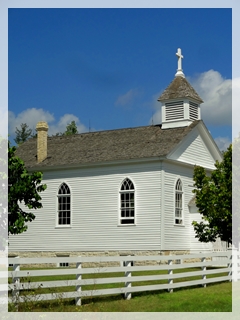
old world wisconsinHis testimony enraged the Jewish high council and he was taken from the city and stoned to death. Stephen was the first of the Christian martyrs but clearly not the last. We’ve all been horror-stricken by the recent news from Egypt where ISIS thugs attacked Coptic Christians on their way to a remote monastery. According to witnesses, the men were told their lives would be spared if they recited the shahada, the Islamic declaration of faith. When they refused to do so, they were gunned down. Since December, more than 100 Coptic Christians have died in Egypt in four different attacks. On Palm Sunday, two of their churches were bombed leaving forty-four dead. It’s not easy being a Christian in Egypt.

Apparently, it’s not that easy in India, either. Last winter, Bartu Urawn and his wife were forced to stand all night in a freezing pond. When they refused to renounce their Christian faith after being immersed in the frigid water for seventeen hours, they were beaten. Although his wife survived, Urawn died as a result of the torture. A decade ago, Christianity was embraced by ten families in this remote Indian village. Unfortunately, in the years that followed, seven of those families caved into threats and returned to their indigenous tribal religion. The Urawns, however, remained faithful to Jesus.

After watching the news of the Egyptian attack last night, my husband asked how I would respond in a similar situation. I wondered. Would I choose to be a martyr? I’d like to think I would. Like the Urawns, could I endure hours of torture and still stay true to Christ? I’d like to think I could. What if, rather than saving my life, renouncing Christ meant I could keep my children from suffering torture or death? Now it’s getting harder to know the answer. Could I watch them suffer? How could I live with myself in either scenario? Perhaps I’d find an excuse for verbally abandoning Jesus by telling myself that they were just empty words from my mouth and my heart didn’t mean them. I’m not so sure God would see it that way and it doesn’t much sound like something Jesus would do. These are not easy questions and, hopefully, I’ll never be forced to ask them. Nevertheless, the uncertainty of my answers indicates the level of my faith and it’s nowhere near as strong as I thought it was. Jesus told us to pick up our crosses and follow him; let us never forget that the cross was an instrument of torture and He was walking to Calvary. We have been called to share in His suffering and persecution should not deter us.

Living here in the United States, we’re not likely to be threatened with torture or death for our Christian faith. We don’t risk our lives by reading the Bible or gathering in worship and prayer. Perhaps, rather than wondering if we would stand up to ISIS soldiers or an angry mob of non-believers, we should ask ourselves how well we stand up to the world in which we live. Although we may never have to choose between Jesus and our physical survival (or that of our loved ones), there are plenty of opportunities every day to forsake Him in far more subtle ways. If we’re not walking in His footsteps and led by His Holy Spirit, we’re denying Him. There’s more than one way to lose one’s soul.

 I will not deny Christ…I will continue to believe until my last breath. [Bartu Urawn]

Then Jesus said to his disciples, “If any of you wants to be my follower, you must give up your own way, take up your cross, and follow me. If you try to hang on to your life, you will lose it. But if you give up your life for my sake, you will save it. And what do you benefit if you gain the whole world but lose your own soul? Is anything worth more than your soul? [Matthew 16:24-26 (NLT)]

Copyright ©2017 jsjdevotions. All rights reserved.

THE SWEET AROMA

Let Christ’s word with all its wisdom and richness live in you. Use psalms, hymns, and spiritual songs to teach and instruct yourselves about God’s kindness. Sing to God in your hearts. Everything you say or do should be done in the name of the Lord Jesus, giving thanks to God the Father through him. [Colossians 3:16-17 (GW)]

honeysuckleI’m in the midst of reading a series of seven children’s fantasy novels, The Chronicles of Narnia, by C.S. Lewis. Some of them, like The Lion, the Witch and the Wardrobe, I read as a girl but others are new to me. The world of Narnia is a world to which one wants to return again and again and I’m enjoying my visit ever so much. C.S. Lewis, however, was much more than a writer of fantasy, non-fiction and poetry; he was a well-known lecturer, a brilliant scholar and a renowned Christian apologist.



Because of his tremendous faith and knowledge of Scripture, there is much more to his fiction than first meets the eye. Intentionally (and probably unintentionally), Biblical truths and Christian themes are woven throughout all of his writing. Lewis was so aware of God, so steeped in Biblical knowledge, and so in tune with the Holy Spirit, that I don’t think he could have written any other way, even if he’d wanted to do so. His faith emanated from him the same way a honeysuckle blossom emits a sweet aroma. His writing reflects what all of us are asked to do—share Jesus. Lewis’ knowledge of Scripture, his insight into the Holy Spirit’s ways and the enemy’s wiles, his love of Christ, his faith in a God who is good even when life isn’t, and his awareness of God’s presence in all circumstances are evident in his stories and yet there is nothing sermon-like about them. The adventures of the Pevensie children in Narnia brought them closer to a great lion by the name of Aslan and those same adventures can bring the reader closer to someone who (as Lewis suggested) arrived at the same time as Father Christmas, was the son of the Great Emperor, gave himself up to be killed by wicked people, came to life again, and is often spoken of as a lamb.

While we’re not likely to teach at Oxford or Cambridge, write over 70 books, sell 100 million copies of anything we might write or be asked to explain Christianity on a radio show, we are asked to share our faith. If Biblical truths become a part of us, they will become second nature and will be evident in all that we say or do. We don’t have to become theologians or write a best-seller; we just have to emit the sweet aroma of Christ in our lives.

I believe in Christianity as I believe that the Sun has risen, not only because I see it but because by it I see everything else. [C.S. Lewis]

But I thank God, who always leads us in victory because of Christ. Wherever we go, God uses us to make clear what it means to know Christ. It’s like a fragrance that fills the air. To God we are the aroma of Christ among those who are saved and among those who are dying. [2 Corinthians 2:14-15 (GW)]

Copyright ©2017 jsjdevotions. All rights reserved.

OUR LAST LECTURE

Whoever says he abides in him ought to walk in the same way in which he walked. [1 John 2:6 (ESV)]

monarch-butterfly

Last Friday, I was blown away when I walked into a restaurant to discover that my family had gathered from both far and near to surprise me with a 70th birthday party. I couldn’t believe how beautifully they had secretly choreographed the entire celebratory weekend. With tears of joy leaking from my eyes and a heart bursting with love, I prayed that they would be as fulfilled in their lives as I have been in mine. Having just finished yesterday’s devotion about last lectures, I couldn’t help but think of the passing along of life lessons. Although I’m in good health, I know that much sooner than later my time in this world will be over. Is there a last lecture I should prepare?

Remembering that my children rarely listened to any of my lectures when they were young, I realized they certainly wouldn’t listen now they’re grown adults. I recalled Randy Pausch’s last lecture and what he considered the most useful weapon in a teacher’s arsenal: the “head fake.” Simply put, the head fake is indirect learning. While thinking they are learning about one thing, the students really are learning about quite another. Perhaps these devotions are my version of a head fake. They aren’t just about finding God in both His Word and everyday occurrences; they’re about how to lead our lives. And, like Professor Pausch’s lecture, while freely shared, they are actually for my children.

Most of us, however, aren’t professors or writers and yet we all have a last lecture, a legacy of sorts, to leave to those who follow in our footsteps. The best last lecture, of course, is the ultimate head fake—a life well lived. We can teach more with our examples that we ever could with our words. Unlike most lectures, however, that lecture lasts far longer than an hour or so. It is ongoing; every time we interact with our loved ones or they observe us with others, we’re giving that lecture. Do we treat people who can do nothing for us with the same respect and dignity we do to those who can do something for us? Is the Fruit of the Spirit obvious in our conduct? Do our actions match our words? In the end, the example of our lives will be far more powerful than even the most eloquent of lectures. If Christ can be seen in us, we will have given the most powerful lecture of all.

Heavenly Father, fill us with your Holy Spirit and guide us so that we are living examples of Jesus. Enable us to walk as He walked, talk as He talked, give as generously as He gave, care as deeply as He cared, forgive as freely as He forgave, and love as largely as He loved.

Live so that when the final summons comes you will leave something more behind you than an epitaph on a tombstone or an obituary in a newspaper. [Billy Sunday]

Let love be genuine. Abhor what is evil; hold fast to what is good. Love one another with brotherly affection. Outdo one another in showing honor. Do not be slothful in zeal, be fervent in spirit, serve the Lord. Rejoice in hope, be patient in tribulation, be constant in prayer. Contribute to the needs of the saints and seek to show hospitality. Bless those who persecute you; bless and do not curse them. Rejoice with those who rejoice, weep with those who weep. Live in harmony with one another. Do not be haughty, but associate with the lowly. Never be wise in your own sight. Repay no one evil for evil, but give thought to do what is honorable in the sight of all. If possible, so far as it depends on you, live peaceably with all. … Do not be overcome by evil, but overcome evil with good. [Romans 12:9-18,21 (ESV)]

Copyright ©2017 jsjdevotions. All rights reserved.

NURSERY LOGS

nursery log - corkscrew swamp
Blessed is the man who fears the Lord, who greatly delights in his commandments! His offspring will be mighty in the land; the generation of the upright will be blessed. Wealth and riches are in his house, and his righteousness endures forever. [Psalm 112:1-3 (ESV)]

When walking in the swamp, I often see what are known as “nursery logs.” After a tree dies, its roots eventually decay and it falls to the ground, leaving an opening in the forest’s canopy for sunlight to reach down to the forest floor. The dead tree’s raised trunk becomes a nursery for new plant life as seeds fall on it and take root. Its bark holds moisture, providing young plants with water, and the decaying wood provides them with decades of rich organic nutrients. Starting with moss and ferns, vegetation grows and flourishes in the patch of light left by the tree’s demise. These nursery logs become gardens of new life and can contain five times more living matter than they did when alive! Eventually, a new tree will take root in the remains of the old one and the cycle of life continues for another generation. Supposedly, it will take about the same number of years for a tree to decompose as it took to live. Considering that trees can live several hundred years, one dead tree can leave quite a legacy.

I thought of those nursery logs today while reading an obituary in our local paper. Like the trees, this man may be dead but, most definitely, he is neither gone or forgotten. Here are just a few of the loving words written about him:

He touched the lives of everyone he came in contact with…after talking to him for two minutes he would immediately become your friend…would do anything to help someone in need…always had a positive attitude and was ready to listen if you needed to talk…a great man who was loved by all his family and friends and will be missed dearly…he would say love unconditionally, don’t hold grudges, and never walk away mad… tomorrow isn’t promised so make the best of today so you have no regrets…know you are right with God…remember [him] as the man who always made the most of life and always had a smile on his face.

I never met this man and consider it my loss that I didn’t. I have no idea the size of his financial holdings but, based on his career as a fishing guide, I suspect he was not a wealthy man. He was, however, an incredibly rich one! Whether or not he left his family with any money, his bequest of love, faith and joy, as seen in a life well lived, makes them more than rich.

While it is our belief in Jesus that gives us eternal life in our heavenly home, like the nursery logs in the forest, even dead, we can still persist. Once we’ve fallen to the forest floor, we continue to nourish life if the lives we touched while living were touched with faith, love, generosity, compassion and joy. Unlike the cypress trees, we may only be blessed with seventy to eighty years but, if wisely lived, think how that legacy can grow as each life we touched touches another. As did this man, we can leave a patch of sunlight when we fall, our example can provide a base for young seedlings, and the memory of us can bring nourishment to hungry souls.

Our death is not an end if we can live on in our children and the younger generation. For they are us, our bodies are only wilted leaves on the tree of life. [Albert Einstein]

Therefore I intend always to remind you of these qualities, though you know them and are established in the truth that you have. I think it right, as long as I am in this body, to stir you up by way of reminder, since I know that the putting off of my body will be soon, as our Lord Jesus Christ made clear to me. And I will make every effort so that after my departure you may be able at any time to recall these things. [1 Peter:12-15 (ESV)]

Copyright ©2017 jsjdevotions. All rights reserved.

THE RESPONSIBILITES OF A CONGREGATION

Obey your spiritual leaders, and do what they say. Their work is to watch over your souls, and they are accountable to God. Give them reason to do this with joy and not with sorrow. That would certainly not be for your benefit. [Hebrews 13:17 (NLT)]

And I will give you shepherds after my own heart, who will guide you with knowledge and understanding. [Jeremiah 3:15 (NLT)]

southern mockngbirdAfter more than a year without a pastor, our northern church is finally getting its new minister. He will be stepping into some very big and well-worn shoes. The last pastor was at his post for over forty years. To say that the congregation has become somewhat set in their ways is probably an understatement. “But we’ve always done it that way!” and “He’s not like Pastor S!” are bound to be said more than once.

According to our new pastor’s Letter of Call, a pastor is to be “diligent in the study of Holy Scripture, in the use of the means of grace, in prayer, in faithful service, and in holy living.” Having met him, I have no doubt he will do that. His letter also included the duties of his congregation. We are to pledge our “prayers, love, esteem and personal support for the sake of the ministry entrusted to [him] and for our ministry together in Christ’s name.” While congregations expect their ministers to live up to their side of the bargain, I’m not so sure we live up to ours.

As members of a church, do we regularly pray for our clergy? Do we offer prayers for their confidence, wisdom, inspired preaching, and faith? Do we ask God to lift from their hearts the grief they face daily or to help them find time for study and their families? Do we offer our love, friendship and thanks along with their salary? Do we give them our respect even when they’re younger than our children? Do we value the new ideas they bring to our church family? Do we appreciate the insight that comes when someone views us with fresh eyes? As for that pledge of personal support—do we complain rather than make constructive comments? Do we come to our worship with a willingness to try new things (more than once)? Although new doesn’t always mean better, it doesn’t necessarily mean worse! As our churches grow and evolve we have to be willing to grow and change with them.  None of us like change but we can’t allow the church to become stagnant. We need new people and the new ideas they bring. Our clergy do not act alone; we all minister together in Christ’s name.

Being a pastor, while a blessed calling from God, isn’t easy. If Moses thought he had problems shepherding his “stiff-necked” people across the desert, he should try shepherding one of today’s congregations! Although it’s supposed to be rewarding, I suspect it sometimes seems thankless and overwhelming. Whether our pastors are new or longstanding, young or old, they desperately need our prayers, love, esteem and personal support for God’s Kingdom to expand!

So encourage each other and build each other up, just as you are already doing. Dear brothers and sisters, honor those who are your leaders in the Lord’s work. They work hard among you and give you spiritual guidance. Show them great respect and wholehearted love because of their work. And live peacefully with each other. [1 Thessalonians 5:11-13 (NLT)]

Copyright ©2017 jsjdevotions. All rights reserved.

SEND IT ON AHEAD

Do not lay up for yourselves treasures on earth, where moth and rust destroy and where thieves break in and steal, but lay up for yourselves treasures in heaven, where neither moth nor rust destroys and where thieves do not break in and steal. For where your treasure is, there your heart will be also. [Matthew 6:19-21 (ESV)]

For the Son of Man is going to come with his angels in the glory of his Father, and then he will repay each person according to what he has done. [Matthew 16:27 [(ESV)]

orchid“A Christian doesn’t die,” declared the pastor, which may have been news to some of those attending the Celebration of Life. “He just moves!” the minister added as an explanation. Indeed, we are just temporary residents here on earth. Death for a Christian is simply a relocation and, unlike most moves we’ve made, it doesn’t require a purging of the items in the attic, garage sales, packing up boxes, or wrangling friends into helping us carry the heavy stuff! This is one transfer that neither requires moving vans nor mail forwarding.

Although we can’t take anything with us, our pastor often reminds us that we can send things on ahead! That doesn’t mean we gather our favorite possessions and take them to FedEx but it does mean we can store treasures in heaven. Unlike treasure here on earth, however, heavenly treasure has no monetary value. It’s made of up things like earnest prayers for others (including our enemies), sharing the gospel message, loving unconditionally, using our wealth for God’s good works, being generous with our time and talents, obedience, patience, taking a stand against evil and wrongs, and fulfilling God’s purpose for us. These are the treasures laid up in heaven and no good deed will be overlooked.

At first, that sounds a lot like salvation through works but it isn’t. All the good works in the world won’t get us into heaven without belief in Jesus. We are saved through God’s grace—it is His gift to us. Jesus’ death and resurrection paid the price for our ticket to eternal life. There is, however, some fine print on that ticket—once we get there, God will hold us accountable for His gifts to us in this life. Were we good stewards who used them wisely or did we squander His blessings? Did we invest God’s gifts in His kingdom or bury them in the ground? Did our activities transform the world in some way? Did we change anyone’s life for the better?

I can’t pretend to know what our heavenly rewards will be but I seriously doubt they’ll be anything like gold faucets and marble floors for the truly generous and just stainless and linoleum for those who didn’t tithe. I think the rewards will have something to do both with joy and responsibility. Here on earth, responsibility sounds suspiciously like work and work is hardly what we consider a reward, especially in heaven! Yet, in the parable of the talents, Jesus told the servants who had invested wisely that they would be given even more opportunities to serve their master. The difference between earthly work and heavenly work is that it won’t be a burden; work in God’s kingdom will be a joy! Perhaps the greatest reward, however, will be hearing His voice say, “Well done, good and faithful servant!”

And he who had received the five talents came forward, bringing five talents more, saying, “Master, you delivered to me five talents; here, I have made five talents more.” His master said to him, “Well done, good and faithful servant. You have been faithful over a little; I will set you over much. Enter into the joy of your master.” [Matthew 25:20-21 (ESV)]

Copyright©2017 jsjdevotions. All rights reserved.