
Jesus spoke to the people once more and said, “I am the light of the world. If you follow me, you won’t have to walk in darkness, because you will have the light that leads to life.” [John 8:12 (NLT)]
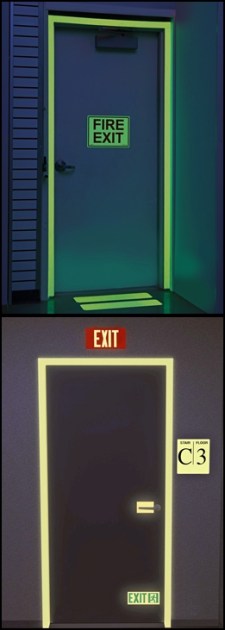 A business friend took us upstairs at his corporate center and then turned out all of the lights. With blackout curtains covering the windows, we were in complete and utter darkness. As our eyes adjusted to the dark, we saw glowing strips marking the perimeter of the room and around the door. A luminous exit sign was above the door and the doorknob was marked with a glowing circle around it. In spite of the blackness, we easily found our way to the door. When we opened it, another glowing sign warned us “Caution—watch your step.” Although the stairwell was pitch black, we weren’t frightened because the hand railing, baseboards, and edges of every stair were marked with glowing strips and another exit sign, outlined door, and marked doorknob indicated the way out of the dark stairway. That luminous greenish light safely guided us even when we couldn’t see where we were going.
My friend manufactures photoluminescent tapes and signs and it was his products that were glowing in the dark. He explained that photoluminescence occurs when a substance is capable of absorbing energy photons, storing them and then emitting them as a glowing greenish or yellow light. His products also glow in the light but, because of the ambient light, our eyes don’t see the glow; they seem brightest in the darkness!
Light and dark in the Bible are usually metaphors for good and evil, God and Satan, believers and unbelievers. Maybe it’s because I write Christian devotions but, after seeing how that glowing light led us through the building, I couldn’t help but think about the light of Christ that leads us. Just as the purpose of those photoluminescent products is to give off light, Christians are called to be the light of the world. Needing neither electricity nor batteries, those tapes and signs must absorb external light before they can make light of their own and it is Christ’s light that enables us to illuminate the world’s darkness; we can’t do it on our own. And, just as those photoluminescent tapes and signs seem brightest in the dark, the light of Christ shines brightest in the shadowy and troubled times. While darkness can never overpower God’s light, His light can overpower the world’s darkness.
Photoluminescent products continually absorb ambient light and, when fully charged, can glow brightly for about 90 minutes. But, without being recharged by light, they’ll eventually run out of energy and stop glowing. While 90 minutes is more than enough time to guide one out of a burning building, Jesus expects us to have more than a mere hour-and-a-half worth of His energy in us; we are to shine 24/7! Moreover, if photoluminescent tapes and signs get dirty or covered with paint, they can’t do their job. The same goes for Christ’s followers, but it won’t be dust, mud or paint that will soil us; rather, the filth of the world can keep us from lighting the way. We must keep ourselves free from sin and continually recharge with prayer, Scripture, fellowship, study, worship, praise and thankfulness.
Jesus led us from darkness into light. Are we doing our part to lead people to the fire exit and safely home to the Lord? Do we live as people of the light and glow with the glory of the Lord?
The fundamental principle of Christianity is to be what God is, and he is light. [John Hagee]
For once you were full of darkness, but now you have light from the Lord. So live as people of light! [Ephesians 5:8 (NLT)]
You are the light of the world—like a city on a hilltop that cannot be hidden. No one lights a lamp and then puts it under a basket. Instead, a lamp is placed on a stand, where it gives light to everyone in the house. In the same way, let your good deeds shine out for all to see, so that everyone will praise your heavenly Father. [Matthew 5:14-16 (NLT)]
Copyright ©2019 jsjdevotions. All rights reserved.
 We were enjoying hundreds of exotic butterflies amid tropical plants in the conservatory of a nearby botanic garden when I turned around to see a hummingbird hovering nearby. In spite of the building’s double-door containment procedures, this beautiful little bird managed to find his way into what, for him, must be paradise and no one seemed to mind. Seeing him reminded me of a question asked several years ago: “Which would you rather be—a hummingbird or a vulture?” I thought, “That’s a no-brainer!” as I watched the iridescent bird hover over the flowers; then I remembered the question wasn’t what we wanted to be but rather what we actually were.
 The day’s gospel was from Mark 10 and, as the sermon began, the pastor shared having spent three hours earlier that week in a tiresome meeting on evangelism. The speakers had been lauded for the high number of “first public professions of faith” in their parishes. As the meeting went on, the pastor furtively checked his phone to see if memory had served him right. Indeed, his church far exceeded the numbers of the keynote speakers. Part of him (the bad part), like James and John, wanted to boast and be honored but the other part reminded him that ministry is about people and not numbers. He ate a little humble pie and said nothing. As often happens in long meetings, his mind wandered and he thought back to an encounter some twenty-eight years ago when he first came to the parish.
 When Meg and John walked into the church narthex, Meg was visibly disturbed. “I just can’t believe they said that. How can they call themselves Christians?” she asked her husband. Seeing Meg’s obvious distress, the pastor who’d been greeting at the door went over to talk. The two had been at a small group study before service when, after class, another couple nonchalantly dismissed the virgin birth as fiction and, as they walked out the door, added that the resurrection was as much a fabrication as the virgin birth.
 A pastor friend shared a story about a woman at a previous church who had an odd habit. Whenever the pastor announced a change of some kind, more often than not, she would say to him, “I’m so thankful. I’ve been praying you would decide to do that.” When curiosity overcame him, he asked “Instead of using God as a middle man, why don’t you just tell me what you’re thinking or want changed?” Revealing that she was a preacher’s kid, the woman told of the officious interference, meddling, criticism and complaint her father had endured during his ministry. In fact, the often unchristian fault-finding behavior of his parishioners nearly turned her away from the church. She vowed that, unless asked, she’d never tell a pastor what she thought he should do. Instead, she’d simply pray about it and, “if it is God’s will, then He will reveal it to the pastor.” Apparently, as she discerned, God makes an excellent “middle man!”
 So now I am giving you a new commandment: Love each other. Just as I have loved you, you should love each other. Your love for one another will prove to the world that you are my disciples. [John 13:34-35 (NLT)]
 Devotions of the Heart