MEASURING OTHERS

Judge not, that you be not judged. For with the judgment you pronounce you will be judged, and with the measure you use it will be measured to you. [Matthew 7:1-2 (ESV]

yellow-crowned-night-heronIn a classic Peanuts comic (drawn by Charles Schulz), the meek Linus asked his bossy big sister Lucy, “Why are you always so anxious to criticize me?” She answered, “I just think I have a knack for seeing other peoples’ faults.” When Linus queried, “What about your own faults?” Lucy replied, “I have a knack for overlooking them.” Along with her over-sized ego, Lucy has what psychologists call “fundamental attribution error.”

Fundamental attribution error is the tendency people have of attributing other people’s actions to their character flaws while ignoring any impact the situation might have on their behavior. Rather than considering how circumstances can affect a person’s actions, we tend to think people do bad, rude, thoughtless, or foolish things simply because they’re bad, rude, thoughtless, or foolish people. On the other hand, although we attribute other people’s faulty behavior to shortcomings in their character, we typically attribute our failings to the challenges of our situation.

It’s not just Lucy who makes this error! When someone cuts us off, forgets something, or has a fit of pique, they’re a jerk, inconsiderate, or unpleasant but, when we do the same things, we excuse or defend our behavior because we were rushed, over-committed, or under stress! Flawed beings that we are, even the best of us manage to screw up now and then—let’s show some grace when others do! “Stop having a measuring rod for other people,” said Oswald Chambers before adding, “There is always one fact more in every man’s case about which we know nothing.”

When Jesus referred to measuring people, He was borrowing from a Jewish proverb usually applied to the markets: “It is measured to one according to the measure by which one measures.” In Jesus’ day, a  Roman inspector of measurement and weights (an agoranomos)  would be stationed in the marketplace. His measuring table and scale weights were used to calibrate vessels and balances to a standard measure. Rather than an agoranomos keeping watch on the fairness of our weights and measures, we have God. If we measure ourselves in yards, we can’t measure others in fractions of an inch and, if we round up when appraising ourselves, we can’t round down when appraising others! If we use a short measure or light weight when judging others, God will use that same short measure or balance when judging us! The standard we use for others is the standard God will use for us and I suspect the way we extend grace to others may affect the amount of grace He extends to us, as well.  

 There is a Chinese proverb that says, “Deal with the faults of others as gently as your own.” Rather than dealing with our faults, however, like Linus’ big sister Lucy, we have an uncanny knack for overlooking them completely. Jesus, however, tells us to deal with our own faults before we begin to deal with anyone else’s. Let us remember that the first principle of judgment is to start with the logs in our eyes before concerning ourselves with anyone else’s specks!

It is the peculiar quality of a fool to perceive the faults of others and to forget his own. You can‘t clear your own fields while you’re counting the rocks on your neighbor’s farm. [Cicero]
Why do you see the speck that is in your brother’s eye, but do not notice the log that is in your own eye? Or how can you say to your brother, “Let me take the speck out of your eye,” when there is the log in your own eye? You hypocrite, first take the log out of your own eye, and then you will see clearly to take the speck out of your brother’s eye. [Matthew 7:3-5 (ESV)]

Copyright ©2023 jsjdevotions. All rights reserved.

HIS SANCTUARY

Don’t you realize that your body is the temple of the Holy Spirit, who lives in you and was given to you by God? You do not belong to yourself, for God bought you with a high price. So you must honor God with your body. [1 Corinthians 6:19-20 (NLT)]

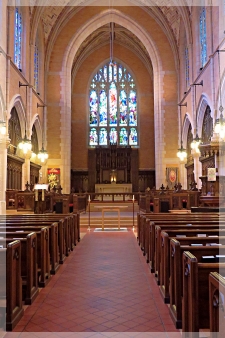
St. Paul's Cathedral - MNSince we both attended liturgical churches as girls, my friend and I were trying to recall the terms for the various parts of a traditional church building. We knew the foyer is called the narthex and the congregation sits the church’s nave. We also knew the altar rail usually separated the nave from the chancel in the front. It’s from the chancel that the service is conducted and where the altar, pulpit, and lectern are located. We even recalled that the sacristy was the room holding Communion supplies and linens. Since we were worshipping in a park that morning, my friend asked the location of our sanctuary. In historic usage, sanctuary and chancel were synonymous but, in modern usage, a sanctuary consists of the entire worship space of a church. With no building, we had no narthex, nave, or chancel but we did have a worship space; our sanctuary was a gazebo in a county park.

As God would have it, my next morning’s reading took me to today’s verse from 1 Corinthians. The Greek word usually translated as “temple” was naós, meaning a sanctuary, a divine dwelling-place, a temple, or place of divine manifestation. In Paul’s day, naós referred to the Temple proper, from the inner courts to the Holy Place with the seven-branched candlestick, golden incense altar, and showbread table all the way to the innermost area called the Holy of Holies—a place so sacred that it could be entered only by the High Priest once a year, on the Day of Atonement.

Having recently written about the lack of respect and reverence now common in a church sanctuary, Paul’s words gave me pause. The Temple and all its utensils—from the Ark, altars, and lamps to the snuffers, basins, oil, incense, and priest’s garments—were considered holy. Dedicated solely to serving God, they were not to be used for common or profane uses. If we are God’s sanctuary, a place of worship and the divine dwelling place of the Holy Spirit, do we treat ourselves with the reverence and respect due God’s temple? Are we solely dedicated to serving God? Are we ever used for vulgar, disrespectful, or profane purposes?

Do we ever desecrate our sanctuary by not treating our bodies properly? Do we treat them with the same care and regard we would Communion wafers, altar linens, or a Baptismal font? God’s sanctuary, however, is more than our physical bodies; it’s our entire being, our hearts and minds. Do we speak, read, look at, find humor in, think about, or do things we wouldn’t if we were in church? Do we always serve as a worship space of our amazing Triune God or just during prayers or worship service? Do we reflect the dignity, sanctity, and holiness that comes with being the house of God?

A great deal of responsibility comes with being God’s dwelling place. Just as the Temple was defiled in 168 BC when Antiochus Epiphanes sacrificed a pig on the altar of incense, our sins defile us. They are like obscene graffiti on a church walls, vandalism of the altar, defacement of the Bible, or leaving excrement on the pews. Preacher Harry Ironside reminds us, “How careful you and I ought to be that we grieve not that blessed One who dwells within, that we do not bring dishonor upon the name of the Savior who has sent His Spirit to live in our body.”

The Jews were so zealous about maintaining the purity of God’s sanctuary that a low fence  separated the court of the Gentiles from the rest of the Temple mount complex. Gentiles and ritually unclean Israelites were forbidden, on pain of death, from passing through its gates to the interior areas—the sanctuary of the Temple. Are we that zealous about keeping His dwelling place within us—His sanctuary—pure and undefiled?

For that matter, our brothers and sisters in Christ also serve as a dwelling place of God. Do we treat them with the same reverence and respect due God’s sanctuary? We should!

Don’t you realize that all of you together are the temple of God and that the Spirit of God lives in you?… All of you together are Christ’s body, and each of you is a part of it. [1 Corinthians 3:16,12:27 (NLT)]

Copyright ©2023 jsjdevotions. All rights reserved.

WHOSE SIDE?

When Joshua was near the town of Jericho, he looked up and saw a man standing in front of him with sword in hand. Joshua went up to him and demanded, “Are you friend or foe?” “Neither one,” he replied. “I am the commander of the Lord’s army.” [Joshua 5:13-14 (NLT)]

spiderwortThe Israelites had just crossed the Jordan River and were preparing to conquer Canaan when Joshua came upon an armed man. Joshua was a stranger in a foreign land and, as Israel’s general, he may have been scrutinizing Jericho’s defenses to determine his plan of attack. I wonder if Joshua brandished his sword (while shaking in his sandals) as he queried, “Friend or foe?” The man, however, was neither ally nor adversary. Identifying himself as the commander-in-chief of the Lord’s army, his loyalty was to neither side. His allegiance was to God and the only side he was on was God’s! God wasn’t on Israel’s side any more than He was on Canaan’s. Israel, however, was on God’s side because their conquest of Jericho was part of His master plan of redemption. It was because they were on God’s side that the fortified city’s walls collapsed.

Jump ahead some 500 years to King Asa of Judah. In 2 Chronicles, we find the people of Judah under attack by an Ethiopian army of tens of thousands equipped with 300 chariots. Asa turned to God for guidance. Rather than ask God to be on their side, he prayed that Judah’s side was God’s and confirmed that it was in God’s name that they fought. In spite of overwhelming odds, Judah’s army was victorious, not because God was on their side but because they were on God’s. Asa then committed his kingdom to seeking God with all their heart and soul.

Unfortunately, twenty-one years later, the King forgot whose side he was on when Israel invaded Judah. Rather than turning to God, he committed himself to an alliance with the pagan Ben-hadad of Aram. Although the alliance at first appeared to be a success, the prophet Hanani rebuked the king for violating his covenant to seek the Lord’s side. Sadly, Asa’s foolhardiness meant that Judah would continue to be at war for generations.

When addressing a joint session of Congress in 1984, President Ronald Reagan noted that America was founded by men who believed God was their rock of safety. The President then added, “We must be cautious in claiming that God is on our side, but I think it’s all right to keep asking if we’re on His side.” 120 years earlier, in the midst of the Civil War, one of Abraham Lincoln’s advisors said he was grateful God was on their side. Lincoln replied, “Sir, my concern is not whether God is on our side; my greatest concern is to be on God’s side, for God is always right.” Being on God’s side should be our concern, as well. Our all-powerful God does not choose sides; there only is one side and it is His.

Whether the dispute or disagreement is religious, political, familial, among neighbors or nations, we tend to get behind one side or another. Before taking sides, drawing lines in the sand, making threats, burning bridges, creating alliances, waging battle, or championing a cause, we must prayerfully determine which side is God’s. In many of our disputes, there’s a fair chance that neither side is God’s! While we may not be sure where God stands on every question, we do know He’s on the side of things like love, peace, forgiveness, truth, mercy, compassion, salvation, justice, healing, generosity, humility, decency, righteousness, and kindness. Let His Spirit and Word be our guide. Remember, it doesn’t matter whose side we’re on, if it isn’t God’s!

They always win who side with God. [Frederick W. Faber]

The Lord will stay with you as long as you stay with him! Whenever you seek him, you will find him. But if you abandon him, he will abandon you. [2 Chronicles 15:2b (NLT)]

Don’t copy the behavior and customs of this world, but let God transform you into a new person by changing the way you think. Then you will learn to know God’s will for you, which is good and pleasing and perfect. [Romans 12:2 (NLT)]

Copyright ©2023 jsjdevotions. All rights reserved.

OUR HEAVENLY FATHER (Father’s Day 2023)

And I will be your Father, and you will be my sons and daughters, says the Lord Almighty. [2 Corinthians 6:18 (NLT)]

See how very much our Father loves us, for he calls us his children, and that is what we are! [1 John 3:1 (NLT)]

I lost my first father the same year I gained my second one. I only had my birth father for twenty years, but I was blessed to have my father-in-law for thirty-seven! Dad J lived his life well—with vigor, enthusiasm, joy, laughter, and a whole lot of love. Compassionate and generous, responsible and helpful, good-humored and resourceful, he was a man of faith and integrity (with a large dose of mischief on the side). The Bible might describe him as a man after God’s heart.

Nineteen years ago, my father-in-law died as the result of a car accident. His severe injuries necessitated him being air-lifted to a distant trauma center and, by the time any family got there, he was gone. Initially, it troubled me that, in his final hours, Dad was alone in a strange place. There was no one to tell him that my mother-in-law (who’d been taken to another hospital) had survived the crash and there were no loved ones to hold his hand or pray with him. Then I realized that Dad was never alone; his Heavenly Father was right there with him, protecting, comforting, and leading him home.

If, at any point in his ninety-six years, Dad had been told that he had only one day left in which to live, I think he would have lived that last day in the same way he lived every other one. He had no regrets, no grudges, no scores to settle, and no debts to repay. There was no one to whom he owed an apology, no amends that had to be made, no deeds left undone, and no loving words left unsaid. He was an example of how life should be lived and an inspiration to us all. In the words of Will Rogers, Jr., “His heritage to his children wasn’t words or possessions, but an unspoken treasure, the treasure of his example as a man and a father.” Indeed, he was as close to an ideal husband and father that any mortal man could be. I enjoy the benefit of his example in my husband and our boys because there’s a beautiful bit of Dad J in them all.

For me, Father’s Day is a day of celebration and thanks because I was blessed by the fathers in my life. Sadly, not every earthly father is worthy of a place in the Dad’s Hall of Fame. While cars and washing machines come with instruction manuals, fatherhood doesn’t. It’s a learn-as-you-go role and even the best fathers make mistakes.

Nevertheless, we must never allow a dysfunctional relationship with our earthly fathers to distort our view of God, our Heavenly Father. Earthly fathers can be untrustworthy and deceitful, but God is faithful and never lies. Earthly fathers might withhold love, but God is love. Earthly fathers can be emotionally or physically absent, but God is every-present. Earthly fathers can be condemning, enraged, and bad-tempered, but God is forgiving, merciful, and patient. Earthly fathers can be brutal and harsh, but God is kind and compassionate. Earthly fathers may play favorites, but God has no favorites! Even the best earthly father is imperfect and temporary, but our heavenly Father is perfect and everlasting.

For those fathers who failed to live up to their roles, may we offer them the same grace and forgiveness our Heavenly Father offers us. Let us leave any bitterness behind and move forward into tomorrow with peace, courage, faith, and humility—confident in the knowledge that we are unconditionally loved by our Father in Heaven!

It is easier for a father to have children than for children to have a real father. [Pope John XXIII]

The Lord is like a father to his children, tender and compassionate to those who fear him. [Psalm 103:13 (NLT)]

God is our merciful Father and the source of all comfort. [2 Corinthians 1:3 (NLT)]

Even if my father and mother abandon me, the Lord will hold me close. [Psalm 27:10 (NLT)]

Copyright ©2023 jsjdevotions. All rights reserved.

CATHOLIC WITH A SMALL “C”

Together, we are his house, built on the foundation of the apostles and the prophets. And the cornerstone is Christ Jesus himself. We are carefully joined together in him, becoming a holy temple for the Lord. [Ephesians 2:20-21 (NLT)]

We believe in…the holy catholic church. [Apostle’s Creed]

dayflowerWhen reciting the creeds as a youngster, I wondered why I said we believed in the catholic church when we didn’t go to one. My family didn’t attend the Church of the Nativity of the Blessed Virgin Mary, our priest was married, and our service was in English, so why did we attest faith in the catholic church? It wasn’t until my confirmation class that I clearly understood that the creeds weren’t referring to the Roman Catholic church. Coming from the Greek katholikos (derived from kath holos, meaning “throughout the whole”), catholic simply means universal! The term originates from the first century and the words of Ignatius of Antioch: “Where Jesus Christ is, there is the catholic church.”

The catholic church wasn’t founded by Peter, James, Paul, Clement, Ignatius, or Polycarp. It wasn’t founded by Augustine, Emperors Constantine or Theodosius, or Patriarch Michael Cerularius nor was it founded by reformers like Martin Luther, John Wesley, John Wycliffe, William Tyndale, or John Calvin. The catholic church was founded by Jesus! The “catholic” in the creeds simply confirms the universality of the entire Christian church—a church that is not confined by ethnicity, race, geography, language, culture, or time. The catholic church shares a common confession of God’s redemptive work in Christ and our necessary response to it.

While we Christ followers may disagree on a number of secondary and minor issues like celibacy for the clergy or the day to worship, we agree about the essentials of faith and are united by the beliefs stated in the Apostles’, Nicene, and Athanasian creeds. It is this unity that transcends our various denominational differences. Our brothers and sisters in Christ may belong to different churches and worship in different ways, but we all are members of the holy catholic church.

Nevertheless, some still mistake catholic with the small “c” for (Roman) Catholic with the capital “C.” To avoid any confusion, some Protestant churches prefer to say “holy Christian church” when reciting the creeds but it’s the same thing. Regardless of the term used, the catholic church is what remains when all the Christian church buildings burn down and the priests and ministers all leave town.

Sadly, however, Christians sometimes forget that we’re in the same family. A friend attended the same church for nearly two decades and, as one of the parish’s “prayer warriors,” she received a weekly list of prayer requests. Within a week of her quietly changing to another Christian church, she stopped getting the list. She contacted her previous pastor and, after pointing out that her love for her brothers and sisters in Christ did not stop when she changed her place of worship, she respectfully asked to keep receiving the prayer list so she could continue offering prayers for their needs and praises for their blessings. Unfortunately, her request fell on deaf ears. Perhaps, just as I did when a child, the pastor confused one’s place and manner of worship with what it means to be part of the catholic church.

Indeed, wherever Christ is, there we find the church. Without a doubt, Jesus tells us to pray and why anybody would arbitrarily decide who is allowed to pray for someone or whose prayers God will hear is beyond me. I’ll gladly welcome any prayer sent on my behalf, regardless of who offers it or where they attend church. If they believe in and worship God the Father, God the Son, and God the Holy Spirit, they are my brothers and sisters and members of my church—the holy catholic church—the body of Christ!

For you are all children of God through faith in Christ Jesus. And all who have been united with Christ in baptism have put on Christ, like putting on new clothes. There is no longer Jew or Gentile, slave or free, male and female. For you are all one in Christ Jesus. And now that you belong to Christ, you are the true children of Abraham. You are his heirs, and God’s promise to Abraham belongs to you. [Galatians 3:26-29 (NLT)]

Copyright ©2023 jsjdevotions. All rights reserved.

WORSHIP AND FUN

Do you see what we’ve got? An unshakable kingdom! And do you see how thankful we must be? Not only thankful, but brimming with worship, deeply reverent before God.  [Hebrews 12:28 (MSG)]

big cypress fox squirrelCan worship be fun? In various translations, Hebrews 12:28 tells us to worship God with reverence and awe, honor and respect, or deep reverence. No where is there any mention of fun. In fact, except for the somewhat cynical and world-weary words directing us to eat, drink, and be merry in Ecclesiastes 8:15 Scripture uses the word “fun” in a negative way—that of “making fun” of someone. Hagar was sent away after she and Ishmael made fun of Isaac, Delilah accused Sampson of making fun of her with his lies, and the fertile Peninnah made fun of Hannah because of her barrenness. So, if, by “fun,” we mean mere amusement (especially at another’s expense), it doesn’t seem that fun and worship go hand in hand. On the other hand, if by “fun” we mean something deeper than light-hearted entertainment or diversion, perhaps it does.

When using fun in its broader definition of enjoyable, pleasurable, and joyful, it appears that worship can and should be all that and more! After all, there are well over 300 instances of joy, joyful, or joyous in Scripture, many of which are associated with worship. 2 Chronicles 30 tell us that the people of Judah enjoyed the seven-day festival of Passover so much that “they celebrated joyfully for another week” and “there was great joy in the city.” Although having fun should never be our primary purpose for worship, we often find that worship gives rise to enjoyment, pleasure, and joy! Indeed, worship can be fun!

Worship, however, is more than an act; it is an attitude not limited to Sunday mornings and church. Since God’s Holy Spirit lives in us, we should live in a way that corresponds to His nature at all times. Colossians 3:23 tells us to work as though we were working for the Lord, perhaps we should play the same way—as if we were playing with the Lord! Just as we worship in our work by serving, witnessing, honoring and glorifying Him as we labor, we should do the same in our leisure time and fun.

But, does the way we relax, play, and spend our free time honor and glorify the Lord? Do we choose our reading material, movies, or TV shows with Him in mind? When socializing with our friends, do our words and actions give evidence of God’s presence in our lives? Do we honor God and His children with our humor or does it consist of mockery, sarcasm, or ridicule? As for sports—does the way we compete and react to the coach’s decisions, the umpire’s call, another player’s error, or our defeat honor God? Do we bring Him to Bible study and choir practice but leave the Lord behind when going to the gym, pickleball court, golf course, yoga studio, bridge table, or book club? Is Jesus invited when we dish with our friends over coffee, watch our child’s baseball game, or relax at the 19th hole with our golf buddies? Do we pack God in our bag when we go on vacation or is He left home with the work clothes and computer? What happens in Vegas may stay in Vegas but whatever happens in Vegas is how we’ve chosen to worship the Lord!

Worshiping God in spirit and in truth means we worship with our entire lives, at all times, and in all places—whether at church, work, or play. Regardless of what we’re doing or where we’re doing it, our words and actions always should bring glory to God. The question really isn’t whether worship can be fun; the question is whether our fun is worship!

So here’s what I want you to do, God helping you: Take your everyday, ordinary life—your sleeping, eating, going-to-work, and walking-around life—and place it before God as an offering. Embracing what God does for you is the best thing you can do for him. Don’t become so well-adjusted to your culture that you fit into it without even thinking. Instead, fix your attention on God. You’ll be changed from the inside out. Readily recognize what he wants from you, and quickly respond to it. Unlike the culture around you, always dragging you down to its level of immaturity, God brings the best out of you, develops well-formed maturity in you. [Romans 12:1-3 (MSG)]

Copyright ©2023 jsjdevotions. All rights reserved.