
But he who enters by the door is the shepherd of the sheep. To him the gatekeeper opens. The sheep hear his voice, and he calls his own sheep by name and leads them out. [John 10:2-3 (ESV)]
 Brent Askari’s play, The Refugees, begins with an unusual premise. Because of a violent civil war in the United States, an upscale American family become refugees in a Middle Eastern country. When the family’s Arab social worker referred to the American refugees as “you people,” the once suburban housewife’s expression spoke volumes. In her previous Connecticut life, anyone who wasn’t white and upper middle class had been “those people” but the tables have turned and the roles reversed. Instead of being the ones with the money and advantages, her family and others like them are “those people:” a minority, seeking asylum in a new country, unfamiliar with the customs, and unable to read, write, or speak the language. Wearing clothes they once would have sent to Goodwill, they need government assistance to survive. Her once high-priced lawyer husband is now a stock boy whose boss takes advantage of his immigrant status. This family and other American refugees are as unwelcome in the unnamed Arab country as are the refugees at our border.
“Those people” is a term frequently used to draw a distinction between people like ourselves and others. Whether that difference is color, nationality, disability, sexual preference, ethnicity, sex, religion, age, politics, or social standing, that phrase usually indicates some kind of bias or discrimination, be it racism, ageism, sexism, anti-Semitism, chauvinism, xenophobia, homophobia, or some other phobia or ism. When saying “those people” or “you people,” the speaker usually is ascribing a particular quality (usually negative) to an entire group. “Those people” and “you people” doesn’t see individual faces and stories; it sees stereotypes and generalizations.
In Jesus’ day, “those people” in Palestine were beggars, lepers, tax collectors, prostitutes, the unclean, Gentiles, and Samaritans. Even Galileans, like Jesus, were “those people” to Judeans! With a reputation as trouble makers, they were disdained because of their mixed ancestry and considered uneducated because of their accent. Being one of “those people,” Jesus knew ethnic prejudice first hand.
For Jesus, however, there were no “those people.” Rather than a Samaritan woman of questionable morals, He saw a woman thirsty for His living water. Rather than a pagan Syrophoenician woman, He saw a loving mother with faith in Him. Rather than a noisy blind beggar or unclean lepers, Jesus heard people begging for God’s mercy and, instead of a collaborating publican, He saw a man desperate enough to climb a tree just to see Him. The Pharisees only saw a sinful woman, but Jesus saw a woman in need of forgiveness who showed her love for Him with her tears. Jesus didn’t see a self-righteous legalistic Pharisee when Nicodemus visited in the dead of night; He saw a man in search of the truth.
In fact, Jesus knowingly sought out “those people.” He deliberately went through Samaria when most Jews avoided it like the plague and He is the one who defied convention and started the conversation with the woman at the well. He’d gone deep into a pagan territory with a long history of opposition to Israel when He encountered the Syrophoenician woman. He openly dined with Matthew, his publican friends, and other sinners and Jesus is the one who invited Himself to dinner at the home of Zacchaeus. The Lord sailed clear across the Sea of Galilee to the Gentile region of the Gadarenes just to heal the demon-possessed! We may not know all the names of those touched by Jesus, but He did! As the Good Shepherd, He knew their names.
There were no “those people” to the Lord—every one of them was one of God’s children. It shouldn’t take becoming one of “you people” to make us understand that “those people” are people just like us—people in need of God’s love.
 It was while Jesus and the disciples were eating the Passover meal that the Lord instituted the Eucharist. The 1st century church followed His lead by celebrating the Eucharist in the context of a communal meal. The wealthier contributed the food and portions were set aside for the sick, poor, and widowed. Nourishing both body and soul while building a sense of community, these fellowship meals were known as agape or love feasts!
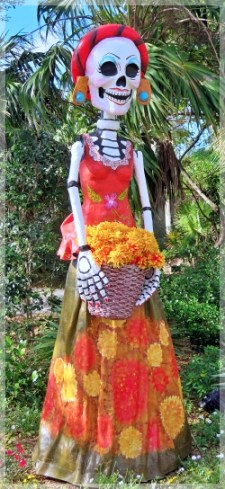 All Saint’s Day for the Western Christian Church is November 1. While Roman Catholic and Orthodox church observances tend to focus on those who’ve been canonized saints, the Protestant church has a different approach to this holy day. Whether living or dead, it regards all Christian believers as “saints” and part of the Communion of Saints we speak of when reciting the Apostles’ Creed. For Protestants, All Saint’s Day is a time to commemorate Christian family members, church members, and friends who have died. At our liturgical church, there will be a solemn reading of the names of all church members who passed during the year. After each name is read, the bell will toll.
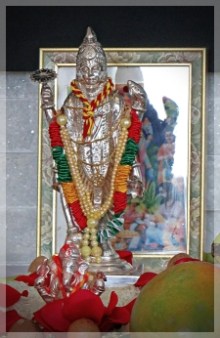 I recently met Esha while walking and we occasionally stop to chat. Although the bindi (mark) on her forehead told me she is a Hindu and the cross I wear told her I am Christian, our different faiths have not prevented us from talking about God and our beliefs. My younger son’s marriage brought many Hindus into our extended family and I try to understand this complicated religion.
 In a classic Peanuts comic (drawn by Charles Schulz), the meek Linus asked his bossy big sister Lucy, “Why are you always so anxious to criticize me?” She answered, “I just think I have a knack for seeing other peoples’ faults.” When Linus queried, “What about your own faults?” Lucy replied, “I have a knack for overlooking them.” Along with her over-sized ego, Lucy has what psychologists call “fundamental attribution error.”
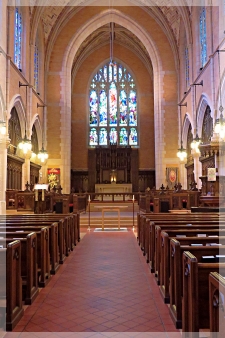 Since we both attended liturgical churches as girls, my friend and I were trying to recall the terms for the various parts of a traditional church building. We knew the foyer is called the narthex and the congregation sits the church’s nave. We also knew the altar rail usually separated the nave from the chancel in the front. It’s from the chancel that the service is conducted and where the altar, pulpit, and lectern are located. We even recalled that the sacristy was the room holding Communion supplies and linens. Since we were worshipping in a park that morning, my friend asked the location of our sanctuary. In historic usage, sanctuary and chancel were synonymous but, in modern usage, a sanctuary consists of the entire worship space of a church. With no building, we had no narthex, nave, or chancel but we did have a worship space; our sanctuary was a gazebo in a county park.
