
 And we know that all that happens to us is working for our good if we love God and are fitting into his plans. [Romans 8:28 (TLB)]
When someone has an unduly optimistic or positive view of things, they are often said to be wearing “rose-colored glasses.” According to Adam Anderson, a University of Toronto professor of psychology, our moods actually affect the way we see things and, as moods change, so does our visual perception. “Good and bad moods literally change the way our visual cortex operates,” says the professor about a 2009 study he conducted. ”In a positive mood,” he explained, “our visual cortex takes in more information, while negative moods result in tunnel vision.” He concluded that the better our mood, the better able our brains are to comprehend what it is our eyes are seeing. In short, we see better when we have a positive outlook and are wearing rose-colored glasses!
I imagine it was a set of rose-colored glasses that allowed young David to see the possibility of defeating the huge Goliath with his sling. In all of Saul’s army, there had to have been other brave men equally skilled with a sling. Because of their despair and pessimism, however, they never saw what was right in front of them—an enormous man, encumbered by a coat of mail weighing 125 pounds, wearing heavy bronze leg armor, and carrying a javelin, spear and sword. Instead of seeing a man so weighed down that he needed another man to carry his shield, they saw an undefeatable opponent. David, however, saw someone who wouldn’t be able to move fast enough to dodge a well-aimed stone. That stone wasn’t from a child’s toy sling-shot; it came from a shepherd’s weapon used to kill wild animals. According to Malcom Gladwell, that sling had the stopping power of a .45 caliber handgun. With their defeatist attitude, Saul and his army only saw the power of the enemy. David’s optimism allowed him to clearly see both the enemy’s weakness and his own strength and skill!
Like Saul and his army, when the disciples found themselves in the midst of a storm, the fearful men had tunnel vision. They only saw danger and impending death. If they’d put on some rose-colored glasses, they would have seen the one who can calm storms sleeping in their boat! Rose-colored glasses can help us see what is right in front of us. A positive attitude is what helps us notice any weakness in the opposition, find detours in life’s roadblocks, identify solutions to our problems, and spot help when we need it.
We actually can purchase rose-colored glasses but, unless they have corrective lenses, they’ll not improve our eyesight. Faith in God, however, is what offers us the kind of rose-colored glasses that give clarity to life and allow us to see the big picture. It is knowing Jesus that enables us to face each morning with optimism, joy and hope. It is the power of the Holy Spirit that allows us to see our challenges as opportunities to do God’s will. So, put on your rose-colored glasses and see what wonderful things the day will bring!
 In the Sunday school stories we learned as children, the Bible’s heroes were larger than life. When we read about them as adults, however, we read the parts skipped in Sunday school and realize they were real people with feet of clay. Yet, it’s their sins and weaknesses that make their lives as relevant today as they were centuries ago. No matter how great, all except Jesus were flawed. Peter denied knowing Jesus, Matthew was a dishonest tax collector, Thomas doubted Jesus’ resurrection, Noah and Lot got drunk, Abraham lied to protect himself, David was an adulterer and murderer, Rahab was a prostitute, Jacob deceived his father, Jonah refused and fled, Sarah doubted and grew impatient, Samson allowed lust to lead him, Paul persecuted Christians, Elijah got so depressed he wanted to die, Gideon dared to question God, and, in spite of his great wisdom, Solomon disobeyed Him. The disciples argued amongst themselves and deserted Jesus, Isaac played favorites with his sons, and both Eli and Samuel tolerated the shameful behavior of their boys. Nevertheless, flawed as they all were, there is much to learn from their stories. We see the possibility of transformation and redemption. The prostitute was instrumental in an Israelite victory and became one of Jesus’ ancestors. The corrupt taxman became a disciple and turned his record keeping skills into gospel writing. The Pharisee became Christ’s messenger throughout the Roman Empire and the fisherman who denied Christ became the leader of the disciples. In spite of their faults, all of them were saints of God.
 These people are false apostles. They are deceitful workers who disguise themselves as apostles of Christ. But I am not surprised! Even Satan disguises himself as an angel of light. So it is no wonder that his servants also disguise themselves as servants of righteousness. In the end they will get the punishment their wicked deeds deserve. [2 Corinthians 11:13-15 (NLT)]
 Most of us think of sloth as laziness: a dislike of work or any physical exertion. Having watched the local zoo’s sloth in action (or, rather, inaction), I think the sluggish animal is appropriately named. Spiritual sloth, however, is far different than being a couch potato. Originally, the sin of sloth was two sins: sadness and acedia. Compiled by Evagrius of Ponticus, a 4th century monk, these two “capitals sins” were part of a list of eight he believed to the greatest threats to devout monasticism.
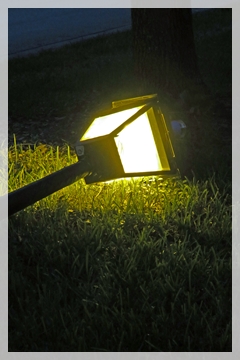 To avoid the southwest Florida heat, I waited until dusk to take my walk. Thanks to Hurricane Irma, most of the street lamps in my neighborhood don’t work. For a light to function, electrical energy has to be converted into light energy and both a source of electricity and a working connection are needed. For many of the lights, the connection was broken when blowing debris shattered their bulbs. For others, Irma’s 150 mph winds broke the connection when it blew off their tops, wrapped their poles around trees, or knocked them to the ground. Without a connection to their source of power, those street lights are useless—they’re just a tangle of wires and a pile of glass, plastic and metal. Even though they don’t work, people have been cautioned to remember that their exposed wires are live. It’s not the electricity that is missing; it’s the connection that is inoperative. Two poles, however, were down but not out. Even though they’d been flattened by the storm, neither wires nor bulb had broken. In spite of the storm’s violence, they remained connected and were beacons in the night’s darkness.
 Yesterday I mentioned getting an email with the subject, “How firm is your foundation?” Although it was an advertisement for a new study Bible connecting Biblical teachings to Christian beliefs, that very question has been the topic of discussion in our northern church for the last few weeks. The parish is doing a church-wide study of Martin Luther’s Small Catechism. Back in the 1500s, Martin Luther was appalled at the lack of knowledge of both pastors and their congregations. Not especially tactful, he accused some pastors of being “lazy bellies and presumptuous saints!” His words for their congregations, “simple cattle and mindless pigs!” were no more diplomatic. People who called themselves Christians had no idea what that meant. They didn’t know the Ten Commandments, the Apostle’s Creed or even the Lord’s Prayer, let alone anything else in the Bible. Last week, our Pastor asked us what Luther might say if he visited today’s churches. We agreed that his words for our pastors would be more complimentary but that his words for their congregations might be the same or worse!
 Devotions of the Heart