THE EMPTY TOMB

You are looking for Jesus of Nazareth, who was crucified. He isn’t here! He is risen from the dead! [Mark 16:6 (NLT)]
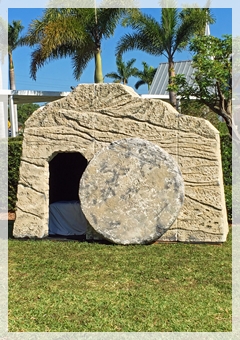
empty tomb - north naples churchYesterday I mentioned the wooden cross and rustic nail on my desk that serve as reminders of the terrible price Jesus paid for our salvation. Although early Christian symbols included a dove, ship, lyre, anchor, and fish, the cross has become the universal symbol for Christianity. While Coca-Cola’s logo, Nike’s swish and McDonald’s golden arches may come close, I doubt there is any so recognizable sign in the world. Nevertheless, a gruesome instrument of Roman torture seems an odd symbol for a faith that preaches such things as reconciliation, sacrifice, forgiveness, hope, love, and peace. While I’d never wear a miniature gallows, guillotine, or electric chair on a chain around my neck, I do wear a cross. Although it symbolizes everything that happened to Jesus on that dark Friday two thousand years ago, the cross would be meaningless if the tomb had not been empty Sunday morning.

As we walked out of worship service on Easter morning, we came upon a large replica of a stone tomb. The boulder that had covered its opening since Friday was rolled away and it was empty except for some linen cloth resting on a ledge. Like the women who came early that first Easter morning (and Peter and John who arrived later), a few curious children entered the tomb. No angel was there to reassure them, but they didn’t need one. They’d come from Sunday school and know the Easter story well. At worship services, they’ve joined their parents in saying: “Christ has died; Christ is risen; Christ will come again.” Rather than frighten them, that dark empty tomb reassured them of Jesus’s continual presence in their lives.

Jesus’s death upon the cross is important but it is His rising from the dead that demonstrates triumph over evil, sin, hate, and death. It is the empty tomb that allows us to say these words in the Apostle’s Creed: “I believe in Jesus Christ…[who] was crucified, died and was buried; he descended to the dead. On the third day he rose again… I believe in…the resurrection of the body and the life everlasting.”

Out of curiosity, I searched the stock of several Christian supply stores using the word “tomb.” There were plenty of books, choral collections, CDs, and songs with “tomb” in the title, some Easter stickers depicting an empty tomb, and even a “Raiders of the Empty Tomb” kit, but there were no empty tomb t-shirts, paper weights, jewelry, or wall décor. Apparently, there is no danger of an empty tomb replacing the cross as the universal symbol of Christianity. Nevertheless, when we see a cross, let us never forget that the story of God’s love for us did not end at Golgotha. It didn’t even end with the empty tomb three days later. The story of God’s presence, grace and love continues today.

Christians do not believe in the empty tomb, but in the living Christ. [Karl Barth]
So you see, just as death came into the world through a man, now the resurrection from the dead has begun through another man. Just as everyone dies because we all belong to Adam, everyone who belongs to Christ will be given new life. But there is an order to this resurrection: Christ was raised as the first of the harvest; then all who belong to Christ will be raised when he comes back. [1 Corinthians 15:21-23 (NLT)]

Copyright ©2018 jsjdevotions. All rights reserved.

GONE IN A FLASH – EASTER MONDAY

And just as each person is destined to die once and after that comes judgment, so also Christ was offered once for all time as a sacrifice to take away the sins of many people. He will come again, not to deal with our sins, but to bring salvation to all who are eagerly waiting for him. [Hebrews 9:27-28 (NLT)]

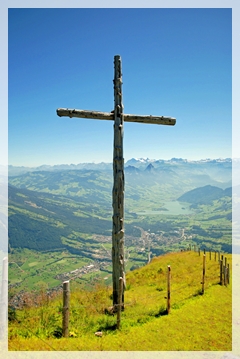
Zermatt - Switzerland - crossAfter warning us not to put them in our pockets and accidentally take them home (or put them in the dryer if we did), small pieces of paper were given to everyone in attendance at last week’s Good Friday service. Following the sermon, we were asked to write a sin (or sins) for which we repent on the papers, come forward, and nail them to a cross resting on the steps before the altar. Listening to the hammering echoing in the sanctuary, I thought of what it must have sounded like two thousand years ago when Jesus and the others were hammered to their crosses: the loud pounding of the hammers, the commotion of the crowd, the mockery of the soldiers, and the cries of agony from the men as those blunt tipped nails pierced their bodies.

Those slips of paper were made of nitrocellulose; often used by magicians, they are commonly known as flash papers. Once we’d nailed our papers to the cross, the pastor ignited them and they instantly disappeared in a brilliant display of fire. Nothing, neither smoke nor ash, was left of them. What a powerful illustration of the way Jesus’s blood, shed on the cross as those nails were hammered into Him, made our sins disappear forever.

Next to the small olive wood cross on my desk, I now have a three-inch square-cut nail, a souvenir from Good Friday’s service. The cross, with its distinctive grain, artistic shape, and smooth finish, is so beautiful that it’s easy to forget it represents an instrument of torture. The dark rustic nail beside it will better remind me of the sacrifice Jesus made for all of us. Paying the price for our sins, His death brought us back into fellowship with God the Father. After the joy of Resurrection Sunday, however, it’s easy to forget the magnitude of that sacrifice until Lent rolls around next year. Let us never forget the miracle of forgiveness that occurred when a suffering bleeding and totally sinless Jesus endured torture and death for the forgiveness of our sins.

He has redeemed me, a lost and condemned human being. He has purchased and freed me from all sins, from death, and from the power of the devil, not with gold or silver but with his holy, precious blood and with his innocent suffering and death. [Martin Luther]

Christ suffered for our sins once for all time. He never sinned, but he died for sinners to bring you safely home to God. He suffered physical death, but he was raised to life in the Spirit. [1 Peter 3:18 (NLT)]

Now all of us can come to the Father through the same Holy Spirit because of what Christ has done for us. [Ephesians 2:18 (NLT)]

Copyright ©2018 jsjdevotions. All rights reserved.

FAITHFUL FRIENDS

Then they lowered the man on his mat, right down in front of Jesus. Seeing their faith, Jesus said to the paralyzed man, “My child, your sins are forgiven.” … “Stand up, pick up your mat, and go home!” [Mark 2:4b-5,11 (NLT)]

monarch butterfly - cannaJesus had returned to Capernaum and the word was out—the rabbi from Nazareth could heal. People were flocking to Him and the crowd followed Jesus right into the house where he was staying. Four friends of a paralyzed man carried him to see Jesus but the house was so full they couldn’t get through the door. Determined to get to Jesus, they carried the paralyzed man up the outside stairs to the rooftop and started to dig through the thatch. Picture the scene. The room is jam-packed when a disturbance is heard overhead. Dried mud and straw start to fall into the room, a head peaks through, more straw and dirt come spilling through the opening, a mat is dropped, and then four men lower their paralyzed friend down to the ground right at the feet of Jesus.

Rather than heal the man, however, Jesus forgave his sins. Then again, Jesus always put first things first; even more important than health is the forgiveness of sin! Scandalized, the scribes thought His words blasphemy since only God can forgive sins. To prove His authority to forgive, Jesus then healed the paralytic. While the forgiveness of the man’s sins couldn’t be demonstrated, the scribes couldn’t refute the validity of his healing when the once paralyzed man jumped up, grabbed his pallet, and walked. Imagine the gasps of the astonished people as he worked his way through the crowded room to the door.

This story tells us we must be stretcher bearers. When our friends are weak, we should bring them to God as did those four men when they placed the paralytic at Jesus’s feet. We often think that Jesus healed the man because of his faith. Look more carefully at the words; Jesus healed the man because of the faith of his friends! They were so sure that Jesus could heal him that nothing discouraged or stopped them. Like them, nothing should stop us from carrying our friends (or even people we don’t know) to God in prayer. Yet, how often do we offer to pray for someone and pray just once, haphazardly, or not at all? Our faithful prayers can make a difference!

For the last several months, I’ve been praying for a toddler with metastasized cancer. Hundreds of us, many of whom don’t even know her (including fifty from my Tuesday Bible study), have joined in bearing her stretcher and placing it at Jesus’s feet. What looked absolutely hopeless in October looks hopeful today; her scans are good and she’s begun physical therapy. Knowing she still has to face a transplant, radiation, and immunotherapy, her stretcher bearers will continue to carry her until the day she lifts up her pallet and goes home—which brings me to another lesson from this story. It is God, and God alone, who has the authority both to forgive our sins and to answer our prayers. No matter how deep our faith, not everyone whose stretcher we bear will be healed. Some may pick up their pallet and go home to their family but others will pick up their pallet and go home to God. Nevertheless, let us never forget that before Jesus healed, He forgave; while health is not guaranteed, forgiveness is. Thank you, God, for your saving grace!

Rejoice in our confident hope. Be patient in trouble, and keep on praying. When God’s people are in need, be ready to help them. [Romans 12:12-13a (NLT)]

Copyright ©2018 jsjdevotions. All rights reserved.

TAKING THE LONG WAY

Tent Rocks - NMDon’t be afraid, I’ve redeemed you. I’ve called your name. You’re mine. When you’re in over your head, I’ll be there with you. When you’re in rough waters, you will not go down. When you’re between a rock and a hard place, it won’t be a dead end—Because I am God, your personal God, The Holy of Israel, your Savior. [Isaiah 43:2-3a (MSG)]

When visiting New Mexico, we often drive from Albuquerque to Santa Fe. The shortest route is north on I-25. If we’re not in a rush, however, the best way is the longer Turquoise Trail, a national scenic byway on the east side of the Sandia Mountains. In theory, this route should only add about a half-hour to the trip but it always takes longer. The whole point of going that way is to enjoy some breath-taking scenery, take a hike in the high desert hills, check out one of the bizarre roadside attractions (like the Tinkertown Museum), visit various art galleries along the trail, and stop for lunch (and more shopping) in the reborn ghost town of Madrid. Sometimes the journey is as important as the destination.

When the Israelites escaped from Pharaoh, God didn’t lead them the shortest way to the Promised Land; His reasoning, however, had nothing to do with sightseeing or shopping. The most direct route would have taken them northeast along a coastal road and directly into Philistine territory. Instead, God led them south southwest into the desert on the eastern edge of Egypt. Although they were armed for battle, the Israelites were anything but ready to face a military conflict. Having been oppressed for generations, rather than a mighty nation, they were a ragtag band of former slaves. While the longer route made sense, God’s next instructions certainly didn’t! He told Moses that Pharaoh’s men would give chase but that the Israelites should turn back and camp in such a way that they were exposed and trapped against the sea. Although God promised this strange tactic would demonstrate his power and glory, I can’t help but think that Moses was shaking in his sandals when reassuring the people that God had everything under control.

If the Israelites weren’t ready to face the Philistines a few days earlier, they were no more ready to face Pharaoh’s mighty army then. In fact, from a logistical point of view, by turning back, the novice warriors moved into an utterly indefensible position. That, of course, is exactly why God arranged it. Whether facing Philistines or Egyptians, the Israelites’ reaction to either would be panic. With the Philistines, they could have fled, even if that meant returning to Egypt. With Pharaoh’s army, however, they had no escape route. Although their sarcastic complaints to Moses revealed their lack of faith, pinned against the sea as they were, they had no choice but to trust in God. Since we know the rest of the story, that trust was well-founded. The people of Israel walked through the Red Sea on dry ground and Pharaoh’s army perished in its waters. After experiencing God’s miraculous deliverance, the Israelites no longer feared Pharaoh. They did, however, fear, trust, and believe in the Lord!

Sometimes God takes us the long way around for a reason; while it may be for the scenery, there’s a good chance it’s to take us away from trouble. On the other hand, sometimes God takes us on detours that seem to make absolutely no sense because they lead us into trials and difficulty. That usually happens when there’s something we need to learn. When we find ourselves between an army and the sea or a rock and a hard place, there’s no need to panic. We just need to trust in the Lord.

And Israel looked at the Egyptian dead, washed up on the shore of the sea, and realized the tremendous power that God brought against the Egyptians. The people were in reverent awe before God and trusted in God and his servant Moses. [Exodus 14:30-31 (MSG)]

Copyright ©2018 jsjdevotions. All rights reserved.

DEMI-GLACE

If you openly declare that Jesus is Lord and believe in your heart that God raised him from the dead, you will be saved. For it is by believing in your heart that you are made right with God, and it is by openly declaring your faith that you are saved. [Romans 10:9-10 (NLT)]

mourning doveOn the days his restaurant is closed, a French chef friend works in his kitchen to make gallons of demi-glace. Hundreds of pounds of veal bones get roasted along with carrots, celery and onions. After deglazing the roasting pans with wine, he adds tomato paste, seasonings and water and simmers the concoction. At some point, he strains out the solids and continues simmering (and straining) the hot broth. More than twenty-four hours later, his stock has a rich brown color and a gelatinous consistency. After all of that simmering, less than one gallon of thick sauce remains for every ten gallons of liquid he added. Chef packages and sells this richly concentrated sauce to other restaurants that use it as the “mother sauce” or backbone of their own sauces.

I thought of my chef friend’s sauce reduction when reading about the Apostle’s Creed. The author compared our Christian creeds to a demi-glace: a creed is to the Bible as a demi-glace is to meat broth. In our creeds, the message of the Bible is reduced to a few precise and succinct paragraphs just as the meat broth is reduced to an intensely flavored thick liquid in a demi-glace. The odd bits have been strained out and all that remains is a clear concentrate. A Christian creed, however, still needs Scripture for a full spiritual meal and a demi-glace doesn’t make a meal without meat and potatoes. Nevertheless, both a creed and demi-glace condense the essence of their sources into something easy to understand and use.

As a matter of preference, some chefs use beef or chicken instead of veal or add bacon fat, but it’s still a demi-glace. I’m a vegetarian and wouldn’t use veal (or any other animal) bones. Although I could make a broth using only vegetables, reduce it by 90%, and make a thick sauce, without any meat, it wouldn’t be a demi-glace. In the same way that meat is required for a true demi-glace, certain ingredients are required for one’s beliefs to be called Christianity. For example, it’s not Christianity without the belief that Jesus was both true God and truly human or that He died and rose again. As Christians, we have unity in our creeds’ essential beliefs. Like those chefs who prefer beef bones or add bacon, Christians have liberty in non-essential beliefs such as the day we worship, the meaning of predestination or the use of alcohol.

Before graduating from Le Cordon Bleu or the Culinary Institute of America, a student chef must know the essentials of a good demi-glace. Fortunately, there are no entrance exams or finals in our churches (nor should there be). Nevertheless, when we no longer reside in this world, there just might be an entrance exam in the next. We’d better know and believe the essentials when that time arrives.

In essentials unity, in non-essentials liberty, in all things charity. [Rupertus Meldenius]

Make every effort to keep yourselves united in the Spirit, binding yourselves together with peace. For there is one body and one Spirit, just as you have been called to one glorious hope for the future. There is one Lord, one faith, one baptism, one God and Father of all, who is over all, in all, and living through all. [Ephesians 4:3-6 (NLT)]

Therefore, let us offer through Jesus a continual sacrifice of praise to God, proclaiming our allegiance to his name. [Hebrews 13:15 (NLT)]

Copyright ©2018 jsjdevotions. All rights reserved.

SEALING THE DEAL

A few days later Felix came back with his wife, Drusilla, who was Jewish. Sending for Paul, they listened as he told them about faith in Christ Jesus. As he reasoned with them about righteousness and self-control and the coming day of judgment, Felix became frightened. “Go away for now,” he replied. “When it is more convenient, I’ll call for you again.” [Acts 13:50-51 (NLT)]

Steamboat ski areaWhile under arrest in Caesarea, the Apostle Paul spent two years sharing Jesus with Felix, the governor. Nevertheless, after two years of testifying about salvation through Christ, Paul couldn’t seal the deal and Felix never came to believe. I’m reminded of a charming salesman who worked for a friend of ours. Although he diligently went out and made sales calls, no matter how many times he called on a potential client, he couldn’t close a deal! Eventually, as nice as he was, he had to be let go. After all, salesmen are expected to make the sale. Fortunately, God doesn’t work that way; if He did, the Apostle Paul might have been out of a job after failing to seal the deal with Felix!

Like Paul, we can repeatedly share our testimony with someone—we can teach Sunday school, invite people to church, talk about Jesus to everyone we meet, and even write Christian devotions. Nevertheless, we might never close the deal and hear someone say, “I’m accepting Jesus Christ as my Lord and Savior.” That, however, does not mean we have failed.

In my son’s first job out of college, he worked with a team of engineers selling cogeneration technology. Prior to his employment, the engineers from his company would meet with a potential customer to show them the benefits of their technology but they just couldn’t close a deal. It was not until my son joined the team that they made a sale. Rather than engineering, my son’s specialty was finance. The people making the final decision about purchase weren’t the engineers—they were the financial officers. Engineers talked combustion, turbines, power ratings and reciprocating engines which meant nothing to them but my son talked their language: percentages, return on investment and profits. Although my son closed the deal with his talk of financial advantages, he couldn’t have done it without the engineers who laid the groundwork by explaining the process.

Evangelism, like sales, is often a team effort; we may not be the ones who close the deal but we all must do our part to make the sale! While some may hear the message and respond immediately, committing to Jesus is a gradual process for many others. If we think we have to seal the deal every time we have a Jesus conversation, we’re going to be very disappointed Christians. That, however, doesn’t mean we stop having those conversations. Whether we’re just laying the ground work, explaining the process, or extolling the advantages, we may never know if our words have moved someone just a little closer to accepting Christ.  It may be someone else’s job to seal the deal; our job is just to keep sharing God’s Word!

For “Everyone who calls on the name of the Lord will be saved.” But how can they call on him to save them unless they believe in him? And how can they believe in him if they have never heard about him? And how can they hear about him unless someone tells them? [Romans 10:13-14 (NLT)]

Copyright ©2018 jsjdevotions. All rights reserved.