
You are God’s building. Because of God’s grace to me, I have laid the foundation like an expert builder. Now others are building on it. But whoever is building on this foundation must be very careful. For no one can lay any foundation other than the one we already have—Jesus Christ. [1 Corinthians 15: 9b-11 (NLT)]
 Two members of our small group attended Easter service at a Christian church in another town. Imagine their shock when the pastor began his sermon by saying he didn’t believe in the resurrection. Thinking his statement had been made for shock value, they patiently waited for him to make a case for Christ and defend the truth of Easter. Unfortunately, he only offered a feel good message about new beginnings. I was reminded of their story when another pastor mentioned his experience when a youth pastor. After one of the teens complained that he talked too much about Jesus, he was called into the senior pastor’s office and told that Jesus just should be a “side dish” in the church youth group!
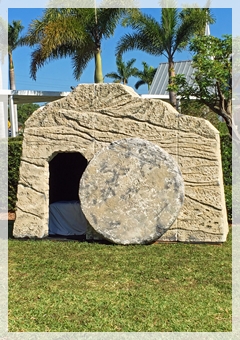
As for the resurrection—can it be Christianity without the risen Christ? Without Easter, we just have a man who said some beautiful and wise things and was killed for his words. While He may have had a great message, he was either delusional or a liar. In the early church, an Apostle was someone who had personally known Jesus both before that dark Friday and after that glorious Sunday. Without the resurrection, Peter and the rest of the Apostles were equally delusional or liars who perpetrated a fraud with their claims of an empty tomb and their witness to the risen Christ. Without the resurrected Christ, everything that happened after the crucifixion and much of what happened before is suspect. When we read Acts, we find that the essence of every sermon preached is the resurrected Christ. Without the resurrection, how can we believe Jesus was God in flesh? Without the risen Christ how can we believe in the Holy Trinity, the resurrection of the dead, or the truth of the New Testament?
There are plenty of authors who make excellent cases for the resurrection and I’ll leave the Christian apologetics to them. Believing in the resurrection doesn’t mean we totally understand it, can explain how it happened, or know exactly what the body of the risen Christ was like but we don’t need those answers to believe in the risen Christ. Jesus is the cornerstone of Christianity and, if Jesus is still dead, so is our religion
As for a “side dish Jesus:” side dishes are optional and you can take as much or as little as you want or skip them altogether. They’re like the Brussels sprouts or green beans at Thanksgiving dinner. Jesus, however, is not a side dish; along with God the Father and the Holy Spirit, He’s the main (and only) course! Rather than a turkey, our Triune God is more like one of those Turduckens: three meats (turkey, duck, and chicken) rolled into one. When you slice through it, you get all three—each one equally delicious and equally essential. If we are going to call ourselves Christians, it seems that both the resurrection and Jesus are fundamental to our faith.
I don’t know about that doubting pastor from Easter but I do know a little about that teen who thought there was too much Jesus in her youth group. Her youth pastor refused to back down and, rather than put Jesus in a side dish, He kept the risen Christ front and center. The teen who objected to the main dish Jesus? Shortly after that meeting, she accepted Jesus—not as an optional add-on but as her Lord and Savior!
Scripture often referred to Jesus as the cornerstone: the foundation upon which the church is built. The cornerstone of a building gives it a reliable and firm foundation; it is indispensable and prominent. May the risen Christ remain indispensable and prominent in our witness as we build His church!
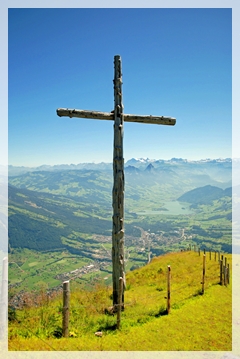
 Yesterday I mentioned the wooden cross and rustic nail on my desk that serve as reminders of the terrible price Jesus paid for our salvation. Although early Christian symbols included a dove, ship, lyre, anchor, and fish, the cross has become the universal symbol for Christianity. While Coca-Cola’s logo, Nike’s swish and McDonald’s golden arches may come close, I doubt there is any so recognizable sign in the world. Nevertheless, a gruesome instrument of Roman torture seems an odd symbol for a faith that preaches such things as reconciliation, sacrifice, forgiveness, hope, love, and peace. While I’d never wear a miniature gallows, guillotine, or electric chair on a chain around my neck, I do wear a cross. Although it symbolizes everything that happened to Jesus on that dark Friday two thousand years ago, the cross would be meaningless if the tomb had not been empty Sunday morning.
 After warning us not to put them in our pockets and accidentally take them home (or put them in the dryer if we did), small pieces of paper were given to everyone in attendance at last week’s Good Friday service. Following the sermon, we were asked to write a sin (or sins) for which we repent on the papers, come forward, and nail them to a cross resting on the steps before the altar. Listening to the hammering echoing in the sanctuary, I thought of what it must have sounded like two thousand years ago when Jesus and the others were hammered to their crosses: the loud pounding of the hammers, the commotion of the crowd, the mockery of the soldiers, and the cries of agony from the men as those blunt tipped nails pierced their bodies.
 Jesus had returned to Capernaum and the word was out—the rabbi from Nazareth could heal. People were flocking to Him and the crowd followed Jesus right into the house where he was staying. Four friends of a paralyzed man carried him to see Jesus but the house was so full they couldn’t get through the door. Determined to get to Jesus, they carried the paralyzed man up the outside stairs to the rooftop and started to dig through the thatch. Picture the scene. The room is jam-packed when a disturbance is heard overhead. Dried mud and straw start to fall into the room, a head peaks through, more straw and dirt come spilling through the opening, a mat is dropped, and then four men lower their paralyzed friend down to the ground right at the feet of Jesus.
 Don’t be afraid, I’ve redeemed you. I’ve called your name. You’re mine. When you’re in over your head, I’ll be there with you. When you’re in rough waters, you will not go down. When you’re between a rock and a hard place, it won’t be a dead end—Because I am God, your personal God, The Holy of Israel, your Savior. [Isaiah 43:2-3a (MSG)]
 On the days his restaurant is closed, a French chef friend works in his kitchen to make gallons of demi-glace. Hundreds of pounds of veal bones get roasted along with carrots, celery and onions. After deglazing the roasting pans with wine, he adds tomato paste, seasonings and water and simmers the concoction. At some point, he strains out the solids and continues simmering (and straining) the hot broth. More than twenty-four hours later, his stock has a rich brown color and a gelatinous consistency. After all of that simmering, less than one gallon of thick sauce remains for every ten gallons of liquid he added. Chef packages and sells this richly concentrated sauce to other restaurants that use it as the “mother sauce” or backbone of their own sauces.
