Be generous: Invest in acts of charity. Charity yields high returns. Don’t hoard your goods; spread them around. Be a blessing to others. This could be your last night. [Ecclesiastes 11:1-2 (MSG)]
 The following is a holiday pass-along story that has made the rounds on the Internet. Years ago, little Jimmy was shocked when his big sister told him there was no Santa. He tearfully went to his grandmother and asked her. Assuring Jimmy that Santa existed and she’d prove it to him, Grandma took him to the local department store. Instead of seeing the store Santa, as Jimmy expected they would, his grandmother gave him $10 and told him to use it to purchase a present for someone who needed one. Alone in the store, the boy pondered who should get a gift and finally decided on Robby, a boy in his classroom. Robby never went out at recess; although he said it was because he wanted to study, everyone knew it was because he didn’t have a warm coat. Jimmy found a brown wool coat, took it to the clerk and asked the price. After telling her he hoped he could afford it since it was a gift for a boy at school who didn’t have a coat, the clerk questioned how much he had. Proudly showing her his ten dollar bill, she told him that was the exactly what the coat cost and bagged it up for him.
Once home, Jimmy’s Grandma removed the price tag, tucked it into her Bible, and helped him box and wrap the coat. That evening the two of them went to Robby’s house. After placing the festively wrapped gift at his front door, they rang the bell and hid behind the bushes. The joy they felt when Robby answered the door and picked up the box convinced Jimmy that Santa did, indeed, exist and that he and his grandmother were on Santa’s team. That little boy is now a grown man and Grandma is gone. When she passed, Jimmy was given her Bible. It was when he found the coat’s $19.95 price tag between its pages that Jimmy realized there had been three on Santa’s team that day.
I remembered that holiday story last month when our church provided fifty-four Christmas shoeboxes for Samaritan’s Purse. Packed with toys, school supplies, books, clothing, hygiene items, and games, these boxes will bless children in over 100 countries around the world. My husband and I were on Santa’s team while roaming through stores picking out things that a nine-year-old boy and a fourteen-year-old girl would like to find in their boxes, when trying to fit everything into the shoe-box size green plastic boxes, when writing short notes to include with the gifts, and when hearing one woman share her experience of being on a mission trip and meeting Christmas box recipients who told her of the great impact those boxes had on their lives and faith.
As you do your Christmas shopping for family and friends in the coming weeks, why not think about getting on Santa’s team and purchasing some items for those less fortunate. In His parable, Jesus told us that He identifies with those in need—the hungry, thirsty, homeless, impoverished, sick and imprisoned—and when we do something for them, we are doing it for Him. On someone’s birthday, it’s traditional to give him a gift so, when we purchase Christmas gifts for the poor and needy, we’re really buying birthday gifts for Jesus!
 In writing about the Sinner’s Prayer yesterday, I wondered if, by saying it, a new believer gets the false impression that his responsibility ends with a prayer when, in fact, it has just begun! Justification takes only a moment but sanctification takes a lifetime. Addressing the guilt of our sins, justification is when, by the grace of God, we are made righteous through God’s grace and our faith. It’s as if we’re guilty criminals, standing in God’s courtroom, and God pardons us. Telling us our debt to society has been paid, He sets us free. While it’s easy to walk out of the courthouse, it’s not so easy to alter the behavior that led to our life of crime. Like any felon, we need to change our ways, which is where sanctification comes in. Rather than the reformation of a criminal, it is the transformation of a sinner.
 I’ve been reading The Pilgrim’s Progress by John Bunyan. I vaguely remember reading some of this 1678 allegory in senior English class but that time it was in the original Middle English (the language of the King James Bible) and difficult to read. Although I thought myself a Christian, I was unfamiliar with most of the biblical references and concepts. In reality, all I wanted to do was to get through it (along with Beowulf, Canterbury Tales, and Ulysses). With less pressure, more biblical knowledge, and an annotated modern version, I’m actually enjoying the tale of Christian: a man who leaves his home in the City of Destruction in search of the Celestial City.
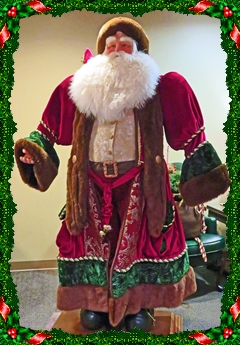 Everyone loves Christmas—in fact, in our extended family it is our Hindu relatives who seem to make the most of this holiday with copious gifts, family get-togethers, peppermint bark, visits to and from Santa, cards, lights festooned around the yard, a beautifully decorated tree, wreaths, candles, and holiday attire. While driving through a nearby neighborhood famed for its decorations, I couldn’t help but wonder what sleighs, Rudolph, reindeer, trains, inflatable snowmen, igloos, teddy bears, toy soldiers, Disney characters, candy cane arches, icicle lights, meteor shower light shows and blow mold Snoopys and Grinches have to do with Jesus. Yes, there were a few blow mold nativities but even they were surrounded by gingerbread men and polar bears.
 Knowing it was important for both the leaders and the people to be reminded of their rights and duties, Moses instructed the people that every seven years the Book of the Law was to be publicly read to the entire nation (including children and foreigners). This reading was to be done following the Feast of Shelters during the Sabbath year.