
One day when the crowds were being baptized, Jesus himself was baptized. As he was praying, the heavens opened, and the Holy Spirit, in bodily form, descended on him like a dove. And a voice from heaven said, “You are my dearly loved Son, and you bring me great joy.” [Luke 3:21-22 (NLT)]
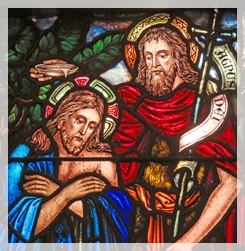 Although I don’t remember my Baptism as an infant, I do have a picture that tells me I wore a long white dress and a bonnet. Another picture tells me that I wore a shorter white dress, a hat instead of a bonnet and my first pair of nylon stockings and heels at my Confirmation thirteen years later. That, however, is about all I remember of making a public reaffirmation of my faith and recommitting to the baptismal promises made for me when I was a baby. Although I knew a lot about Jesus at the time, I’m not sure that I truly knew Him. I know Him now and, in a much simpler ceremony, I recently reaffirmed my Baptism in a way I will never forget.
The first Sunday after Epiphany is when many churches celebrate the Baptism of our Lord which is the case at one of the churches we attend. The hymns (When Jesus Came to Jordan, O Come and Dwell in Me, and On the Wings of a Snow White Dove) set the stage. The readings from Isaiah, Acts, and Luke kept our focus on Baptism and the pastor’s sermon continued the theme as she told of her visit to the Holy Land, standing where John may have baptized Jesus, and collecting water from the Jordan River. After the sermon, she offered us the opportunity to reaffirm our Baptisms when we came to the altar to receive Communion.
The Pastor held a chalice filled with water and, when we approached her, she dipped her finger in it, made the sign of the cross on our foreheads and said, “In Baptism you were marked with the cross of Christ and sealed with the Holy Spirit forever.” That she’d collected the water from the Jordan River made it even more meaningful. If there could be frosting on this cake, it is that we then received the bread and wine of the Lord’s Supper. With just two steps, I passed from the beginning of Jesus’s ministry—His Baptism when the Holy Spirit descended upon Him—to the night He was betrayed and instituted Communion. I accepted the wafer from a second person, dipped it in a chalice of wine held by a third and ate it while remembering the body that was given and the blood that was shed, not just for me, but for all of us.
It’s rare that we celebrate the two New Testament ordinances (what many call sacraments) together and I found it a moving experience. Baptism and the Lord’s Supper are the two rituals or practices that Jesus commanded (or ordained) the assembly of believers to observe. Baptism is not what a person does to be saved; our salvation is by grace through faith in Jesus Christ. Nevertheless, Baptism is something a saved person does. It symbolizes the death of the old life and our resurrection as a new person in Christ. While it’s only done once, it can be reaffirmed, as I did last weekend. Participating in Communion is another thing the saved person does. Unlike Baptism, however, taking Communion is something the saved person does throughout his life. When we partake of the Lord’s Supper, we walk as that new person in Him and connect not just with our Lord but with all with all believers, both past and present.
No matter how long ago we became Christians or the age at which we were baptized, let us always remember that we have been marked with the cross of Christ and sealed with His Holy Spirit forever.
 If you ever visited the Mayan ruins near Cancun, Mexico, chances are you saw the remains of a stone ball court with sloping walls. Nowhere near as impressive as the Mayan pyramids, I didn’t even take a picture when I saw one. Two stone rings hang about 20 feet up the walls. A ball game called pok-ta-pok was played there. As in volleyball, players passed a solid rubber ball around by hitting it with various parts of their bodies. Unlike volleyball, however, they could not touch the ball with their hands. The goal was to get the ball through one of the rings.
 In 2009, the United Methodist Church and the Evangelical Lutheran Church of America became full Communion partners. This agreement, while showing respect for each other’s differences, created a relationship based on a common confession of faith and a mutual recognition of Baptism and the sharing of Holy Communion. That the partnership included a mutual recognition of ordained ministers of both denominations meant that a local Methodist church could hire a soon-to-be ordained Lutheran minister. Her ordination, done by the Lutheran bishop, was held in the Methodist church she would be serving. The only sticking point for the rite was the Lutheran Bishop’s insistence that actual wine be used for Communion. Methodists have a strong temperance tradition and this church uses only grape juice. The senior Methodist pastor managed to find an excellent compromise when he obtained a non-alcoholic wine that satisfied both Methodist and Lutheran sensibilities; the ordination went off without a hitch.
 In honor of that first Christmas, the one without decorations, piles of gaily wrapped presents or a feast, let’s try to keep it simple today and tomorrow. It’s not too late to change our plans and readjust our expectations. I’m sure Joseph and Mary didn’t plan on birthing in a stable, but their Christmas was a blessed one even though life didn’t go as they’d intended. Accept in advance that some things are certain to go wrong: guests won’t arrive on time, a gift will disappoint, food will burn, a drink will spill, toys will break, tears will be shed, directions will get thrown away, someone’s feelings will be hurt, and we’ll miss those who are absent. That’s as much a part of this holiday as church, carols, family, prayers, candy canes, laughter, a Christmas tree, and pine-scented candles.
 When we think of the Pharisees, we usually think of their hypocrisy and self-righteousness but they started out with good motives. Like us, they simply wanted to avoid sin. I have no doubt that some were well meaning, with high standards and pure motives. Since Jesus was teaching in the Temple, it was only right that these interpreters of the law would want to examine His teachings.
 Throughout Scripture, we find Jesus at odds with the Pharisees, one of the most important Jewish sects of the day. Not priests, the Pharisees were laymen (mostly merchants and tradesmen) who zealously followed Mosaic Law, often by adding non-Biblical traditions to it. Considered interpreters of the law, they were known for their austere life style and vast knowledge. The Pharisees accepted the oral explanations and additions of earlier generations to be equally inspired and authoritative as the written words of the Torah (the first five books of the Bible).
