WHAT DOES GOD WANT?

Listen to the Lord, you leaders of Sodom. Listen to the law of our God, people of Gomorrah. “What makes you think I want all your sacrifices?” says the Lord. “I am sick of your burnt offerings of rams and the fat of fattened cattle. I get no pleasure from the blood of bulls and lambs and goats.” [Isaiah 1:10-11 (NLT)]

Although Hosea and Micah told Israel that God rejected their insincere sacrifices, when Isaiah addressed the people of Judah as the wicked Gentile cities of Sodom and Gomorrah, the vehemence of God’s words was unmistakable. The prophets’ words did not mean that God was rejecting the sacrificial system but that He found their offerings and sacrifices meaningless because of the people’s depravity, hypocrisy, and superficial worship.

Sacrifices and offerings of incense, grain and animals were an essential part of the Israelites’ rituals at the time. They were made as a way of praising God, showing dedication to Him, in thanksgiving for His many gifts, as a way of asking forgiveness, and as atonement for sins. Most of Leviticus is dedicated to the conduct of sacrifices and Numbers includes additional requirements concerning offerings. Yet, some 600 years after being given those regulations, the prophets told the people that God did not want their sacrifices and burnt offerings because, without faith in and love for Him, their offerings were meaningless.

Since we no longer make burnt sacrifices at our altars, what do those prophets’ words mean to us? To me, it means that it is not enough to simply go to church, sing in the choir, usher, recite Bible verses, teach Sunday school, bring treats, participate in a small group, or be diligent about our financial offerings to the church. God wants more!

As a girl, in confirmation class, I learned that the sacraments were “an outward and visible sign of an inner and spiritual grace.” The prophets’ words tell us that, no matter what the “outward and visible sign” may be, without an “inner and spiritual grace” it is meaningless. Even being dunked in a baptismal tank or regularly taking Communion are nothing more than empty rituals if our hearts and souls are not committed to God. Just as God wanted changed lives rather than bulls, lambs, and goats from the Israelites, He wants more from us than simply going through the motions of being a Christian.

God doesn’t want us just to know His word; He wants us to live it. He doesn’t want us just to know about Him, He wants us to know Him. He doesn’t want us going through the motions; He wants us! Rather than lip service; He wants our hearts. He must be an essential part of our lives. God wants us to serve Him not just with our bodies, but with our hearts and souls.  The prophets told the Israelites what God wanted; we should listen to them!

I want you to show love, not offer sacrifices. I want you to know me more than I want burnt offerings. [Hosea 6:6 (NLT)]

Wash yourselves and be clean! Get your sins out of my sight. Give up your evil ways. Learn to do good. Seek justice. Help the oppressed. Defend the cause of orphans. Fight for the rights of widows. [Isaiah 1:16-17 (NLT)]

Copyright ©2021 jsjdevotions. All rights reserved.

NATIONAL DAY OF PRAYER – 2021

I urge, then, first of all, that requests, prayers, intercession and thanksgiving be made for everyone – for kings and all those in authority, that we may live peaceful and quiet lives in all godliness and holiness. [I Timothy 2:1-2 (NLT)]

Without God, there is no virtue because there’s no prompting of the conscience. And without God, democracy will not and cannot long endure. If we ever forget that we are One Nation Under God, then we will be a nation gone under. [Ronald Reagan]

In 1775, the Continental Congress proclaimed that “a day of public humiliation, fasting, and prayer” be created and, since then, a president has called for over 140 national days of prayer. In 1795, for example, George Washington declared a day of public thanksgiving and prayer and, in 1863, Abraham Lincoln signed a resolution making April 30 a day of fasting and prayer. It was in 1952, during the Korean War, that Reverend Billy Graham challenged our nation’s leaders with these words: “What a thrilling, glorious thing it would be to see the leaders of our country today kneeling before Almighty God in prayer. What a thrill would sweep this country. What renewed hope and courage would grip the Americans at this hour of peril.”

In response to Graham’s challenge, a bill proclaiming an annual National Day of Prayer “on which the people of the United States may turn to God in prayer and meditation at churches, in groups, and as individuals” was unanimously passed by both houses of Congress. President Truman signed the bill requiring each subsequent president to proclaim a National Day of Prayer on the date of his choice. The original law was amended in 1988 when the first Thursday in May was designated as our nation’s National Day of Prayer.

The National Day of Prayer isn’t just a “Christian only” holiday and people of all faiths are encouraged to put aside their differences to pray for our nation. The day’s purpose is to unite people of all religions in prayer and to renew respect for God. Over 40,000 prayer gatherings at churches, parks, mosques, synagogues, temples, courthouses, and schools are held on this day every year. Of course, even though the law doesn’t establish or mandate a religion, its constitutionality has been challenged several times. The day has been found legal because it simply acknowledges the role of religion in the United States and can be ignored if one so wishes.

”Lord, pour out your love, life, and liberty,” is this year’s prayer theme and, other than being sure to pray, there are no guidelines for the day’s observance. This past year has been an extremely challenging one for our nation—the lives and health taken by COVID-19, chaos in our capitol, political polarization, isolation from friends and family, on-line learning, business closures, working from home, immigration issues, a troubled economy, church services suspended, unemployment, and escalating racial tensions to name just a few. We could spend the entire day in prayer and not cover them all. Regardless of your politics, I think we all can agree that divine intervention is desperately needed if our nation is to heal. The president’s call to prayer on this day, however, is merely a symbolic gesture unless we collectively fall to our knees in heartfelt prayer! Let us pray, not just today but every day, for our nation.

It is our prayer today and throughout 2021 that the Spirit of the Lord, pour out, pour through us across America, to fill our lives, families, churches, workplace, education, military, government, arts, entertainment and media, with Biblical, not cultural, not worldly, but Spirit-empowered, Spirit-filled LOVE, LIFE and LIBERTY as designed and defined by our Creator and Savior. [Kathy Branzell, President, National Day of Prayer Task Force]

What joy for the nation whose God is the Lord, whose people he has chosen as his inheritance. … We put our hope in the Lord. He is our help and our shield. In him our hearts rejoice, for we trust in his holy name. Let your unfailing love surround us, Lord, for our hope is in you alone. [Psalm 33:12,20-22 (NLT)]

Copyright ©2021 jsjdevotions. All rights reserved.

IMITATING CHRIST

Instead, clothe yourself with the presence of the Lord Jesus Christ. And don’t let yourself think about ways to indulge your evil desires. [Romans 13:14 (NLT)]

rue anemoneBecause of the Jewish prohibitions about images, I understand why no pictures of Jesus were drawn by His followers. Nevertheless, any decent author gives a minimal word picture of his characters but the gospels’ writers give us nothing. With Melville’s description of Captain Ahab’s gray hair, scarred face, and whale-bone peg-leg, we know more about the fictional whale hunter’s looks than we do about the real Jesus! The most we know about His exterior is found in Isaiah’s prophecy: “There was nothing beautiful or majestic about his appearance, nothing to attract us to him,” [53:2] which describes most of us! Adjectives are few and far between in Scripture but the Bible isn’t a novel and its words were God-breathed not writer created. If God wanted us to know about Jesus’s appearance, He would have told us. After all, if we knew what Jesus looked like, wouldn’t we focus more on His looks rather than His words? Rather than wanting to emulate His character, we’d probably want to match His features—after all, He was God!
When Paul told the Romans to “put on” or clothe themselves with Christ, he wasn’t speaking of robes, sandals, beard or haircut. He was speaking of spiritual clothing—to take off our “dark deeds like dirty clothes, and put on the shining armor of right living.“ [13:12] While we know nothing of Jesus’ physical appearance, the New Testament writers gave us more than enough description of Jesus’ words and behavior to clearly picture the “shining armor of right living.” When we put on Christ, our minds and behavior transform so that our lives imitate His—so that, when people see us, they should see Him.

Below is an excerpt from the Epistle to Diognetus. While not part of the Christian canon, it is a valuable document. Written around 130 AD, the author calls himself Mathetes (meaning “disciple” in Greek) and claims to be a student of the apostles. Yesterday, I wrote of the misconceptions surrounding the early followers of Jesus. In Mathetes’ letter, he defends the doctrines of Christianity and describes Christian behavior to the “most excellent Diognetus.” In one chapter, Mathetes explains that, while Christians follow the ordinary customs of clothing, food and conduct, “they display to us their wonderful and confessedly striking method of life.” The lifestyle to which Jesus calls us has not changed since Mathetes’ time and yet, when reading his words, I wonder if anyone would describe today’s followers of Christ in the same way.

They dwell in their own countries, but simply as sojourners. As citizens, they share in all things with others, and yet endure all things as if foreigners. Every foreign land is to them as their native country, and every land of their birth as a land of strangers. They marry, as do all [others]; they beget children; but they do not destroy their offspring. They have a common table, but not a common bed. They are in the flesh, but they do not live after the flesh. They pass their days on earth, but they are citizens of heaven. They obey the prescribed laws, and at the same time surpass the laws by their lives. They love all men, and are persecuted by all. They are unknown and condemned; they are put to death, and restored to life. They are poor, yet make many rich; they are in lack of all things, and yet abound in all; they are dishonoured, and yet in their very dishonour are glorified. They are evil spoken of, and yet are justified; they are reviled, and bless; they are insulted, and repay the insult with honour; they do good, yet are punished as evil-doers. When punished, they rejoice as if quickened into life; they are assailed by the Jews as foreigners, and are persecuted by the Greeks; yet those who hate them are unable to assign any reason for their hatred.

To sum up all in one word—what the soul is in the body, that are Christians in the world. The soul is dispersed through all the members of the body, and Christians are scattered through all the cities of the world. The soul dwells in the body, yet is not of the body; and Christians dwell in the world, yet are not of the world.  [Epistle to Diognetus – translated by Alexander Roberts and James Donaldson]

Put on your new nature, and be renewed as you learn to know your Creator and become like him. [Colossians 3:10 (NLT)]

Put on your new nature, created to be like God—truly righteous and holy. [Ephesians 4:24 (NLT)]

Copyright ©2021 jsjdevotions. All rights reserved.

ALEXAMENOS

“I’ve said these things to you,” Jesus went on, “to stop you from being tripped up. They will put you out of the synagogues. In fact, the time is coming when anyone who kills you will suppose that they are in that way offering worship to God. They will do these things because they haven’t known the father, or me. But I have been talking to you about these things so that, when their time comes, you will remember that I told you about them.” [John 16:1-4 (NLT)]

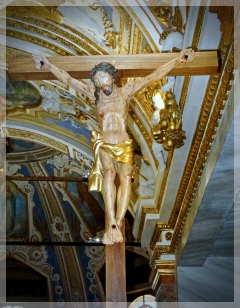
Locarno-Madonna del SassowIn any cathedral or art museum, we’ll find many pictures of Jesus and even rather graphic depictions of Him on the cross. None of them, however, tell us anything about His appearance because they were created long after His time. Still, in a world where we seem to memorialize everything with pictures, you’d think one of Jesus’ followers would have sketched Him while blessing the children, giving the Sermon on the Mount, or feeding the multitude! 1st century rabbis in Judah, however, vehemently objected to the depiction of human figures because the second commandment prohibited making a “graven image.” With its Jewish roots, this prohibition carried into the early church and inhibited early Christian art.


At first, Jesus was represented indirectly by symbols such as the peacock, lamb, dove, and anchor. One of the most common was the ichthus (fish) because the Greek word served as an acronym “Jesus Christ, Son of God, Savior.” While making the sign of the cross dated from sometime in the second century, because of its connection with the horrific death of criminals, the cross did not became a symbol of Christianity until the 4th century; crucifixes and other depictions of the crucifixion did not occur until the 6th.

One earlier depiction of Jesus’ crucifixion, however, does exist. Crudely scratched into a stone wall, it was discovered in 1857 during an excavation of the Paedagogiumon (a school for the training of slaves) on Rome’s Palatine Hill. Dating from around 200 AD, it shows a man (or boy) worshiping a figure on a cross; the figure, however, has the head of an ass. The inscription reads, “Alexamenos worships his God.” This derisive graffiti gives us an idea of the way early Christians were ridiculed for worshiping a man who had been executed as a criminal.

Along with claims of onolatry (donkey worship), the early Christians had to deal with several other disparaging, malicious, and false accusations such as incest, cannibalism, and drinking the blood of infants. Roman orator Marcus Cornelius Fronto (c. 100-160) wrote that Christians were “initiated by the slaughter and the blood of an infant” and that Christianity was “foolish” because, “they worship a crucified man, and even the instrument itself of his punishment” and “are said to worship the head of an ass.”

This was the world—a world that misunderstood, slandered, ridiculed, hated and persecuted them—of the early Christians. And yet, they proceeded in faith and spread the gospel. I wonder how the 21st century church would do in similar circumstances! As for Alexamenos, the fellow mocked by that ancient graffiti—more graffiti was found on a wall in an adjacent room. In Latin it said, “Alexamenos is faithful.”  In the face of opposition, we must be the same!

Think back on those early days when you first learned about Christ. Remember how you remained faithful even though it meant terrible suffering. Sometimes you were exposed to public ridicule and were beaten, and sometimes you helped others who were suffering the same things. You suffered along with those who were thrown into jail, and when all you owned was taken from you, you accepted it with joy. You knew there were better things waiting for you that will last forever. So do not throw away this confident trust in the Lord. Remember the great reward it brings you! [Hebrews 10:32-35 (NLT)]

Copyright ©2021 jsjdevotions. All rights reserved.

RENDER UNTO GOD (PART 2)

The point is this: whoever sows sparingly will also reap sparingly, and whoever sows bountifully will also reap bountifully. Each one must give as he has decided in his heart, not reluctantly or under compulsion, for God loves a cheerful giver. And God is able to make all grace abound to you, so that having all sufficiency in all things at all times, you may abound in every good work. [2 Corinthians 9:6-8 (ESV)]

Yesterday was tax day: the day we rendered unto Washington what is theirs. In case we weren’t sure how much that was, we had 1099s, W-2s, 1040s, TurboTax, various receipts, H & R Block, and accountants to help us figure it out. Since Jesus told us to give God what is His, how much is that? God doesn’t send out W-2s listing our year’s many blessings, supply us with 1040s to fill out, or give us deductions for medical expenses, charitable donations, mortgage interest, property taxes, or gambling losses. Rather than a CPA or the IRS, we need to consult our Bibles for the answer to that question.

“Tithe” is an Old Testament term for the 10% gifts the Israelites were required to pay to support the Levites, provide for the Temple, and relieve the poor. A series of complicated rules regarding which tithes were made in what year and the amount tithed ended up making the tithe more like 23.3%. Although the New Testament never commands (or even recommends) a tithing system, Christians often refer to a tithe (or 10% of one’s earnings) as being the right donation to the church. In reality, for some, 10% would be unwise and for others, 10% is hardly enough!

Rather than a fixed percentage, the New Testament calls us to give regularly, according to our means, generously and joyously (even sacrificially at times), and out of love for God and others. While this requirement is vague about the actual amount, it actually is stricter than a fixed 10% because it is a matter of obedience and trust. What we give is a matter of prayer. It is an issue between God and us and we must be willing to give whatever it is He asks—be it time, talents, or finances—in the amount he desires.

Because Caesar’s image was on the coin, it belonged to him. Let’s not forget that we are made in God’s image and it is His face that is stamped upon us. We belong to Him and whatever we give to God already is His. We simply are returning it to the rightful owner. Moreover, the list of what we should render unto God goes far beyond money. We should give Him our worship, service, obedience, praise, love, respect, gratitude, and fidelity. In short, we owe Him everything and not just on Sundays—we owe Him everything all of the time.

As John Wesley said, the question isn’t “how much of my money will I give to God, but, how much of God’s money will I keep for myself?” Although there is no need to worry about a letter from God questioning our deductions or demanding an audit, we must remember that one day we will be called in for an accounting of how we used His gifts.

Come, you who are blessed by my Father, inherit the kingdom prepared for you from the foundation of the world. For I was hungry and you gave me food, I was thirsty and you gave me drink, I was a stranger and you welcomed me, I was naked and you clothed me, I was sick and you visited me, I was in prison and you came to me. [Matthew 25:34-36 (ESV)]

Do not be conformed to this world, but be transformed by the renewal of your mind, that by testing you may discern what is the will of God, what is good and acceptable and perfect. [Romans 12: 2 (ESV)]

Copyright ©2021 jsjdevotions. All rights reserved.

WHEN GOD MOVES A STONE (Easter – part 1)

On the way they were asking each other, “Who will roll away the stone for us from the entrance to the tomb?” But as they arrived, they looked up and saw that the stone, which was very large, had already been rolled aside. [Mark 16:3-4 (NLT)]

Easter tombAlthough Jesus repeatedly predicted that He’d rise from the dead, the women didn’t bring clean clothes for a living man that Sunday morning when they went to the tomb. Instead, they brought burial spices of their own with which to anoint His dead body. Because of the Sabbath, Jesus’ burial was rushed and His body laid in a borrowed tomb. Although Joseph and Nicodemus had anointed Him, perhaps the women were concerned that, in the men’s haste to finish before sunset, they hadn’t done a proper job of preparing the body. The spices they brought would conceal the stench of decay and, out of love for Jesus, they wanted to complete the burial rites properly.

Not knowing about the guards Pilate had posted at the tomb, the women wondered how they would manage entry into it. Many Judean tombs were caves. The opening was covered by a large disc-shaped stone set into a groove cut in the bedrock. Getting the stone in place was fairly easy as it was rolled down a slight incline to cover the tomb’s opening. Several men, however, would be needed to roll it up the incline. “Who will roll the stone away?” they asked. Even though the women didn’t know how it would be done, they trusted that it could be done and proceeded in faith.

For a moment, consider that heavy stone at the cave’s opening. It was impossible to remove from within the tomb but it wasn’t removed so Jesus could exit the tomb. The Messiah who raised the dead, walked on water, and healed the sick certainly didn’t need anyone to move the stone for Him. Regardless of size, no boulder could block the way of the one whose resurrection meant that death had been conquered. That stone wasn’t moved so He could get out; it was moved so that His followers could get in, find the tomb empty, and share the good news!

The women didn’t let their reservations about moving the stone stop them from going to the burial site and serving their Lord. What about us? When we are called to serve Him, do we worry about the stones that might block our way and allow them to stop us? Let the Easter story remind us that, just as that stone was removed for the women so they could tell the good news, God will remove the barriers blocking our way from sharing the resurrected Christ!

Then the angel spoke to the women. “Don’t be afraid!” he said. “I know you are looking for Jesus, who was crucified. He isn’t here! He is risen from the dead, just as he said would happen. Come, see where his body was lying. And now, go quickly and tell his disciples that he has risen from the dead, and he is going ahead of you to Galilee. You will see him there. Remember what I have told you.” [Matthew 28:5-7 (NLT)]

Copyright ©2021 jsjdevotions. All rights reserved.