THE KINGDOM

One day the Pharisees asked Jesus, “When will the Kingdom of God come?” Jesus replied, “The Kingdom of God can’t be detected by visible signs. You won’t be able to say, ‘Here it is!’ or ‘It’s over there!’ For the Kingdom of God is already among you.” Luke 17:20-21
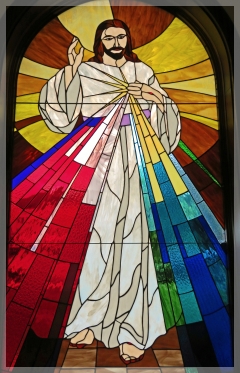
holy name cathedralDepending on your Bible translation, the Kingdom of God is mentioned at least 68 times in the New Testament. Rather than “Kingdom of God,” Matthew usually used “Kingdom of Heaven.” All four gospels, however, are speaking of the same place. Matthew was a Jew and primarily writing for a Jewish audience. While we tend to interpret the third commandment about not misusing the Lord’s name to mean not using it irreverently, Jews have a much stricter interpretation. Believing God’s name too sacred to say aloud, by the 1st century, His name wasn’t even written or spoken in anything but prayer. Even today, many observant Jews substitute “G-d” rather than write the full name.

Because Jesus continually preached the Kingdom of God (or Heaven), the Pharisees asked Him when it would come. Like the rest of Judah, they were thinking of a materialistic kingdom—one with boundaries and a Jewish ruler—so they missed what was happening in front of them. Looking for a political rather than a spiritual fix, they couldn’t understand that the Kingdom had arrived and God was busy restoring it.

Jesus’ answer to the Pharisees sounds like He’s saying the Kingdom is present and yet He also told His disciples to pray for its coming. Rather than an involved theological explanation to explain a kingdom that was both here and pending, Jesus compared the Kingdom of God to a mustard seed that was planted in a field but hadn’t matured into its future glory. The Kingdom was “already” because believers were taking part in building it but it also was “not yet” because it wouldn’t reach its full expression until the future. To further explain the Kingdom, Jesus used a number of metaphors: a farmer scattering seed, yeast in dough, a fishing net, a merchant in search of fine pearls, treasure in a field, a king settling his accounts, a landowner hiring workers for his vineyard, a king’s wedding feast for his son, ten bridesmaids meeting the bridegroom, and a landowner with tenant farmers. Even then, His own disciples were still thinking of an earthly kingdom when they asked the resurrected Jesus, “has the time come for you to free Israel and restore our kingdom?” [Acts 1:6]

The Kingdom of God is not about going to heaven when we die; it’s about bringing God’s kingdom to earth. We pray, “May your Kingdom come soon. May your will be done on earth, as it is in heaven.” [Matthew 6:10] God is king of everything and everyone and, when He reigns in our hearts and minds, His Kingdom is already here. At the same time, His Kingdom is not yet here until its full realization when paradise is re-created in the New Jerusalem.

The Messiah has accomplished the work of redemption, the Spirit has been poured out, yet evil has not been eradicated, the general resurrection is still future, and the final state of God’s kingdom has not been established. In other words, the new era has begun–has been inaugurated–but it has not yet replaced the old era. [Dr. Peter Cockrell]

Jesus answered, “My Kingdom is not an earthly kingdom. If it were, my followers would fight to keep me from being handed over to the Jewish leaders. But my Kingdom is not of this world.” [John 18:36 (NLT)]

Copyright ©2021 jsjdevotions. All rights reserved.

HE WEPT – PALM SUNDAY

The next day, the news that Jesus was on the way to Jerusalem swept through the city. A large crowd of Passover visitors took palm branches and went down the road to meet him. They shouted, “Praise God!  Blessings on the one who comes in the name of the Lord! Hail to the King of Israel!” [John 12:12-13 (NLT)]

All glory, laud, and honor to you, Redeemer, King,
to whom the lips of children made sweet hosannas ring.
You are the King of Israel and David’s royal Son,
now in the Lord’s name coming, the King and Blessed One.
[Theodulph of Orleans (820)]

palm - ncp7943awWe are people of physical signs and symbols and rituals help us connect with events. As a little girl, I loved Palm Sunday and not just because it meant my Lenten fasting would soon end and jelly beans would be in my Easter basket the following week. I loved the way our liturgical church observed it. The hymns of the day were filled with hosannas (a welcome relief from the more somber hymns of the Lenten season). Typically, the opening hymn was “All Glory, Laud, and Honor” and we children would follow the choir into the church while waving our palm branches. Even as a small child, I knew this day commemorated Jesus’ triumphal entry into Jerusalem.

Like the people of Jerusalem, I was filled with joy on this day. Having sung that “the wee little” Zacchaeus had to climb a tree to see the Lord, I pictured people lining the streets and jostling one another for the best view as they might for a parade. I wondered if little children sat on their parents’ shoulders so they could see Jesus. Between the palms I waved and the day’s joyful music, I felt like I was there in Jerusalem and watching the promised Messiah approach on his donkey.

Today, in preparation for Palm Sunday, rather that thinking about those joyful cries of “Hosanna!” and the royal welcome given to our Lord, I thought about Jesus and what He must have been thinking. As Jesus neared the city, Luke tells us that He wept. Jesus, however, wasn’t just a little teary-eyed. Luke used the word eklausen which meant to sob or wail loudly, as one who mourns the dead! As He rode triumphantly into Jerusalem, Jesus was in tears!

Having already told his disciples He would suffer and die, we know Jesus saw what lay at the end of the parade and it’s easy to think His tears were because of the horror awaiting Him. Those sobs, however, weren’t for Him—they were for His people and the city of Jerusalem.

Jesus knew that, in spite of their hosannas, He would be rejected. The people didn’t want their Messiah to be a Prince of Peace—they wanted him to be a conquering king. As He rode into town, Jesus pronounced judgment on the city that was blind to the true nature of God’s kingdom and prophesized its siege and destruction. Thirty-seven years later, the Romans laid siege to Jerusalem, the city was burned, the Temple destroyed, and over one million Jews were slaughtered. While palms waved and people cheered, the grief-stricken Jesus saw Jerusalem’s future and sobbed. It would be nearly 19 centuries before the Jews again had a homeland.

On that Sunday so long ago, the Prince of Peace arrived in the city whose name meant peace. The first part of Jerusalem’s name is yiroo, meaning “they will see” or “they will feel awe,” and core of the word is shalem, meaning completeness and wholeness. Shalem is the root of the Hebrew word for peace—shalom. Jerusalem’s name literally meant, “They will see wholeness” or “They will feel the awe of completeness.” That day they saw the wholeness of God but, sadly, they didn’t understand!

But as he came closer to Jerusalem and saw the city ahead, he began to weep. “How I wish today that you of all people would understand the way to peace. But now it is too late, and peace is hidden from your eyes. Before long your enemies will build ramparts against your walls and encircle you and close in on you from every side. They will crush you into the ground, and your children with you. Your enemies will not leave a single stone in place, because you did not recognize it when God visited you.” [Luke 19:41-44 (NLT)]

Copyright ©2021 jsjdevotions. All rights reserved.

WHAT ARE THE ODDS? (Part 3)

He [Jesus] rolled up the scroll, gave it to the attendant, and sat down. All eyes in the synagogue were fixed on him. “Today,” he began, “this scripture is fulfilled in your own hearing.” [Luke 4:20-21 (NTE)]

evening primroseIn writing about Blaise Pascal yesterday, I mentioned that he, along with Pierre de Fermat, laid the groundwork for probability theory back in 1654. I remember a school friend writing her term paper on probabilities who began by testing what’s called the “birthday paradox:” in a room of 23 people, there is a 50% chance that two people will have the same birthday and, out of 75 people, there is a 99.9% chance of two people’s birth dates matching. Imagine her surprise when the first two people she asked had the same birth date! That, of course was sheer coincidence but, if the next 30 people she asked also had the same birth date, another explanation would have been necessary.

I know nothing of permutations, exponents, or probability theory, but even I know when coincidence can’t explain the improbable. Consider the improbability of anyone fulfilling the many Messianic prophecies found in the Hebrew Scriptures. The Messiah would come from the seed of a woman (not a man) and be born of a virgin in Bethlehem. He would be from the line of Abraham, a descendant of Isaac and Jacob, of the tribe of Judah, and from the house of David. The Messiah would spend time in Egypt, would be a Nazarene, and a messenger would prepare His way. He would be a light to the Gentiles, give sight to the blind and hearing to the deaf, visit the Temple, and enter Jerusalem as a king on a donkey. The Messiah would be betrayed for 30 pieces of silver, falsely accused, and stand silent before His accusers. He’d be mocked and ridiculed, his hands and feet pierced, dice would be thrown for his clothing, and would die with the wicked but be buried with the rich.

Taking just eight of the some 300 fulfilled Messianic prophecies in Hebrew Scripture, mathematics professor Peter Stoner calculated the odds of one man fulfilling them by coincidence at 1 in 1017 (100,000,000,000,000,000). Putting those many zeros into perspective, Stoner likened it to covering the entire state of Texas with silver dollars piled 2-feet deep, placing one marked silver dollar among them, and expecting a blindfolded person to wander through the state and pick up the marked coin in his first try. Stoner then figured the odds of one man fulfilling 16 of those Messianic prophecies at 1 in 1045 and of fulfilling 48 of those prophecies at 1 in 10157, a truly mind-boggling number. Although the odds against one man fulfilling all those prophecies are astronomical, that’s exactly what Jesus did! Looking at it purely from a mathematical viewpoint, Professor Stoner concluded, “Any man who rejects Christ as the Son of God is rejecting a fact proved perhaps more absolutely than any other fact in the world.”

While probability theory proves that Jesus is the promised Messiah, intellectual assent is not quite enough when it comes to our salvation because it’s not the same as believing in Jesus. Faith is more than an acceptance of facts; it is a commitment to those facts. A profession of intellectual belief is meaningless until it makes a discernible change in us! Nevertheless, Stoner’s use of probability theory to prove Jesus is the promised Messiah helps bolster our own faith. Moreover, it enables us to defend the validity of Scripture and the truth of Jesus’ identity to those who don’t believe.

And we have the prophetic word made more certain. You will do well to hold on to this, as to a lamp shining in a dark place, until the day dawns and the morning star shines in your hearts. You must know this first of all, that no scriptural prophecy is a matter of one’s own interpretation. No prophecy, you see, ever came by human will. Rather, people were moved by the holy spirit, and spoke from God. [2 Peter 1:19-21 (NTE)]

Copyright ©2021 jsjdevotions. All rights reserved.

TOO DEFINITE FOR LANGUAGE

We know that a person is not justified by works of the law but through faith in Jesus Christ, so we also have believed in Christ Jesus, in order to be justified by faith in Christ and not by works of the law, because by works of the law no one will be justified. [Galatians 2:16 (ESV)]

You see that a person is justified by works and not by faith alone. [James 2:24 (ESV)]

Siberian reindeerChristianity seems to be full of paradoxes. We’re saved by faith and not by works but we can’t have faith without works. As for grace and obedience—it’s God’s grace not our obedience that saves us. But, what initially sounds like a free pass isn’t because the saved are expected to have grace-fueled obedience! It’s easy to get confused when we read only isolated verses in Scripture. Rather than inconsistent or even contradictory concepts, however, faith, works, grace and obedience are complementary and interrelated. Perhaps some of the confusion comes from our language rather than our doctrine.

I think back to an exchange between two characters in Perelandra by C.S. Lewis. When the character Ransom is at a loss for words while trying to explain a concept, his companion says, “I realize it’s all too vague for you to put into words.” Looking at his friend sharply, Ransom replies, “On the contrary, it is words that are vague. The reason why it can’t be expressed is that it’s too definite for language.” Faith, works, grace, and obedience are so distinct and yet so interconnected in Christian doctrine that it’s a pity we don’t have a wider Christian vocabulary.

According to The Washington Post, there really are at least fifty Inuit words for snow that describe everything from a soft falling snow to a wet snow that will ice a sled’s runners. Along with having a multitude of words related to snow and ice, the Sami people of northern Scandinavia and Russia have over 1,000 words for reindeer. They have a different word for each year of a male reindeer’s life and I suspect they have one that would perfectly describe the reindeer in today’s picture. It’s done through something linguists call “polysynthesis,” which allows speakers to encode a huge amount of information into one word by plugging various suffixes onto a base word so that one word can encompass a whole sentence

Language evolves to meet the ideas and needs of the people speaking it. If the Sami people can use a single word like sietnjanjunni to describe a reindeer with the hair nearest to its nostrils having a different color than the one you’d expect from the color of the rest of its hair, we should be able to come up with something for the combined concepts of faith, works, grace, and obedience. Using a little polysynthesis, we could try for the whole shebang and come up with “faithorkobegracience,” but it still wouldn’t capture these concepts because we’re talking of something far greater than reindeer, snow, or ice.

We are finite beings trying to capture an infinite, omnipotent, omniscient, and omnipresent being with words. No word in any language can come close to the immensity of all that is encompassed in our salvation. We are saved by grace through faith but true faith is obedient and obedient faith leads to works. Simply put, it is our obedience and works that reveal the authenticity of our faith!  We will just have to continue as we have for centuries: by having faith, doing His works, being saved by grace, remaining obedient to His commands and walking the way Jesus walked.

And by this we know that we have come to know him, if we keep his commandments. … By this we may know that we are in him: whoever says he abides in him ought to walk in the same way in which he walked. [1 John 2:3,5b-6 (ESV)]

But someone will say, “You have faith and I have works.” Show me your faith apart from your works, and I will show you my faith by my works. [James 2:18 (ESV)]

Copyright ©2021 jsjdevotions. All rights reserved.

SHARPENING and SPURRING

As iron sharpens iron, so one person sharpens another. [Proverbs 27:17 (NIV)]

And let us consider how we may spur one another on toward love and good deeds, [Hebrews 10:24 (NIV)]

plumariaIn ancient times, when an iron tool became dull, another iron implement was used to give it a finer polish and sharper edge. It’s not just tools that can become dulled—so can minds and spirits. Good Christian friends who act as whetstones can make us accountable, keener, stronger, and more enthusiastic and valuable. Rather than allowing us to grow dull and settled in our comfort zones, they sharpen us with challenges that make us better disciples for Christ.
The Greek word translated as spur in Hebrews 10:24 was paroksysmós. Often translated as motivate or stimulate, the NIV’s use of spur seems most accurate. Paroksysmós was a noun meaning a provocation which literally jabbed into someone so sharply they had to respond (as a spur does to a horse). As with a stubborn mule, sometimes we need to apply the spurs to get someone moving and, sometimes, we’re the stubborn ones who need that extra encouragement or motivation!

Whenever I read Proverbs 17:17 or Hebrews 10:24, I think of a special friend who both sharpened and spurred me! One of a small group receiving daily email devotions from me in 2014, she doggedly insisted that I have a devotional website. I didn’t claim to be the least qualified and from the weakest clan as did Gideon, but I came close by pointing out my lack of computer skills and religious training. Like Moses, I protested and offered several reasons why I wasn’t the woman for the job but she had an answer for every one of my objections! Then, instead of giving me Aaron as God did for Moses, she gave me her technical skill, designed the site, loaded several older devotions, and patiently walked me through the steps required to prepare photos, post devotions, and maintain the site. She sharpened and spurred me as a good Christian friend should!

Today marks my 2,073rd post on “Devotions of the Heart.” Staring with about 20 followers from my email group, I now have 576 followers. The site has been viewed over 48,500 times by over 28,700 people from 162 countries. That’s a drop in the bucket when it comes to celebrity influencers whose followers and views number in the millions but these devotions aren’t about numbers, fame, product endorsements, or me. They’re simply about sharing the Word of God and the only thing I endorse is Jesus! All the glory belongs to God but the thanks go to my iron-sharpening friend who wasn’t afraid to apply the spurs! Without her, you wouldn’t be reading this!

Friendship isn’t about what we get from it; it’s about how we serve God through it. My friend did what we all should do for our Christian brothers and sisters—she sharpened and spurred me by challenging, motivating, inspiring, helping, and encouraging me to become a better disciple for Christ. When iron is used to sharpen iron, both pieces improve and, by sharpening me, my friend sharpened herself, as well! Discipleship is not about maintaining the status quo—it’s about moving forward. Let us sharpen and spur on one another in Christian love.

Therefore encourage one another and build each other up, just as in fact you are doing. [1 Thessalonians 5:11 (NIV)]

Preach the word; be prepared in season and out of season; correct, rebuke and encourage—with great patience and careful instruction. [2 Timothy 4:2 (NIV)]

Copyright ©2020 jsjdevotions. All rights reserved.

CONCEIT AND COMPARISON (Galatians 6:2-5 – Part 3)

Carry each other’s burdens; that’s the way to fulfill the Messiah’s law. If you think you’re something when you are not, you deceive yourself. Every one of you should test your own work, and then you will have a reason to boast of yourself, not of somebody else. Each of you, you see, will have to carry your own load. [Galatians 6:2-5 (NTE)]

sled dogs mushingThese last few days, I’ve been discussing Paul’s instructions both to carry one another’s burdens and to carry our own loads. In between those two directives, we find a warning about the things that can prevent us from doing that: conceit and comparison.

Conceit is thinking we’re better than we are. In carrying another person’s burden, we must never think ourselves too good to help nor should we think ourselves morally or spiritually superior to someone in their weakness and need. Comparison can lead to competition as we try to determine who is the better Christian by carrying his load better! The Lord has given each of us a task and equipped us with a specific set of skills and spiritual gifts to achieve it. The load given us is our responsibility just as the tasks and talents given to others are theirs. Moreover, we must never compare our virtues with other’s imperfections (leading to pride) or our flaws with others’ accomplishments (leading to jealousy). If we’re going to compare ourselves to anyone, it should be to Jesus!

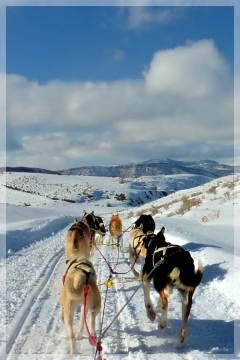
Oddly, this reminds me again of the Alaskan huskies I wrote about on Monday. Like us, each dog on the team has his own strengths (and weaknesses) and is assigned a position and a specific task that fit his attributes. Because they must follow the musher’s commands, set the pace, and keep the gangline taut, the lead dogs are the most intelligent on the team. No less important, however, are the swing dogs behind them. After the lead dogs make a turn, their critical task is to pull the sled in an arc that keeps the other dogs on the trail. They’re responsible for getting the musher and sled safely around curves and corners. Next are the team dogs—the brawn of the team who pull the sled and maintain the speed. Last, but hardly least, are the wheel dogs. Often the largest members of the team, as the first to take on the sled’s weight when starting out or going uphill, they play a crucial role in pulling and steering the sled.

Like us, each dog has a different skill set and position. Nevertheless, regardless of their position, no dog is more important than another and each is essential to the team. Just as the dogs’ responsibility is to the musher, ours is to God. The Apostle Paul tells us to examine ourselves (not others) to make sure we’re doing the work given to us by God. Like the sled dogs, we must be committed to doing our task well without conceit or comparison, Let us faithfully carry our own phortions and always be willing to carry one another’s baros.

Don’t think of yourselves more highly than you ought to think. Rather, think soberly, in line with faith, the true standard which God has marked out for each of you. As in one body we have many limbs and organs, you see, and all the parts have different functions, so we, many as we are, are one body in the Messiah, and individually we belong to one another. [Romans 12:3-5 (NTE)]

Copyright ©2021 jsjdevotions. All rights reserved.