
And now, just as you accepted Christ Jesus as your Lord, you must continue to follow him. Let your roots grow down into him, and let your lives be built on him. Then your faith will grow strong in the truth you were taught, and you will overflow with thankfulness. [Colossians 2:6-7 (NLT)]
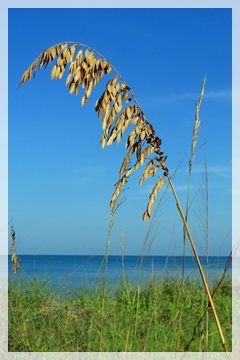 It’s not just light poles that were destroyed by Hurricane Irma’s winds; many trees also met their end at her hands. As I looked at the upended roots of a once mighty oak, I thought of one of Aesop’s fables about an oak in a storm. A proud oak stood by a stream, and like this one, had survived several storms in its many years. One day, a hurricane the likes of Irma arrived and the great oak fell with a thunderous crash. As the water rose, it was carried down to the sea. When the oak eventually came to rest along the shore, it looked up at the sea oats that were waving in the now gentle sea breeze, “How did you manage to weather such a terrible storm?” it asked. “I’m a great oak and even I didn’t have strength enough to battle the wind.”
The sea oats replied, “That was your problem. You were too proud to bend and yield a little and so the wind knocked you over. I’m just an insubstantial sea oats plant but, knowing my weakness, I didn’t resist as the wind gusted. The harder it blew, the more I humbled myself and the lower I bent. So, here I am, still enjoying the beach. Aesop’s moral is that it is better to bend than to break. “Perhaps there a message here,” I thought and, yet, I wasn’t sure it was just about pride and humility.
The Apostle Paul was very clear about standing firm in the face of trials and temptation. He told the early church to stand firm and not to waver; he wanted them to be oaks and not sea oats. When facing one of life’s hurricanes, however, it’s pretty hard not to wobble, quiver and quake wildly. If we stand firm, will we be knocked down and end up a piece of drift wood or ground up into mulch? If that mighty oak couldn’t weather the storm, how can we?
The Apostle also said that growing roots in Jesus is what will keep us strong. That fallen oak’s upended roots were taller than me and yet they didn’t do the oak much good when Irma arrived. The roots of which Paul speaks are deep roots that grown down into our Lord. It is strong deep roots that will serve to anchor a tree in the ground. I’m not an arborist, but I could easily see that there was nothing deep about that oak’s roots (or the roots of the many other uprooted oaks throughout our community).
In Jesus’ parable about soil, he told of seed scattered on good soil that grew, seed strewn on a path that was eaten by the birds, seed that was crowded out by the thorns, and seed that fell on rocky soil. Those plants in rockyy soil grew quickly but, since their roots weren’t deep, they withered in the hot sun. If He’d been in a tropical climate like Florida’s, Jesus could have used sand and hurricanes instead of rocks and sun in His analogy. Good nutritious soil is necessary for a plant’s success and Florida’s soil is shallow and mostly sand. The many fallen oaks’ roots, while wide, were shallow and certainly not the kind of roots of which Jesus and Paul spoke.
Aesop’s fable was about pride and humility but the many uprooted oaks in town tell me something more. Granted, there may be times we need to bend a little, as do the sea oats, but we must never bend if that means compromising our faith. I think of Daniel, Shadrach, Meshach, and Abednego. Their roots were so deep that they were willing to die before they bent down to worship a false god or failed to worship the true one. While a miracle saved them, there was no miracle for Stephen, a man whose deep roots in Christ gave him strength enough to stand and testify before the Jewish high council knowing he’d die because of it. These men were willing to be sacrificed and broken before bending to the prevailing wind.
Given a choice, I would rather stand strong, like an oak with deep roots, than fall because of the wind. Nevertheless, if the wind is blowing in the wrong direction, like Stephen and other Christian martyrs, I would rather be broken and fall than bend and survive as do the sea oats.
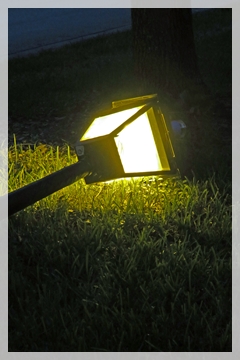 To avoid the southwest Florida heat, I waited until dusk to take my walk. Thanks to Hurricane Irma, most of the street lamps in my neighborhood don’t work. For a light to function, electrical energy has to be converted into light energy and both a source of electricity and a working connection are needed. For many of the lights, the connection was broken when blowing debris shattered their bulbs. For others, Irma’s 150 mph winds broke the connection when it blew off their tops, wrapped their poles around trees, or knocked them to the ground. Without a connection to their source of power, those street lights are useless—they’re just a tangle of wires and a pile of glass, plastic and metal. Even though they don’t work, people have been cautioned to remember that their exposed wires are live. It’s not the electricity that is missing; it’s the connection that is inoperative. Two poles, however, were down but not out. Even though they’d been flattened by the storm, neither wires nor bulb had broken. In spite of the storm’s violence, they remained connected and were beacons in the night’s darkness.

 The damage done by Hurricane Harvey seemed unbelievable until Irma hammered the entire state of Florida. Fortunately, our Florida home was prepared and we were safely situated in the Midwest during Irma’s tirade. Would that all the storms of life announced themselves a week in advance to give us time to put up storm shutters and evacuate to safety.
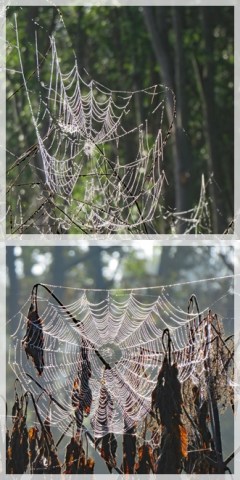 It rained last night. During our early morning walk, we looked out over the prairie and saw hundreds of sparkling spider webs. As the morning sun caught the water droplets on the silk, the master weavers’ work glistened in the mist. Although we take that trail several times a week, it was the first time this season we saw those arachnidan works of art. The spiders didn’t start spinning just the previous night; their webs have been there all summer but weather and light conditions kept us from seeing them. In fact, had we chosen to walk the loop in the other direction, we never would have seen them at all!
