
The Lord says, “I will guide you along the best pathway for your life. I will advise you and watch over you. [Psalm 32:8 (NLT)]
 I’m not a good sitter and I’m even worse at soaking in a tub. Just wanting to get clean and get on with my day, I’m a shower person. Friends insist that sitting in the tub and reading is the best way to relax but that doesn’t work for me. I don’t have the patience to wait for the water to get high enough for a good soak or for the spa jets to work, I’ve never figured out how to turn pages without getting them wet and, rather than relaxing, I think about all the things I could and should be doing instead of sitting in hot water. I considered my inability to enjoy a bath when our pastor suggested that we bathe our decisions in prayer. Unfortunately, the same impatience that keeps me from enjoying my over-sized bath tub keeps me from bathing my decisions in prayer.
While most of us don’t neglect washing our bodies, whether in shower or tub, we tend to neglect bathing our decisions in prayer. Impatient, we tend to act before consulting God about our choices. Easy decisions may need only a quick shower of prayer and more significant ones might require a short soak. The critical ones, however, demand a long soak and should get thoroughly immersed. Bathing our decisions in prayer allows God to saturate our hearts and minds with His word and will. It also means waiting for His answer before getting out of the tub!
When we sit in the bathtub too long, the bath bubbles eventually dissolve, our skin wrinkles like that of a prune, the water gets cold, and someone is sure to complain about our monopolizing the bathroom. The only time a decision is bathed in prayer too long is when God has clearly given us an answer and we use continued prayer as an excuse to avoid His direction or to convince Him our plan is better than His!
James assures us that, if we need wisdom, all we need to do is ask; we do that by bathing our decisions in prayer. Our prayers, however, must be offered in faith and with a readiness to do as God directs. While some of us may not enjoy soaking in the bath tub, we can all benefit from immersing our decisions in prayer.
Goals not bathed in prayer or brought in humility before the Lord turn out to be downright useless. They don’t go anywhere. They don’t accomplish anything. [Charles R. Swindoll]
 These people are false apostles. They are deceitful workers who disguise themselves as apostles of Christ. But I am not surprised! Even Satan disguises himself as an angel of light. So it is no wonder that his servants also disguise themselves as servants of righteousness. In the end they will get the punishment their wicked deeds deserve. [2 Corinthians 11:13-15 (NLT)]
 When asked about her boys, a friend used to answer, “They’re doing their own thing.” Years later, I learned “their own thing” meant they were breaking her mama’s heart with their addictions and run-ins with the law. Because she kept her pain concealed, she carried the weight of that burden alone for many years. We often hear similar answers when we ask someone how they’re doing— brusque responses like, “I’m fine,” “It’s taken care of,” or “We don’t need a thing.” Maybe everything really is hunky dory but those answers are often used when life has gone seriously awry and things are anything but fine. Those vague but terse responses are conversation stoppers. Even best friends, who suspect something is amiss, won’t pry and the subject is politely changed.
 Most of us think of sloth as laziness: a dislike of work or any physical exertion. Having watched the local zoo’s sloth in action (or, rather, inaction), I think the sluggish animal is appropriately named. Spiritual sloth, however, is far different than being a couch potato. Originally, the sin of sloth was two sins: sadness and acedia. Compiled by Evagrius of Ponticus, a 4th century monk, these two “capitals sins” were part of a list of eight he believed to the greatest threats to devout monasticism.
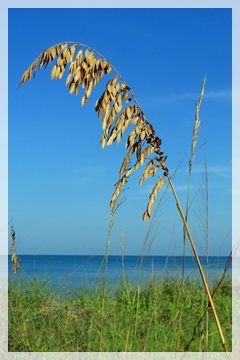 It’s not just light poles that were destroyed by Hurricane Irma’s winds; many trees also met their end at her hands. As I looked at the upended roots of a once mighty oak, I thought of one of Aesop’s fables about an oak in a storm. A proud oak stood by a stream, and like this one, had survived several storms in its many years. One day, a hurricane the likes of Irma arrived and the great oak fell with a thunderous crash. As the water rose, it was carried down to the sea. When the oak eventually came to rest along the shore, it looked up at the sea oats that were waving in the now gentle sea breeze, “How did you manage to weather such a terrible storm?” it asked. “I’m a great oak and even I didn’t have strength enough to battle the wind.”
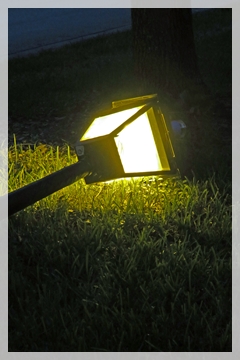 To avoid the southwest Florida heat, I waited until dusk to take my walk. Thanks to Hurricane Irma, most of the street lamps in my neighborhood don’t work. For a light to function, electrical energy has to be converted into light energy and both a source of electricity and a working connection are needed. For many of the lights, the connection was broken when blowing debris shattered their bulbs. For others, Irma’s 150 mph winds broke the connection when it blew off their tops, wrapped their poles around trees, or knocked them to the ground. Without a connection to their source of power, those street lights are useless—they’re just a tangle of wires and a pile of glass, plastic and metal. Even though they don’t work, people have been cautioned to remember that their exposed wires are live. It’s not the electricity that is missing; it’s the connection that is inoperative. Two poles, however, were down but not out. Even though they’d been flattened by the storm, neither wires nor bulb had broken. In spite of the storm’s violence, they remained connected and were beacons in the night’s darkness.
 Devotions of the Heart