
“Then you will know the truth, and the truth will make you free.” They answered, “We are Abraham’s children, and we have never been anyone’s slaves. So why do you say we will be free?” Jesus answered, “I tell you the truth, everyone who lives in sin is a slave to sin. A slave does not stay with a family forever, but a son belongs to the family forever. So if the Son makes you free, you will be truly free” [John 8:32-36 (NCV)]
 While the Jews to whom Jesus was speaking were thinking of political freedom and enslavement to people, Jesus was speaking of spiritual freedom and the enslavement of people to sin. Yet, even then, the Jews were wrong. They’d forgotten about being Pharaoh’s slaves in Egypt; being captives of the Moabites, Canaanites, Philistines, Midianites, Mesopotamians, and Ammonites during the time of the Judges; their Babylonian exile; Persian rule; Alexander the Great; the Ptolemies and Seleucids; and Rome’s occupation of their homeland. They hadn’t had freedom from foreign domination for centuries. Jesus’ answer, however, made it clear that He was speaking of spiritual freedom. His listeners’ hope for spiritual freedom wouldn’t be found in their ancestry; it would be found in Him—He was the Son who could set them free.
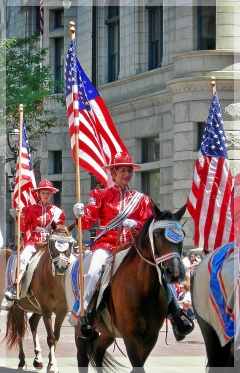
This weekend we will observe our nation’s Independence Day and celebrate the many freedoms we enjoy in this nation. Families and friends will gather for various parades, picnics, band concerts, carnivals, chicken roasts, and fireworks. Let us not make the same mistake the people of Judah did by thinking of ourselves as free when we’re not! While we may live in a nation of freedom, without Christ, we will never truly be free men or women. We won’t be free because, no matter where we live, we still will be slaves to sin.
As thankful as I am for the patriots who made this great nation a reality, I am even more thankful for Jesus and his small crew of apostles who made it possible for us to live in true freedom! The Liberty Bell rang out for our nation’s freedom but the cross gave us our spiritual freedom—freedom from bondage to sin and the freedom to serve God.
As we enjoy the fireworks and patriotic music tonight, let’s remember to thank God both for the freedom we enjoy in our nation and, more important, for the freedom we enjoy in our hearts and souls.
We lift up our hearts, O God, on this day of celebration in gratitude for the gift of being Americans. We rejoice with all those who share in the great dream of freedom and dignity for all. With flags and feasting, with family and friends we salute those who have sacrificed that we might have the opportunity to bring to fulfillment our many God-given gifts. … Come, O gracious God, who led your children Israel from slavery, keep us free from all that might hold us in bondage. Bless our country and join our simple celebration that we may praise you, our Source of freedom, the One in whom we place our trust. [Father Edward Hays, “A Pilgrim’s Almanac”]
 I will be careful to live a blameless life—when will you come to help me? I will lead a life of integrity in my own home. … I will reject perverse ideas and stay away from every evil. [Psalm 101:2,4 (NLT)]
 These words were among those the kings of Israel were to copy, keep on their person at all times, and read every day of their lives. Solomon was Israel’s third king and, while we can’t know about Saul or David, it certainly seems that by Solomon’s reign, the words of Deuteronomy had been forgotten or ignored.
 In a series of negative commands regarding the harvest found in Deuteronomy and Leviticus, we find an ancient form of social justice/economic equity. A landowner was not to return for an overlooked bundle of grain left in the field, olives trees were not to be beaten more than once, grapes vines were not to be repicked after the first fruit was gathered, the edges of the fields were not to be harvested, and any produce dropped by the harvesters or fruit that had fallen or separated from the branch was not to be taken. As the remainders of the harvest, these gleanings were left for the poor.
 A friend once asked her mother which of her children was the favorite. I can’t imagine making such a query, wanting to hear the answer, or how I’d respond to the same question. Since I can’t even pick my favorite color, I certainly couldn’t pick my favorite child. Is it the one with the over-the-top personality who not only could sell ice cubes to Eskimos but convince them to double their order because of a possible shortage? Is my favorite the adventurous one with the wonderfully quirky sense of humor and a mind that puts Wikipedia to shame? Is my favorite the thoughtful child—the one whose faith, strength, and patience rival that of Job? If they were beverages, one child would be a doppio espresso; another spiced chai with ginger, cardamom, allspice, cinnamon and cloves; while the third would be calming chamomile tea with a touch of honey. Like those beverages, each of my children is interesting, pleasant, and delightfully unique. One challenged me, one grieved me, and one worried me. Do I love them less because of that? Absolutely not! While I love them equally, because they have been blessed with different personalities and abilities, I don’t always treat them the same. Nevertheless, I love all three of them, just each in their own special way!
 Although the Apostle Paul seems to have mixed figures of speech by referring to the military with “fought” and “fight,” athletics with “race,” and religion with “faith,” all three references relate to athletics. The word used for fought was agónizomai (the root word for the English word “agonize”) which meant “to contend for a prize” or “struggle.” The word translated as “fight” was agōna, meaning “a gathering, contest, struggle.” Rather than a conflict or dispute, it referred to a gathering to see contests like the ancient games held at Olympia or the games themselves. Paul’s audience would have understood that he meant something grueling and, in their 1st century world, athletic competitions were so fierce and brutal that even the winners usually carried scars.
