STARS

who would you be for a day?Call to me and I will answer you, and will tell you great and hidden things that you have not known. [Jeremiah 33:3 (ESV)]

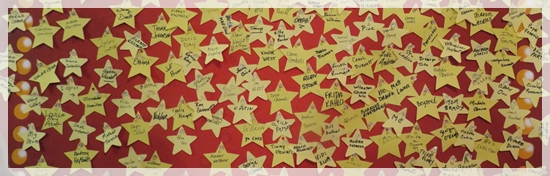
The bulletin board outside the auditorium posed this question: “If you could be someone famous for a day, who would you be?” People had written their answers on paper stars and pinned them to the board. Including both living and dead, the answers ranged from entertainment, royalty and sports to technology, government, and the arts. They included Thomas Edison, Beyoncé, Georgia O’Keefe, Chrissie Evert, Isaac Newton, Thomas Jefferson, Maya Angelou, and Coco Chanel. Oprah received several stars as did Alexander Hamilton, Audrey Hepburn, and Michele Obama. Warren Buffet was the only entrepreneur listed but someone else was satisfied to be “any rich person;” one man wished to be Penélope Cruz’s husband.

I looked at the stars and pondered my answer. Although God had one star, He certainly wouldn’t be my choice. I have enough trouble running my life; running the universe, even for just a day, would be way too much responsibility for me. In the end, I had to agree with the one star that said “Me;” being me is all I can manage. This exercise, however, reminded me of a similar question asked in our small group: “If you could have a conversation with someone famous, who would it be?”

Even though I wouldn’t have much in common with sport stars like Joe DiMaggio or Bobby Orr and probably wouldn’t understand Giacomo Puccini or Leonardo DaVinci, I would enjoy being in the presence of nearly everyone whose star appeared on the board (with the exceptions of Christopher Hitchens, Hugh Hefner and whoever is Penelope Cruz’s husband). If I actually did have an opportunity to meet with one of those people, you can be sure I wouldn’t waste my time talking about me, my background, ambitions, needs and desires. A conversation with Bishop Desmond Tutu, Florence Nightingale, or even Lucille Ball would have no point if I never let them get a word in edgewise. I’d want to hear what they had to say: to ask about them, to know what was important to them, what made them tick, and what advice they’d pass on to me.

Alas, with one notable exception, most of us will never have the opportunity to converse with any of the people whose names were on that bulletin board. The exception, of course, is God, the greatest one of them all. Unlike all of those stars we’ll never meet, we can talk with God in prayer any time we want. Prayer gives us the opportunity not just to know about God but to actually know Him—to have a relationship with Him—and not just for a day, but forever!

I wonder why I’m so willing to jabber on when talking with God—the one who knows all things—when I’d quietly listen intently to a celebrity. The creator of the universe doesn’t require my guidance on world management any more than Ina Garten needs my cooking advice or Billie Jean King needs my tennis pointers. God doesn’t need me to tell Him what it is I need or want and He certainly doesn’t need me to list my concerns or register my complaints; He already knows all there is to know about me! In fact, He knows what I need before I know I even need it!

It is when we quiet our voices that we can hear the voice of God. Thomas Merton describes this listening or contemplative prayer as “not so much a way to find God as a way of resting in him whom we have found, who loves us, who is near to us, who comes to us to draw us to himself.” Let us bask in His presence; let us pray.

Prayer is not asking. Prayer is putting oneself in the hands of God, at His disposition, and listening to His voice in the depth of our hearts. [Mother Teresa]

Be still, and know that I am God. [Psalm 46:10a (ESV)]

And when you pray, do not heap up empty phrases as the Gentiles do, for they think that they will be heard for their many words. Do not be like them, for your Father knows what you need before you ask him [Matthew 6:7-8 (ESV)]

Copyright ©2019 jsjdevotions. All rights reserved. 

CELEBRATING VALENTINE’S DAY

When the Lord your God goes ahead of you and destroys the nations and you drive them out and live in their land, do not fall into the trap of following their customs and worshiping their gods. Do not inquire about their gods, saying, “How do these nations worship their gods? I want to follow their example.” You must not worship the Lord your God the way the other nations worship their gods, for they perform for their gods every detestable act that the Lord hates. [Deuteronomy 12:29-31 (NLT)]

just engagedSt. Valentine may (or may not) have been the Catholic bishop of Terni, a priest who helped persecuted Christians during the reign of Claudius II, one who suffered in Africa, one who secretly married couples when marriage was forbidden, or one who converted the family of a jailer named Asterius and restored sight to his blind daughter. It was a common name and whether there was only priest named Valentine who did all of these things or as many as three, supposedly he or they were beheaded by the Emperor Claudius II on February 14 around the end of the third century. The confusion about Valentine’s identity led the Roman Catholic Church to drop his saint day from their official calendar of feasts in 1969.

Today’s romantic traditions, however, have pagan roots. On February 14, the Romans celebrated a day dedicated to the goddess Juno. Included in the revelry was a matchmaking lottery that paired up couples for the duration of the festival. On the 15th, they continued the merriment with Lupercalia, a fertility festival that involved sacrificing goats and a dog and whipping women with thongs made from the skins of the sacrificed animals. Understandably, the early Christian church was displeased by such behavior and, around 496, Pope Gelasius I recast the pagan festival as a feast day in honor of St. Valentine. Instead of men drawing names of women who’d become sex partners, children drew names of saints whose lives they would emulate for the year.

Although there was a common belief that birds began to mate for the season on February 14, it wasn’t until the late 14th century that Valentine’s Day became associated with romance, thanks to the publication of Geoffrey Chaucer’s poem, The Parliament of Fowls. Probably about the wooing of Anne of Bohemia by King Richard II, the poem depicts a dream of a pagan heaven where all of the birds have come before Dame Nature to choose their mates. “For this was on Saint Valentine’s day,” wrote Chaucer, “When every fowl comes there his mate to take.” The birds have a debate while three eagles unsuccessfully try to seduce a female eagle.

Written valentines began to appear in the early 15th century and, by the middle of the 18th century, it became common for friends and lovers to exchange notes and tokens of affection. By the early 20th century, ready-made cards replaced the personal notes. Nowadays, over one billion valentines are sent each year.

With its pagan beginnings and the murky history of a man or men named Valentine, what does Valentine’s Day mean to Christians? At first thought, the day seems harmless enough. Some churches, however, prohibit celebrating this holiday because it, like certain other popular holidays, Christianizes or “whitewashes” pagan customs and traditions. We know from the Old Testament that God detests anything pagan. The Israelites were warned not to worship other gods but also not to adopt any pagan customs. The Apostle Paul warns us about not copying the behavior and customs of the world. [Romans 12:2] I wonder what God thinks about Valentine’s Day. What does He think of our spending nearly $20 billion to celebrate a day that began as pagan wantonness?

Although God is love, He is nothing like Cupid (the Roman god of erotic love). His love for us is immeasurable, consummate, unconditional, and sacrificial and has nothing to do with chemistry, sexuality, romance or even likability. We are called to love one another as He loves us—with a love that is generous, compassionate, forgiving, unqualified and expects nothing in return. We are to love the undeserving, unlikeable and adversarial as well as family, friend, and ally. How we celebrate this day is between us and God. There is no question, however, as to how we are to love one another every day of the year.

This is my commandment: Love each other in the same way I have loved you. [John 15:12 (NLT)]

Copyright ©2019 jsjdevotions. All rights reserved.

HE KNOWS WHAT WILL FIT

Then the Lord asked Moses, “Who makes a person’s mouth? Who decides whether people speak or do not speak, hear or do not hear, see or do not see? Is it not I, the Lord? Now go! I will be with you as you speak, and I will instruct you in what to say.” [Exodus 4:11-12 (NLT)]

white admiral butterflyWe were window shopping and celebrating our anniversary. Wanting to get me a gift, my husband spotted a dress he liked in the window of a little boutique and insisted we go inside. The owner greeted us, said the dress in the window wouldn’t fit and showed me a different dress. It was so unlike anything I’d ever worn that I immediately said it wouldn’t look right on me—wrong color, wrong style, wrong material, and wrong fit. ”Don’t you tell me what it will look like,” she said indignantly. “I created this dress and know exactly who it will fit. It will be beautiful on you.” Chastened, but still sure it would look terrible, I reluctantly tried it on. The designer, however, was right. As the creator of the dress, she knew what she had in mind when making it and that it would be right for me.
Through the years, we got to know this woman rather well; as a Messianic Jew, I imagine she was familiar with the book of Exodus. Our first exchange was much like that between God and Moses when God spoke out of the burning bush and gave Moses the task of leading the Israelites out of Egypt. Like me, Moses protested that the job wasn’t a good fit. Who was he to approach Pharaoh? Why would the Israelites listen to or believe him? God responded by giving Moses three miraculous signs to convince them but Moses still objected that the task was not right because he wasn’t eloquent. Like the dress designer, God took that complaint personally and was angry that Moses didn’t seem to trust the One who made Him. As Creator of the man’s mouth in the first place, God knew what it could and couldn’t do. When He promised to empower Moses by putting the words in his mouth, Moses still balked so God provided him with Aaron.

It’s not just trying on dresses and freeing Israelites at which we balk. Whenever we feel one of those God nudges to step out of our comfort zones, our first response is usually something like, ”But God, that’s not the right task for me. I’m not designed for that sort of thing!” Be it sharing our faith or offering to pray with someone, volunteering at the food pantry, greeting at church, teaching Sunday school, writing a blog, visiting a shut-in, planning a fund raiser, organizing a blood drive, starting a Bible study or leading a grief group, we’re sure there is someone better qualified.

Perhaps there is; nevertheless, if God calls us to a task, it’s one He wants us to do and, as our creator, He knows exactly what it is we are capable of doing. Besides, He’ll give us the skills we need. He gave Moses the words and, when God appointed Bezalel and Oholiab to be in charge of building the Ark, the Tabernacle and its furnishings, God filled them with His spirit, wisdom, ability and expertise and gave special skill to all of their craftsmen. He’ll do the same for us! Moreover, just as He provided Moses with the assistance of Aaron, He’ll give us all of the help we need to do His work.

What sorrow awaits those who argue with their Creator. Does a clay pot argue with its maker? Does the clay dispute with the one who shapes it, saying, “Stop, you’re doing it wrong!” Does the pot exclaim, “How clumsy can you be”? [Isaiah 45:9 (NLT)]

For we are God’s masterpiece. He has created us anew in Christ Jesus, so we can do the good things he planned for us long ago. [Ephesians 2:10 (NLT)]

Copyright ©2019 jsjdevotions. All rights reserved.

WORRY AND PRIDE

Give all your worries and cares to God, for he cares about you. [1 Peter 5:7 (NLT)]

tropical water lilyWhen the Israelites sent scouts out to Canaan, they were doing due diligence and getting the lay of the land. Let’s remember, Moses had only asked them to scout out the land, not to determine how or whether they should proceed. But, when they returned, ten of the twelve reported the Promised Land was the land of giants who were undefeatable. In spite of Moses’s leadership, the reassurances of Joshua and Caleb, and God’s promises and power, the Israelites pridefully decided they knew more than God and chose fear instead of stepping out in faith.

Right now, while I’m not looking over the Jordan to Canaan, I’m in the land of waiting—between tests and results, between diagnosis and treatment. On the plus side, at least I won’t be here for forty years as were the Israelites! Nevertheless, the land of waiting can turn into a land of fear and worry. Our “what is?” evolves into “what if?” Instead of scouting Canaan, we scour the Internet, sift through contradictory information, imagine assorted scenarios, try to make sense of medical terms, research, and recommendations without benefit of a medical degree, and turn unknown challenges into undefeatable giants.

It occurred to me that, to a great extent, my worry is the result of pride. The Israelites trusted themselves more than God and, apparently, I trust myself and my research more than either my doctors or God. Could I really think that I, whose only medical degree is that of Dr. Mom, am smarter than my doctors? There’s a fine line between understanding a condition and self-diagnosing or treating it, between concern about something and worry over it, and I’ve crossed that line. Having already researched the qualifications of my physicians, I was satisfied with their credentials, so why did I think I should second guess them? I must remember that God didn’t ask the Israelites for their opinion about Canaan; He asked them to trust Him. Not trusting our doctors can be a mistake but not trusting God is a sin!

I’ve been pridefully leaning on my own understanding when I should be leaning on God. He’s the one in control of my tomorrows and whatever they may bring. My prayer is no longer that I become more enlightened and better qualified than my doctors but that God leads me to the right doctors and gives wisdom to them.  We can worry or we can trust God, but we can’t do both! Let us cast our anxiety and cares on Him, our Great Physician.

Do what you can, and then trust God with what you cannot do. [Craig Groeschel]

Trust in the Lord with all your heart; do not depend on your own understanding. Seek his will in all you do, and he will show you which path to take. [Proverbs 3:5-6 (NLT)]

Copyright ©2019 jsjdevotions. All rights reserved.

SLOW THINKING

sliders - turtlesBut the wisdom from above is first of all pure. It is also peace loving, gentle at all times, and willing to yield to others. It is full of mercy and the fruit of good deeds. It shows no favoritism and is always sincere. And those who are peacemakers will plant seeds of peace and reap a harvest of righteousness. [James 3:17-18 (NLT)]

Someone has a small rubber ball tucked into the palm of his hand and you have just one minute to do whatever it takes to get the ball away from him. What would you do? If you were an inner city youth, chances are you’d start by trying to pry his hand open. Your efforts may even escalate into a wrestling match. I’m not sure you’d have to be an at-risk youngster to have that same response; my husband responded the same way. Imagine his reaction when learning that all he needed to do was ask for the ball and it would have been his!

That is just one of the exercises in a program called “Becoming a Man”®, a cognitive behavioral program offered in cities like Boston and Chicago. Knowing that small slights often can lead to pulling a trigger, the program is designed to help young men avoid life’s pitfalls and develop the social and emotional skills necessary for success: integrity, accountability, positive anger expression, self-determination, respect for women, and visionary goal setting. Young women are not exempt from needing life skills and a similar program called “Working on Woman”™ cultivates the core values of self-awareness, emotional intelligence, healthy relationships, visionary goal-setting, and leadership.

Instead of life skills, as Christians, we might call these faculties “Christ skills”, as does a local Christian school in my town. Instead of a formal code of conduct, the school’s teachers make a covenant with the students to live up to ideals listed as Christ skills: trustworthiness, cooperation, truthfulness, courage, organization, curiosity, patience, effort, perseverance, flexibility, pride, common sense, problem solving, caring, resourcefulness, personal best, responsibility, no put-downs, sense of humor, active listening, initiative, friendship, and integrity. With the goal of growing more like Christ, students learn to evaluate their choices and their consequences based on these skills.

All of these programs teach youngsters that there is power in slow thinking—in living deliberately rather than impetuously. Automatic thinking, such as assuming we have to force the ball out of a person’s hand, can mean the difference between life and death in the inner city but it can have bad consequences everywhere. Our typical weapons of anger and irritation may be less lethal than a gang member’s Smith & Wesson but none of us are exempt from needing to learn to think before acting or speaking.

We don’t need to live in the inner city to know it’s an angry, rude, intolerant, and violent world: a world of road rage, air rage, middle finger waving, swearing, bullying, pushing and shoving, domestic violence, tweet rants, peaceful demonstrations that turn violent, school shootings, child abuse, heckling, bickering, heated arguments, fights between students in school, fights between fans at the game, indignant outbursts, name calling, and a “do unto others before they do unto you” kind of mentality. Perhaps we all need a course in cognitive behavioral therapy or a list of desired Christ skills to emulate.

Even so, under our own power, we still will tend to act impulsively and heedlessly. On our own, we’ll never be the people God means for us to be. Maybe, instead of a list, we need a whole lot more of Jesus and the Fruit of the Spirit (love, joy peace, patience, kindness, goodness, faithfulness, gentleness, and self-control) and a whole lot less of self. Along with the power of slow thinking, let’s tap into the power of the Lord!

If someone claims, “I know God,” but doesn’t obey God’s commandments, that person is a liar and is not living in the truth. But those who obey God’s word truly show how completely they love him. That is how we know we are living in him. Those who say they live in God should live their lives as Jesus did. [1 John 2:4-6 (NLT)]

Copyright ©2019 jsjdevotions. All rights reserved.

OFFENSE

Fools have short fuses and explode all too quickly; the prudent quietly shrug off insults. … Overlook an offense and bond a friendship; fasten on to a slight and—good-bye, friend! … Smart people know how to hold their tongue; their grandeur is to forgive and forget. [Proverbs 12:16,17:9,19:11 (MSG)]

giant swallowtail butterflyOur sermon series was titled “Cage Fighting” but, rather than learning about fighting one another, we were learning about the ways Satan attacks and keeps us in his stronghold with things like shame, doubt, fear, and unforgiveness. While chatting with the pastor before church, I asked about the day’s topic. When he said offense, I immediately thought we’d learn how to take offensive action against the enemy.

Imagine my surprise when I looked at the program and read the above proverbs. What did they have to do with spiritual weaponry? I was annoyed that I’d been misled until I realized I’d misunderstood the pastor. While I was thinking about taking the offense and attacking, the pastor would be speaking about taking offense and feeling attacked! He’d be talking about the kind of offense that leaves us feeling outraged, insulted, or (in my case) annoyed. My error that morning illustrates why we’re easily offended; I had a preconceived idea, misunderstood what I heard, and didn’t ask for an explanation.

In this day of political correctness — when BC (before Christ) has become BCE (before the common era), Christmas trees are called holiday trees, no one is quite sure how to refer to a disability, and The Journal of Animal Ethics says calling pets “pets” is demeaning (they’re now “companion animals” to their “human carers”) — mistakes are bound to happen.

Everyone should be treated fairly and with dignity but never giving offense is nearly impossible. In reality, most people don’t mean to be racist, sexist, ageist, elitist, narrow-minded, impolite, or behind the times but sometimes they are. We can give offense inadvertently simply because words may have different connotations to different people, many words have changed their meaning over the years, or we don’t know the history of a symbol or phrase. For example, since my black postman wears a pith helmet, I didn’t know it was considered by some to be a symbol of white imperialism until Melania Trump was criticized for wearing one in Kenya.

Although wrong, rudeness and thoughtlessness are part and parcel of modern life. Today’s world offers an unlimited opportunity to both give and take offense and Satan loves it. To fight him, we must act and speak with love and do our best to never give offense, whether intentionally or unintentionally. Nevertheless, just as we must act and speak with love, we must listen and respond with love, as well. Knowing how easy it is to be offensive, we must work harder at not taking offense. Unfortunately, self-involved creatures that we are, we often choose to see bias, insult, or aggression even where none is meant. Taking offense just leads to anger, resentment, and retaliation (some of the enemy’s favorite weapons). Often translated as forbearance, patience is a fruit of the spirit and literally means “long temper.” Indeed, we should be slow to anger, give the benefit of doubt, not respond to provocation, turn the other cheek, love, and forgive.

I actually did learn how to fight the enemy that day, just not the way I thought. While some may say the best defense is a good offense, I learned that the best defense is not to take offense at all! As for me, I’m going to spend my time and energy being offended by the things that really matter: human trafficking, hunger, lack of safe drinking water for much of the world, poverty, homelessness, discrimination and injustice.

Whenever anyone has offended me, I try to raise my soul so high that the offense cannot reach it. [Rene Descartes]

We should be too big to take offense and too noble to give it. [Abraham Lincoln]

So, chosen by God for this new life of love, dress in the wardrobe God picked out for you: compassion, kindness, humility, quiet strength, discipline. Be even-tempered, content with second place, quick to forgive an offense. Forgive as quickly and completely as the Master forgave you. And regardless of what else you put on, wear love. It’s your basic, all-purpose garment. Never be without it. [Colossians 3:12-14 (MSG)]

Copyright ©2019 jsjdevotions. All rights reserved.