
But if we confess our sins to him, he is faithful and just to forgive us our sins and to cleanse us from all wickedness. [1 John 1:9 (NLT)]
 It was late Saturday night when one of our pastors glanced at the next day’s church program and saw that Sunday’s sermon was titled “Epithet.” Since he wasn’t speaking about insults on social media but about the way we’ll be remembered when we’re gone, it should have read “Epitaph.” After spending the next hour trying to figure out a way to tie epithets into epitaphs, he realized it made more sense to own up to his spelling error, which he did at all three services.
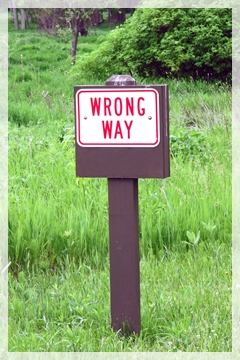
Life gives us an abundance of opportunities to make mistakes and, sometimes, it seems as if we never miss one! We mishear, misinterpret, misjudge, misread, misspeak, misspell, misunderstand and, yes, we sin. We take wrong turns, say the wrong things, and believe the wrong person. Sometimes, that wrong person is an over-confident self. Overly confident, the pastor didn’t proofread, the builders of the Titanic didn’t provide enough life boats, and Napoleon thought he could successfully invade Russia in the winter.
Like the pastor, as much as we hate to do it, we need to own our mistakes and admit our responsibility for them. Sometimes, we can make the best of them, in which case they cease being mistakes. For example, while 3M’s Patty Sherman was trying to develop a rubber that wouldn’t deteriorate when exposed to jet fuel fumes, she made a mistake and spilled a few drops of one failed test batch on her shoe. Later, seeing that those spots were clean while the rest of her shoe had gotten stained and dirty, she made the most of that mistake with a product we call Scotchguard!
Sometimes, we can fix our mistakes. When KFC discovered their motto “Finger-lickin’ good!” became “Eat your fingers off!” in Chinese, they quickly corrected their clumsy translation. Sometimes, though, we just plow on ahead in the face of our errors. The Leaning Tower of Pisa started to lean five years after construction began but, rather than admit and correct the problem, building continued for another for 192 years. They kept compensating by making the uphill side shorter but, because mistakes don’t correct themselves, the tower kept leaning.
Like that learning tower, many of our mistakes are ones with which we must live. Hopefully, we learn from our errors as I imagine NASA did when they accidentally taped over their video of the moon landing. Rather than dwelling on our mistakes, we have to move out of the land of “what if” into the land of “what is.” This, however, is where we encounter the hardest part of making a mistake: forgiving ourselves.
Consider the mistakes of Judas and Peter: Judas sold Jesus for thirty pieces of silver and Peter denied Him three times. Realizing Jesus would die for his betrayal, could Judas have been trying to undo his mistake by giving back the blood money? Filled with remorse and unable to change what had been done, he killed himself. I can’t help but wonder what would have happened if only Judas had waited three days. I know Jesus would have forgiven Him. Think of the testimony Judas could have given if he’d forgiven himself and waited as did Peter. Like Judas, Peter betrayed Jesus but, unlike him, he forgave himself, lived with his mistake, and was in the room when Jesus appeared! Think of the powerful testimony Peter did give!
We have a choice about even our most grievous mistakes. Like Peter, we can live with them, forgive ourselves, accept God’s forgiveness, and move on with our lives in service to Him. Or, like Judas, we can hold on to them and refuse to forgive ourselves. Our guilt may not take our lives but it will take our peace, joy, self-confidence, hope, and even our faith in a forgiving God. We’re told we must forgive to be forgiven; it would seem that command means forgiving ourselves as much as it means forgiving others. Let our guilt be washed away!
Finally, I confessed all my sins to you and stopped trying to hide my guilt. I said to myself, “I will confess my rebellion to the Lord.” And you forgave me! All my guilt is gone. [Psalm 32:5 (NLT)]
And since we have a great High Priest who rules over God’s house, let us go right into the presence of God with sincere hearts fully trusting him. For our guilty consciences have been sprinkled with Christ’s blood to make us clean, and our bodies have been washed with pure water. [Hebrews 10:21-22 (NLT)]
Copyright ©2019 jsjdevotions. All rights reserved.
 If you ever visited the Mayan ruins near Cancun, Mexico, chances are you saw the remains of a stone ball court with sloping walls. Nowhere near as impressive as the Mayan pyramids, I didn’t even take a picture when I saw one. Two stone rings hang about 20 feet up the walls. A ball game called pok-ta-pok was played there. As in volleyball, players passed a solid rubber ball around by hitting it with various parts of their bodies. Unlike volleyball, however, they could not touch the ball with their hands. The goal was to get the ball through one of the rings.
 We were at the symphony watching Alfred Hitchcock’s Psycho while the orchestra played Bernard Herrman’s chilling soundtrack. When Janet Leigh’s character, Marion Crane, stepped into the shower, a man in the audience yelled, ”Don’t do it!” Since most of us saw the movie decades ago, we didn’t want her to take that fatal shower either. In spite of the warning, however, she did. Since Marion was at the Bates Motel because she’d embezzled $40,000 from her boss, perhaps that man should have yelled, “Don’t do it!” much sooner.
 In 2009, the United Methodist Church and the Evangelical Lutheran Church of America became full Communion partners. This agreement, while showing respect for each other’s differences, created a relationship based on a common confession of faith and a mutual recognition of Baptism and the sharing of Holy Communion. That the partnership included a mutual recognition of ordained ministers of both denominations meant that a local Methodist church could hire a soon-to-be ordained Lutheran minister. Her ordination, done by the Lutheran bishop, was held in the Methodist church she would be serving. The only sticking point for the rite was the Lutheran Bishop’s insistence that actual wine be used for Communion. Methodists have a strong temperance tradition and this church uses only grape juice. The senior Methodist pastor managed to find an excellent compromise when he obtained a non-alcoholic wine that satisfied both Methodist and Lutheran sensibilities; the ordination went off without a hitch.
 It was every parent’s nightmare; while the Dad was changing the toddler’s diaper, his four-year old daughter wandered away and disappeared in the zoo! We saw him as he was frantically asking people, “Did you see a little girl in a pink bike helmet?” As he went racing down the path toward the alligators and lions, we went toward the lemurs and play area. Fortunately that pink helmet made her easy to spot as she stood watching the black bears lumber through their enclosure. As we walked her back to her father, I said a prayer of thanksgiving that she would be returning home safely that day.
 The eight of us were brainstorming a difficult and heartbreaking situation facing a family we know. We had plenty of ideas about getting them the assistance and guidance they needed but we could only direct them to the resources. They were the ones who needed to take action. Unfortunately, people often want the easy way out of their problems and desire money rather than counsel. Money, however, is usually only a stop gap measure and it frequently enables a bad situation to continue or get worse. The problem we were discussing required change, compromise, work and sacrifice far more than money. These people had to take action and, truth be told, I’m not so sure they wanted to step forward and act.
 Devotions of the Heart