WHAT’S IN A NAME? (Daniel – part 1)

“But you are my witnesses, O Israel!” says the Lord. “You are my servant. You have been chosen to know me, believe in me, and understand that I alone am God. There is no other God—there never has been, and there never will be. [Isaiah 43:10 (NLT)]

black skimmerAfter Nebuchadnezzar’s first invasion of Judah, he returned to Babylon with the temple’s treasures and some of Judah’s nobility as captives. The best and brightest of the young men were to learn the literature and language of Babylon so they could serve the king. In spite of being captives, they were housed in the palace and given the king’s choice of food. While this would appear to be a pretty good gig for prisoners of war, the boys were probably castrated and made eunuchs as was typically done for palace officials (and prophesied by Isaiah in 2 Kings 20:18).

Among these captives were Daniel, Hananiah, Mishael, and Azariah, all of whom were given new Babylonian names. Daniel, whose name meant “God is my judge,” became Belteshazzar, meaning “Bel protects his life” (Bel was another name for the chief Babylonian god Marduke). Hananiah, whose name meant “The Lord shows grace,” became Shadrach, meaning “Under the command of Aku” (the Sumerian moon god). Mishael, whose name meant “Who is like God?” became Meshach, meaning “Who is what Aku is?” and Azariah, whose name meant “The Lord helps,” became Abednego, “Servant of Nebo” (the god of learning and writing).

“What’s in a name?” asked Juliet in Shakespeare’s Romeo and Juliet. “That which we call a rose by any other name would smell as sweet,” added the star-crossed lover. Romeo’s name made him an enemy to her family but his name was meaningless to Juliet. She knew a man’s name did not determine his value or character. Nebuchadnezzar, king of Babylon, thought otherwise. By changing the captive boys’ names, he wanted more than just their assimilation to Babylon; he wanted their allegiance. When he took their names from them, he also thought he took their God.

These young men lost their homes and families, their masculinity and their names. To further distance them from the God of Israel, as eunuchs, they wouldn’t be allowed to worship in the temple if they ever returned home. Nevertheless, they never lost their identity as children of the God of Israel and refused to defile themselves by partaking of the king’s food and wine.

Some think their decision was based solely on health and nutrition and now offer a wide variety of eating plans based on Daniel’s diet. Their refusal, however, probably had more to do with the youths’ attempt to regain some control over their lives and faith. The king’s meat would not have been butchered or prepared according to Jewish law and would have included prohibited foods like horseflesh and pork that had first been offered to the pagan god Marduk. The four friends refused it and, working out a compromise with the palace guard, agreed to eat nothing but vegetables and water for a trial period of ten days. Since they looked better nourished after that time, they were allowed to continue observing their food rules. Their fitness, however, had more to do with God’s promise of provision than their diet. God granted them not just health but special wisdom. In spite of their new names, they now knew that, by remaining faithful to God, He would be remain faithful to them. Found superior to all of the others in their group, they entered the king’s service in his court.

These four young men knew there was nothing in a name. What mattered was their character and their faith in God—a God who was judge, showed grace, and helped them in their troubles. They knew the Lord would honor those who honored Him and it was this knowledge that would carry them through their later trials in Babylon.

Praise the name of God forever and ever, for he has all wisdom and power. He controls the course of world events; he removes kings and sets up other kings. He gives wisdom to the wise and knowledge to the scholars. [Daniel 2:20-21 (NLT)]

Copyright ©2019 jsjdevotions. All rights reserved.

PERSEVERING PRAYER

O Lord, God of my salvation, I cry out to you by day. I come to you at night. Now hear my prayer; listen to my cry. For my life is full of troubles, and death draws near. [Psalm 88:1-3 (NLT)]

tri-colored heronLast month, a man crashed his car into the frigid waters of the Klamath River in California. Although the accident occurred around 3:00 in the morning, the nearly submerged upside-down car wasn’t reported until 5:30 AM. The dive team finally was able to attach a cable to its undercarriage and tow the vehicle to dry land at 8:00 AM. By this time, thinking it a recovery rather than a rescue operation and with airbags blocking the windows, no one expected to find anyone alive in the car. When the team commander opened the door, however, he heard the words, “Help me!” The car’s driver had survived nearly five hours in icy water while breathing from an air pocket in the car. I have no idea whether the man was a believer but I imagine he might be one now.

This morning, I thought of that man when reading Psalm 88. Although I think the psalmist, Heman the Ezrahite, was writing metaphorically about death drawing near, being “as good as dead,” standing “helpless and desperate,” in “the darkest depths,” with “wave after wave” engulfing him, in a “trap with no way of escape,” and with terrors swirling around “like floodwaters” that engulfed him completely, those words sounded as if they could have been penned by the driver of that submerged car. Alone, in darkness, in a frigid river, desperately trying to keep his head above water, fearful of running out of air, and thinking he’d met his end, I wonder if that frantic man prayed as passionately as did Heman in his psalm.

In his prayer, the despairing Heman doesn’t mince words; nothing is concealed. He lays his miserable life out for God (and everyone else) with brutal honesty. Grieving and in desperate need, estranged from friends and loved ones, he complains that darkness is his closest friend. Yet, in spite of his list of afflictions, there are no accusations, calls for revenge, or anger; there is just woeful resignation, acceptance, and entreaty.

While this is a psalm of lament, it is also one of trust, hope and perseverance. Freely expressing his discouragement and complaint, the psalmist calls to the God of his salvation. Knowing that God is sovereign over his suffering, he also knows God is sovereign over his relief. Even though it seems as if his prayers aren’t being heard, Heman tirelessly continues to pray, crying out to God “day by day” and at night.

I’ve never been gasping for air in an upside down car submerged in icy water and I don’t think I’ve ever been as desperate as Heman must have been when he wrote his psalm. Nevertheless, that doesn’t excuse me from my often sporadic, passionless and perfunctory prayers. Why does it seem that we must be in trouble, in desperate straits, in need of rescue, or in deep despair before we are as forthright, fervent and constant as Heman in our prayers? Shouldn’t every one of our prayers be said with the same level of urgency, ardor, honesty and emotion? Could some of our prayers remain unanswered simply because we haven’t offered them as earnestly as did Heman? What will it take before we pray with his passion? I certainly hope it doesn’t involve an overturned car floating down a river.

When you pray, rather let your heart be without words than your words without heart. [John Bunyan]

I am in a trap with no way of escape. My eyes are blinded by my tears. Each day I beg for your help, O Lord; I lift my hands to you for mercy. … O Lord, I cry out to you. I will keep on pleading day by day. [Psalm 88 8b-9,13 (NLT)]

The earnest prayer of a righteous person has great power and produces wonderful results. [James 5:16b (NLT)]

Copyright ©2019 jsjdevotions. All rights reserved.

LEARNING TO WALK

So put away all malice and all guile and insincerity and envy and all slander. Like newborn babes, long for the pure spiritual milk, that by it you may grow up to salvation; for you have tasted the kindness of the Lord. [1 Peter 2:1-3 (RSV)]

toddlerWatching a friend’s video of her grandbaby’s first steps, I thought back to my children’s first faltering steps. They teetered and tottered, often fell, got up, and fell again. Eventually, the wobbly legs of my eldest became the confident legs that take him down mountain slopes on a snowboard, the awkward steps of my daughter became the graceful ones of a dancer in toe shoes, and the child who took forever to walk now runs marathons. It took time and maturity, however, before they could carry themselves with such strength and assurance.
A pastor friend told me of a young woman, Anne, who recently joined his church. Tuesday mornings, a group meets in the sanctuary to pray over the weekend’s prayer requests. Although Anne is a brand new Christian and self-conscious about offering prayers in a group, she feels called to come on Tuesdays and be a part of this ministry. One morning, she arrived late. With Bible in one hand and a cup of coffee in the other, Anne rushed down the aisle only to stumble. As the coffee spilled over her blouse and onto the floor, what came out of Anne’s mouth definitely was not a nice church lady, “Oops!” Having uttered words not typically heard in church, her face turned red with embarrassment. Mortified at her misstep, I imagine she would have given anything to rewind the previous sixty seconds. Instead of gasps of horror and scornful frowns, however, the prayer warriors in the sanctuary chuckled and reassured her. Like Anne, they once were baby Christians and experienced their share of missteps and lapses. They didn’t approve of her language but, having “been there and done that” (and probably much worse), they understood and reacted with love rather than judgment.

When we first accept Christ, we’re really just baby Christians. Babies aren’t born with all the knowledge and skills they need and we’re not reborn with all the knowledge and skills we need either. There will be stumbles and missteps as we learn to how to walk the Christian way. Like Anne, the new Christian is often torn between the old way of thinking, speaking and acting and the new Spirit-led way of living. Sometimes old habits and attitudes are hard to break. Nevertheless, the baby Christian welcomes the Holy Spirit, follows His lead, listens to His conviction, prays, studies Scripture, and gradually grows more like Christ. Like a toddler, when she falls, she just gets back up and keeps going and growing.

Babies don’t remain babies forever nor would we want them to. We want our children to mature and become all they’re meant to be. That doesn’t happen by being critical, judgmental and unforgiving whenever a child falls. Growth happens with encouragement, patience, love, and through example. While the prayer warriors at my friend’s church understood that, not everyone does.

When our Bible study leader announced that we’d be discussing Nicodemus the following week, the woman beside me asked who he was. I saw her shrink in embarrassment when another woman condescendingly replied, “How could you not know who Nicodemus is?” I quickly looked in my Bible’s index and, reassuring her that she wasn’t alone in her question, told her she’d find his story in John 3. I can only hope she’ll return next week.

Not everyone who attends a Bible study or church is a mature believer; some are brand new disciples while others are seekers or just testing the water. Let’s always be as reassuring, forgiving, and welcoming to baby Christians as we are to our little children and grands!

Above all hold unfailing your love for one another, since love covers a multitude of sins. Practice hospitality ungrudgingly to one another. [1 Peter 4:8-9 (RSV)]

For by grace you have been saved through faith; and this is not your own doing, it is the gift of God—not because of works, lest any man should boast. [Ephesians 2:8-9 (RSV)]

Copyright ©2019 jsjdevotions. All rights reserved.

THE OMEGA

I am the Alpha and the Omega—the beginning and the end,” says the Lord God. “I am the one who is, who always was, and who is still to come—the Almighty One.” [Revelation 1:8 (NLT)]

alpha and omegaIn the book of Revelation, when Jesus says He is the Alpha (the beginning), He also says He is the Omega (the end). He’s not talking of alphabets but rather the absolute beginning, revealed in Genesis, and the absolute end, revealed in Revelation. God had the first word when He spoke the universe into existence and He will have the last word when the world as we know it ends.
Much of the prophecy in the Bible is frightening and it was meant to be. Jeremiah’s warnings to Judah were as urgent as the weather alerts on our phones that tell us to take cover because of an approaching tornado. That kind of warning, while frightening, is meant to save lives. On the other hand, there are other prophecies in the Bible that give us hope. Consider Isaiah’s prophecies of a Messiah, the many prophecies that the people of Judah would return from their captivity in Babylon, and Revelation’s hopeful words that describe a time when death is gone, evil disappears, there are no more tears and sorrow, and all things are made new.

Hidden in Revelation’s joyful news, however, is the prophecy that there will be a final judgment which, depending on the person, can be good or bad news. For those who put their faith in Christ—who thirst of His water—there is nothing to fear; Jesus is forever. For those who ignored previous warnings and failed to put their faith in Christ, however, the eternality of hell awaits.

That Jesus is both the Alpha and Omega is a reminder to all of us: be ready! There will be a time when everyone will give an account to God of his or her life. Jesus is not the omega the way Z ends the alphabet. He’s not like the last page of a book with a finite number of pages. Jesus is the end of an eternal and everlasting book. Whether that never-ending book is set in the New Jerusalem, where God lives among his people, is entirely up to us.

And he also said, “It is finished! I am the Alpha and the Omega—the Beginning and the End. To all who are thirsty I will give freely from the springs of the water of life. All who are victorious will inherit all these blessings, and I will be their God, and they will be my children. But cowards, unbelievers, the corrupt, murderers, the immoral, those who practice witchcraft, idol worshipers, and all liars—their fate is in the fiery lake of burning sulfur. This is the second death. [Revelation 21:6-8 (NLT)]

Copyright ©2019 jsjdevotions. All rights reserved.

THE ALPHA

I am the Alpha and the Omega, the First and the Last, the Beginning and the End. [Revelation 22:13 (NLT)]

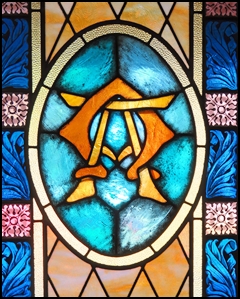
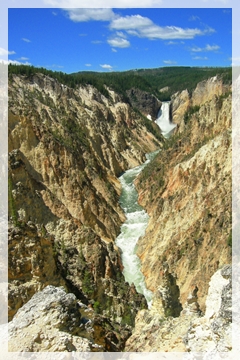
Grand Canyon of YellowstoneHaving forgotten the Greek alphabet he learned as a fraternity pledge, my husband asked the meaning of the symbols on the lecterns in the church sanctuary. On the left was A for alpha and, on the right, was Ω for omega: the first and last letters of the Greek alphabet. In Hebrew, those letters would have been aleph and tau. Among Jewish rabbis, using the first and last letters of the alphabet was a common way to express the whole of something, from its beginning to its end. Today’s equivalent expression would be “from A to Z” or “from soup to nuts.” Those Greek letters refer to three verses in Revelation in which Jesus claims to be the Alpha and Omega. They tell us that that, as part of our Triune God, Jesus was there at the beginning and He will be there at the end.
As for alpha: only God could exist before time even existed! Although Genesis starts with, “In the beginning,” God was already there! Since time, space, and matter are co-relative and God created space and matter, we know it was God who also created time. God never had a beginning because He is the beginning! He didn’t emerge from something; everything emerged from Him!

One of the basic laws of science is that neither mass nor energy can be created. Simply put, it can only be converted or broken apart and put together in a new way. Strictly speaking, mankind can’t create; we can only synthesize or transform by taking existing materials to make something new. We can’t create ice or steam but we can convert water into those things by freezing or boiling it. We can take that water (H2O) and combine it with carbon dioxide (CO2) and end up with carbonic acid (H2CO3) but we couldn’t create carbonic acid without the building blocks of hydrogen, carbon and oxygen. God, however, started from scratch; with no time, space or matter before Him, he created mass and energy. Making something from nothing boggles the mind but it’s the only answer that makes any sense—even to scientists!

Astronomy leads us to a unique event, a universe which was created out of nothing, and delicately balanced to provide exactly the conditions required to support life. In the absence of an absurdly improbable accident, the observations of modern science seem to suggest an underlying, one might say, supernatural plan. … The best data we have are exactly what I would have predicted, had I had nothing to go on but the five books of Moses, the Psalms, the Bible as a whole. [Arno Penzias]

Arno Penzias was the winner of the 1978 Nobel Prize in Physics. He and Robert Wilson discovered cosmic microwave background radiation. Their discovery supported the Big Bang theory of the creation of the Universe and showed that the Big Bang was not a chaotic random explosion. A highly fine-tuned explosion, it appears that some being guided it along.

The Apostle Paul said, “By faith we understand that the entire universe was formed at God’s command.” [Hebrews 11:3] I don’t think we need faith to know that anymore; it appears that science tells us the same thing. The writers of the Bible, however, didn’t know the theory of relativity, didn’t have telescopes telling them the universe is expanding, and had never heard of the Big Bang, thermodynamics, radiation afterglow, or variations in the temperature of the “great galaxy seeds” – they just knew the truth. Our great God is the Alpha!

I alone am God, the First and the Last. It was my hand that laid the foundations of the earth, my right hand that spread out the heavens above. When I call out the stars, they all appear in order. [Isaiah 48:12-13 (NLT)]

All glory to him who alone is God, our Savior through Jesus Christ our Lord. All glory, majesty, power, and authority are his before all time, and in the present, and beyond all time! Amen. [Jude 25 (NLT)]

Copyright ©2019 jsjdevotions. All rights reserved.

MARKED AND SEALED

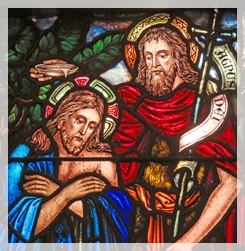
One day when the crowds were being baptized, Jesus himself was baptized. As he was praying, the heavens opened, and the Holy Spirit, in bodily form, descended on him like a dove. And a voice from heaven said, “You are my dearly loved Son, and you bring me great joy.” [Luke 3:21-22 (NLT)]

Baptism of JesusAlthough I don’t remember my Baptism as an infant, I do have a picture that tells me I wore a long white dress and a bonnet. Another picture tells me that I wore a shorter white dress, a hat instead of a bonnet and my first pair of nylon stockings and heels at my Confirmation thirteen years later. That, however, is about all I remember of making a public reaffirmation of my faith and recommitting to the baptismal promises made for me when I was a baby. Although I knew a lot about Jesus at the time, I’m not sure that I truly knew Him. I know Him now and, in a much simpler ceremony, I recently reaffirmed my Baptism in a way I will never forget.

The first Sunday after Epiphany is when many churches celebrate the Baptism of our Lord which is the case at one of the churches we attend. The hymns (When Jesus Came to Jordan, O Come and Dwell in Me, and On the Wings of a Snow White Dove) set the stage. The readings from Isaiah, Acts, and Luke kept our focus on Baptism and the pastor’s sermon continued the theme as she told of her visit to the Holy Land, standing where John may have baptized Jesus, and collecting water from the Jordan River. After the sermon, she offered us the opportunity to reaffirm our Baptisms when we came to the altar to receive Communion.

The Pastor held a chalice filled with water and, when we approached her, she dipped her finger in it, made the sign of the cross on our foreheads and said, “In Baptism you were marked with the cross of Christ and sealed with the Holy Spirit forever.” That she’d collected the water from the Jordan River made it even more meaningful. If there could be frosting on this cake, it is that we then received the bread and wine of the Lord’s Supper. With just two steps, I passed from the beginning of Jesus’s ministry—His Baptism when the Holy Spirit descended upon Him—to the night He was betrayed and instituted Communion. I accepted the wafer from a second person, dipped it in a chalice of wine held by a third and ate it while remembering the body that was given and the blood that was shed, not just for me, but for all of us.

It’s rare that we celebrate the two New Testament ordinances (what many call sacraments) together and I found it a moving experience. Baptism and the Lord’s Supper are the two rituals or practices that Jesus commanded (or ordained) the assembly of believers to observe. Baptism is not what a person does to be saved; our salvation is by grace through faith in Jesus Christ. Nevertheless, Baptism is something a saved person does. It symbolizes the death of the old life and our resurrection as a new person in Christ. While it’s only done once, it can be reaffirmed, as I did last weekend. Participating in Communion is another thing the saved person does. Unlike Baptism, however, taking Communion is something the saved person does throughout his life. When we partake of the Lord’s Supper, we walk as that new person in Him and connect not just with our Lord but with all with all believers, both past and present.

No matter how long ago we became Christians or the age at which we were baptized, let us always remember that we have been marked with the cross of Christ and sealed with His Holy Spirit forever.

Those who believed what Peter said were baptized and added to the church that day—about 3,000 in all. All the believers devoted themselves to the apostles’ teaching, and to fellowship, and to sharing in meals (including the Lord’s Supper), and to prayer. [Acts 2:41-42 (NLT)]

Copyright ©2019 jsjdevotions. All rights reserved.