
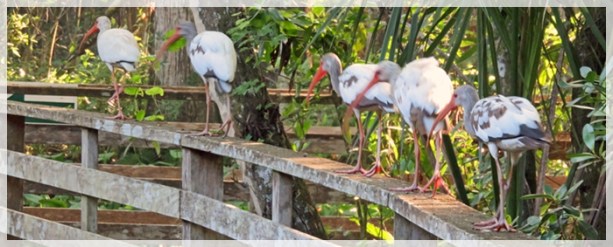
Jesus called out to them, “Come, follow me, and I will show you how to fish for people!” … As Jesus was walking along, he saw a man named Matthew sitting at his tax collector’s booth. “Follow me and be my disciple,” Jesus said to him. So Matthew got up and followed him. … [Matthew 4:19,9:9 (NLT)]
After deciding to explore a park we’d just discovered, I became apprehensive when no map was available on line or posted at the park. It’s not like we were going to get hopelessly lost on asphalt trails and a boardwalk; nevertheless, I was uncomfortable not knowing exactly where the trails would lead. Then again, I’m the sort of person who keeps all sorts of maps in her car, buys guidebooks, Map Quests a location, uses her GPS and never leaves home without a reservation. Admittedly, I’m also a person with a lousy sense of direction so I need all the help I can get!
Simon Peter, Andrew, John and James—they all abandoned their nets, boats, livelihoods, and even the day’s catch to follow Jesus! Later, Jesus called Matthew out of his tax collector’s booth and the taxman immediately followed. That these men responded to Jesus’ call and readily left their old lives behind is remarkable. More astonishing for me is that, after Jesus said, “Follow me,” none of them asked “Where?”
If someone told me to follow him, I’d be sure to inquire, “Where?” Then, I’d probably want to know the route we’d take, whether I’d like it there, when we’d return, where we’d be staying, and what we’d be doing whenever we got to wherever it was we were going. Before they dropped everything to follow Him, those disciples never asked Jesus their destination (or anything else, for that matter). I never even liked playing “Follow the Leader.” Yet, when the disciples blindly followed their leader, they weren’t playing a silly childhood game. The stakes were much higher and their lives were never the same.
When Jesus says, “Follow me!” He expects us to trust Him enough to do just that. Granted, it’s frightening to step into the unknown but the sheep don’t get to ask the shepherd where they’re going and neither do we. Moreover, following Jesus doesn’t mean fitting His plan into our lives; following Jesus means fitting our lives into His plan. Even without a compass, maps or GPS, we can never be lost when we’re following Him because He’ll never lead us astray. Moreover, while we may not know the route He’ll take, we do know we’ll be doing His work along the way. When we think about it, we also know that our final destination is well worth the trip!
 around me, myself and I: my toys, my games, my friends, my wants, my school, my plans. As I matured, I became a little less self-involved but I have to admit that my priorities still revolved around me: my education, my husband, my children, my family, my projects, my future! All of these are important, but no matter how much I love my husband, children and grandchildren, and no matter how worthwhile my projects or causes, none of these should be my first priority. That should always be God.
 The Philistine army, hoping to capture King David, raided the valley of Rephaim. Before responding to the attack, David stopped and asked God what action he should take. He didn’t present his battle plan for God’s consideration nor did he take action before receiving God’s instruction. God told David to go to battle, assuring him of victory over the Philistines. When the battle went as God had promised, David wisely did not take credit for the victory. “God did it!” he exclaimed, giving credit where credit was due. The Philistines, however, returned and raided the valley again. Although David had previously defeated them, he didn’t assume a similar victory the second time. Again, the shepherd king paused, looked to God for his battle plan and listened to His advice. This time, God gave him a new strategy, telling David to circle his army around behind the Philistines and wait for a sound like marching feet in the trees before attacking. David followed God’s advice and was victorious once again.
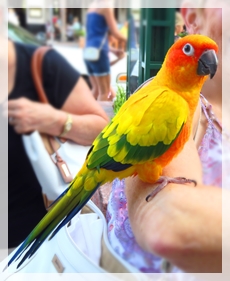 We were strolling through downtown during a street festival when we came upon the “bird lady.” With three parrots on her shoulders, she was surrounded by a number of people. I assumed she was a street entertainer who expected to be paid for pictures with the birds. As I ventured closer, however, she offered to let me hold one of her parrots. Never having touched a bird, I accepted her offer, anticipating a request for money. While the colorful bird wandered up and down my arm, the woman offered me a little food to give the beautiful animal. As my husband grabbed the camera from my purse, I kept looking for the tip jar or expecting to be asked for a “donation.” Instead, when I returned the bird, she handed me a small leaflet, saying “Here’s something about Jesus.” When I responded “God bless you” she said, “If you know Him, pass it on!” The crowd closed in and we continued walking on our way. Another person would soon experience three friendly parrots, an interesting woman, some Christian love and God’s good news. It was a mini-example of God’s grace. While I kept thinking I had to pay for the encounter, it came at no cost to me; it was given out of love—love of Jesus! Unexpected, undeserved and free—that’s grace in a nutshell!
 In Hebrew, mitzvah means command and the mitzvoth are the 613 commandments that came from God in the Old Testament. In Reformed Judaism (and Yiddish), mitzvah has come to mean “good deed.” In actuality, I’m sure any good deed falls somewhere within one of those 613 original commands! Moreover, isn’t every good deed a way to connect with God and express both our love for Him and for our neighbor?
 Devotions of the Heart