NOT SO INNOCENT BYSTANDERS

Here is a simple, rule-of-thumb guide for behavior: Ask yourself what you want people to do for you, then grab the initiative and do it for them. Add up God’s Law and Prophets and this is what you get. [Matthew 7:12 (MSG)]

giraffes Back in 1964, it was the slaying of Kitty Genovese in New York City. For thirty-five minutes, at least 38 people watched a killer stalk and murder her. Twice the attacker was frightened off by lights or voices but, when the police didn’t arrive and no one came to the woman’s aid, her assailant returned to continue his vicious attack. Apparently, the only call to the police was made after the woman was dead.

The Genovese story made headlines across the nation in 1964 and I had no trouble remembering her story and name today. Nowadays, however, stories like hers don’t seem to give us pause. In February of this year, a Chicago man was sucker-punched, knocked unconscious, and landed in the street. Surveillance footage shows that more than a dozen bystanders failed to come to his aid in the nearly two minutes before a cab accidentally hit him. No one tried to pull him out of the street or even to stop traffic. In fact, within seconds of his being punched, while others watched, two men ran up and rifled his pockets, taking his wallet and cell phone. The young man died from his injuries a few hours later. Last April, a girl was attacked by a man and woman on a Chicago commuter train. As she screamed for help, fellow passengers on the train did nothing to help—they simply watched as the nineteen-year old was brutally beaten. Even more shocking is that, after the attack, rather than calling the police or coming to her aid, the witnesses left the train car. More than fifty years have passed and people still won’t get involved. Worse, in this era when onlookers post videos of muggings, schoolyard attacks and rapes, stories like these no longer seem to shock us.

As Christians, we know that we should treat others as we want to be treated. We’re sure that we would never be the kind of bystander who ignores a cry for help and picture ourselves as being the Good Samaritan. In reality, most of us would probably be more like the priest or Levite and avert our eyes or go the opposite way. This attitude of indifference is so prevalent that psychologists have a name for it: Bystander Apathy. Apparently, the greater the number of witnesses, the less likely we are to help. First, we look to others for clues—if they don’t appear to think help is necessary, neither do we. Second, with more bystanders, each person feels less individual responsibility. Surely, someone else has called for help we think as we walk away. Studies have shown that when others are present, people will help only 20% of the time but, when there is only one bystander, the likelihood of offering help raises to 80%. 80%, however, is not good enough.

As you might have guessed, the text for a recent sermon was the parable of the Good Samaritan. An interesting question was asked: who do you think represents Jesus in the story? The obvious answer is the Samaritan because he had mercy, showed love, paid the man’s debt and promised to return. It was suggested that we also consider the victim as a Jesus figure. He was beaten, stripped, and left to die, as was our Lord. He was ignored by the pious Jews, as was Jesus. He was accepted by the outcast Gentile, as was Jesus. I couldn’t help but think of our Lord’s warning that when we ignore the needs of others, we’ve ignored Him. While we may be willing to pay no attention to the screams of a woman in an alley, an unconscious man in the street, or a girl’s plea for help, are we willing to ignore the cries of our Lord?

Father, forgive us for being indifferent and unresponsive to our brothers and sisters. Instead of looking to others to know how to react, remind us to look to you. Don’t let us turn our backs to those in need; give us courage enough to become involved.
Then those ‘sheep’ are going to say, “Master, what are you talking about? When did we ever see you hungry and feed you, thirsty and give you a drink? And when did we ever see you sick or in prison and come to you?” Then the King will say, “I’m telling the solemn truth: Whenever you did one of these things to someone overlooked or ignored, that was me—you did it to me.” … He will answer them, “I’m telling the solemn truth: Whenever you failed to do one of these things to someone who was being overlooked or ignored, that was me—you failed to do it to me.” [Matthew 25:37-40,45 (MSG)]

Copyright ©2016 jsjdevotions. All rights reserved.

EMPTY PAGES

You are my God, and I give thanks to you. My God, I honor you highly. Give thanks to the Lord because he is good, because his mercy endures forever. [Psalm 118:28-29 (GW)]

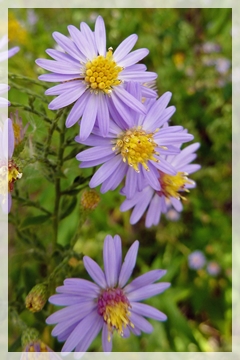
New England asterLast week, I sat down to write in my gratitude journal and couldn’t believe my eyes. I hadn’t written in it for seven days. “I write in it every day!” I protested. Surely there was a mistake—pages must be missing. It wasn’t and they weren’t—the mistake was mine and it wasn’t pages that were missing; it was gratitude! It had been a week jam-packed with family, errands, chores, and writing—a week of “same old, same old,” just at a faster pace than usual. That, however, was no excuse for a heart oblivious to the blessings of seven ordinary days. Surely, within each one of those unexceptional but busy days there had been something for which I could thank God. Although I always offer thanks in my daily prayers, that journal has been a way of making me mindful of God’s specific blessings of each day—a way of making me see His hand in a life of the “same old, same old.”
As I tried to recollect the previous week, I realized how many things I could have listed: a self-cleaning oven, on-line banking, Amazon Prime, Excel spreadsheets, Photoshop, Moody radio, no-iron clothes, auto-save, email, peanut butter, purple asters, discount coupons, honey crisp apples, text messaging and Google. My greatest oversight, however, was not mentioning my husband in that gratitude journal. No, he didn’t do anything out-of-the ordinary; he’s still the same old husband I’ve had for nearly fifty years. Still, I’d taken him for granted, just as I had all the rest of the week’s blessings. I’d neglected to thank God that I still have a spouse to hug when a friend lost her husband to cancer that same week. Oh, how easy it is to take the blessings of our unremarkable ordinary lives for granted.

It wasn’t until something special and out of the ordinary happened that I looked for my gratitude journal and discovered those blank pages. Most of our days, however, are not extraordinary. Rarely are they marked by outstanding achievements or special recognition. For the most part, our lives are simply the “same old, same old,” consisting of the familiar daily grind with a few minor variations. Nevertheless, hidden within each ordinary day are plenty of reasons for thanksgiving, beginning with our first breath of the day.

The unthankful heart…discovers no mercies; but let the thankful heart sweep through the day and, as the magnet finds the iron, so it will find, in every hour, some heavenly blessings! [Henry Ward Beecher]

When I first open my eyes upon the morning meadows and look out upon the beautiful world, I thank God I am alive. [Ralph Waldo Emerson]

Always thank God the Father for everything in the name of our Lord Jesus Christ. [Ephesians 5:20 (GW)]

Enter his gates with a song of thanksgiving. Come into his courtyards with a song of praise. Give thanks to him; praise his name. [Psalm 100:4 (GW)]

Copyright ©2016 jsjdevotions. All rights reserved.


SERVE THE LORD WITH GLADNESS

Worship the Lord your God and only the Lord your God. Serve him with absolute single-heartedness. [Luke 4:8 (MSG)]

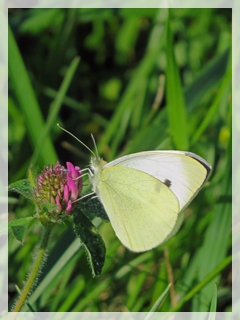
cabbage white butterfly on red clover

In The Book of Common Prayer, Psalm 100 begins with the words, “O be joyful in the Lord, all ye lands; serve the Lord with gladness, and come before his presence with a song.” As a girl, I frequently read those words in my prayer book before worship began. I thought of them again last Sunday. Following the recessional, the visiting pastor exclaimed, “Our worship has ended, let our service begin!” During worship, I’d made a joyful noise and come before the Lord with a song. The minister’s words reminded me that now was the time to serve Him with gladness. The hour or so spent in worship on Sundays is just a small part of a Christian’s life. God blesses us with another 167 hours in the week. How will we choose to serve Him in that time?

Heavenly Father, thank you for the reminder that when our worship ends, the real work of furthering your Kingdom begins. May we not just hear your word, but comprehend it. May we not just say your word, but live it. Let your word turn into our works and cause our faith to turn into action. May we always serve you with gladness.

The greatest single cause of atheism in the world today is Christians: who acknowledge Jesus with their lips, walk out the door, and deny Him by their lifestyle. That is what an unbelieving world simply finds unbelievable. [Kevin Max]

 I slept and dreamt that life was joy. I awoke and saw that life was service. I acted and behold, service was joy. [Rabindranath Tagore]

So here’s what I want you to do, God helping you: Take your everyday, ordinary life—your sleeping, eating, going-to-work, and walking-around life—and place it before God as an offering. Embracing what God does for you is the best thing you can do for him. Don’t become so well-adjusted to your culture that you fit into it without even thinking. Instead, fix your attention on God. You’ll be changed from the inside out. Readily recognize what he wants from you, and quickly respond to it. Unlike the culture around you, always dragging you down to its level of immaturity, God brings the best out of you, develops well-formed maturity in you. [Romans 12:1-2 (MSG)]

Copyright ©2016 jsjdevotions. All rights reserved.

CHRISTIAN FELLOWSHIP

All the believers devoted themselves to the apostles’ teaching, and to fellowship, and to sharing in meals (including the Lord’s Supper,) and to prayer. [Acts 2:42 (NLT)]

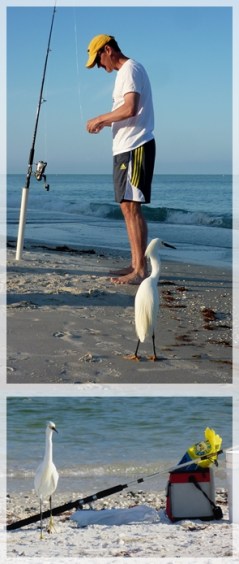
egret at clam passI watched the snowy egret at the beach and couldn’t quite decide if he was an exceptionally smart bird, just plain lazy, or a little of both. Egrets are excellent fishermen and will wade in the shallows stirring up the water with their feet to flush out delicacies like fish, frogs, and crayfish. Other times, they exhibit great patience as they stand nearly immobile for several minutes just waiting for their prey to come near enough for them to strike and catch dinner.

This egret, however, wasn’t wading in the water; he was cruising the beach and visiting various fishermen. Cast netting for bait, the anglers were hurling their nets into the surf. While pulling in the bait-filled nets and dumping the contents in a bucket, a few of the minnows always fall out and that’s what this bird was awaiting. Apparently, he prefers carry-out to hunting and may even prefer shop-lifting if he snatches minnows out of the buckets. Clearly, he wants others to do the work while he reaps the benefits. I look at our churches and think we have a lot of people who are like that egret—people who are willing to let the other guys do most or even all of the work.

The early church devoted itself to learning from the Apostles, eating together, prayers, and fellowship. They didn’t just have fellowship, they dedicated themselves to it. Today, many church-goers would define Christian fellowship as having coffee with other parishioners before or after church. Fellowship in the first century, however, meant much more than that and continues to mean more today. Christian fellowship is concern and commitment to one another; it is caring for and sharing with one another. Moreover, we need to share more than our beliefs, activities, interests, communion or coffee. For true Christian fellowship, we need to share our responsibilities and work, especially if we are to fulfill the call to care for one another.

The volunteers at our church were recently recognized while the rest of the congregation stood and gave them a round of applause. Remembering that we don’t just attend a church but are part of one, rather than giving our church volunteers a hand, we need to think about giving them both of our hands, sharing in their responsibilities, and enjoying true Christian fellowship with our brothers and sisters in Christ!

Is there any encouragement from belonging to Christ? Any comfort from his love? Any fellowship together in the Spirit? Are your hearts tender and compassionate? Then make me truly happy by agreeing wholeheartedly with each other, loving one another, and working together with one mind and purpose. Don’t be selfish; don’t try to impress others. Be humble, thinking of others as better than yourselves. Don’t look out only for your own interests, but take an interest in others, too. You must have the same attitude that Christ Jesus had. [Philippians 2:1-5 (NLT)]

Copyright ©2016 jsjdevotions. All rights reserved.

MY COMPASS

Give me your lantern and compass, give me a map, So I can find my way to the sacred mountain, to the place of your presence, To enter the place of worship, meet my exuberant God, Sing my thanks with a harp, magnificent God, my God. [Psalm 43:3-4 (MSG)]

All sunshine and sovereign is God, generous in gifts and glory. He doesn’t scrimp with his traveling companions. It’s smooth sailing all the way with God-of-the-Angel-Armies. [Psalm 84:11-12 (MSG)]

compass plant

Fortunately, I’m not an explorer—my sense of direction is terrible and I’m not so handy with a compass.  Besides, compasses can’t be trusted. Because the earth actually is one big magnet, instead of pointing to true north (the “North Pole”), a compass will align itself with the earth’s magnetic field. Although true north is located somewhere in the Arctic Ocean, a compass points to magnetic north, which is about 500 km away on Ellesmere Island in Northern Canada. To make it even more confusing, magnetic north is always moving and has moved 1000 km in the last 150 years. Unfortunately, finding true north is essential for accurate navigation, which is why I defer to the captain of my ship and the pilot of my plane when travelling long distances.

Folklore has it that one of my favorite wildflowers can find true north better than most compasses. The Compass Plant (or Silphium laciniatum as the botanists would say) stands six to twelve feet tall and its bright yellow flowers are beacons in the prairie. In bright sunlight, its leaves tend to orient themselves in a north-south pattern to avoid the direct rays of the midday sun. Apparently, the plant got its name because the pioneers used it to guide them across the Midwest prairies. I’m not so sure about its accuracy since, from my observation, the leaves tend to go every which way. The flowers, however, always seem to point in the same direction—toward the sun!

Finding our true north is as essential in life as it is in navigation and it’s even easier to be lost in life’s journey than it is on the prairie or in the ocean. Uncertain of where we are, we’re often unclear about where we’re going or what path we are to take to get wherever it is. Life’s true north, of course, has nothing to do with the North Pole, the earth’s axis, magnetic variations, grid lines, maps or even compasses. If I need to know where I am, where I need to go, or how to get there, I’m going to follow the example of the Compass Plant and look to the Son!

Jesus once again addressed them: “I am the world’s Light. No one who follows me stumbles around in the darkness. I provide plenty of light to live in.” [John 8:12 (MSG)]

Jesus summed it all up when he cried out, “Whoever believes in me, believes not just in me but in the One who sent me. Whoever looks at me is looking, in fact, at the One who sent me. I am Light that has come into the world so that all who believe in me won’t have to stay any longer in the dark. [John 12:44-46 (MSG)]

Copyright ©2016 jsjdevotions. All rights reserved.


AUTOFOCUS

For I have often told you, and now say again with tears, that many live as enemies of the cross of Christ. Their end is destruction; their god is their stomach; their glory is in their shame. They are focused on earthly things. [Philippians 3:18-19 (HCSB)]

golden-silk-spider-Nephila clavipesI have a love-hate relationship with my camera and its autofocus. An enormous golden silk spider hangs over the boardwalk we take through the mangroves to the beach. Officially the Nephila clavipes, the female of this species is the largest non-tarantula-like spider in North America. This impressive arachnid has spun her giant orb-like web high above the walkway. She often scares tourists when they glance up to see her suspended above their heads. While I managed to get a shot that of spider, I’d hoped to get a few more of others that have spun their webs down closer to the boardwalk. Autofocus, however, was my enemy. Because their webs were nestled in the trees, the camera looked right through the spiders and focused on the large branches and leaves behind them. My camera focused only on the spider when nothing was behind the creature, but it had plenty on which to focus when pointed at the spiders in the mangroves. The ease of having a small point-and-shoot camera that is so easy to use keeps me loving (but occasionally hating) it.

Similar to a camera with autofocus, we occasionally focus on the wrong things in life. The consequences, however, are far worse than a few blurry photos. Like my camera, we look at the big things in the background—the unimportant things—rather than what is right in front of us. We automatically focus on all that we lack rather than the little that we have, on all that’s wrong rather than what is right, and on the doors that are shut rather than the door that is open. We worry about our tomorrows rather than focusing on today and see all of the reasons we can’t rather than the reason we can. We focus on the mistakes of yesterday rather the possibility of tomorrow and how bad we are rather than how great our God is. In short, we focus on the world instead of focusing on God. He’s right there in front of us but, sometimes, all that other stuff in the background keeps us from seeing Him! We need to set our autofocus on God and His promises rather than the world and our problems.

Focus on giants – you stumble. Focus on God – Giants tumble. [Max Lucado]

When trouble comes, focus on God’s ability to care for you. [Charles Stanley]

So we do not focus on what is seen, but on what is unseen. For what is seen is temporary, but what is unseen is eternal. [2 Corinthians 4:18 (HCSB)]

Let us run with endurance the race that lies before us, keeping our eyes on Jesus, the source and perfecter of our faith, [Hebrews 12:1b-2a (HCSB)]

Copyright ©2016 jsjdevotions. All rights reserved.