
But Moses protested to God, “Who am I to appear before Pharaoh? Who am I to lead the people of Israel out of Egypt?” God answered, “I will be with you. [Exodus 3:11-12a (NLT)]
 Not all of us have the benefit of eighty years’ experience as did Moses when God called on him. Take David, for example, he was just a young shepherd boy when called on to become both warrior and king. Peter and John were fishermen; nothing in their backgrounds prepared them for their roles as Apostles and founders of a church. Mary was just a girl, in the town of Nazareth, engaged to be married to a local carpenter. What preparation did she have to become the mother of God? Gideon was a farmer, hiding from the Midianites in a wine press while threshing wheat, when God called to him. In fact, Gideon protested that, as the most insignificant member of the weakest clan, he couldn’t be the one to rescue Israel.
When God called to Moses from that burning bush, Moses didn’t see his eighty years’ experience as an asset. Instead, like Gideon, he focused only on his inadequacies. Understandably, the man raised in Pharaoh’s court wondered how the elders of Israel would believe he had been chosen to free their people let alone how an exile could convince Pharaoh to let the people of Israel leave his country. God, however, provided Moses with the additional tools and skills necessary to do the job. He was given three signs to demonstrate God’s power to the Israelites and was enabled to perform miracles before Pharaoh. When Moses pointed out that he wasn’t eloquent, God promised to give him the necessary words and then provided him with Aaron to serve as his mouthpiece. God empowered His servant and provided all that was necessary to achieve His task.
While God probably won’t get our attention with a burning bush, I think He regularly calls to us with tasks. There’s a good chance we’ll be like Gideon and Moses and see only our inadequacies and, like those men, we will be inadequate on our own. God, however, doesn’t ask us to do His work by ourselves. He told Gideon, “I will be with you!” and He will be with us. As God did with Moses, He will shore up our weak spots and provide us with the resources and skills we need to accomplish His will. God doesn’t call the equipped; He equips the ones He calls!
 As we watched the helicopters fly through the sky, we could see the water buckets hanging under them. Once the copters were in position, hoping to extinguish the forest fire, the crews would open the dump valve and empty water on the flames below them. The helicopters flew back and forth all afternoon as they refilled their buckets from the glacial lakes. If the helicopters are too low or slow in dropping the water, the water will be too concentrated to work effectively and, rather that put out the flames, the rotors’ downwash will intensify it. Even though those buckets can carry as much as 2,600 gallons of water, to those of us on the ground, it seemed a little like a mop bucket was being used to extinguish a house fire. Nevertheless, the firefighters continued their valiant fight against the blaze.
 They [the Levites] are to stand every morning and evening to thank and praise the Lord. [1 Chronicles 23:30 (NLV)]
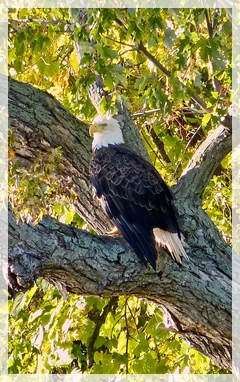 The eagle is mentioned more than any other bird of prey in the Bible. References are made to its swiftness of flight, ability to soar high in the air, excellent vision, the way it sets its nest in high places, and the strength of its wings. The above two verses about eagles, however, are more figurative than literal and have no scientific basis. Although mother eagles do hover over their young, they cannot carry them. A bald eagle’s lifting power is only about a third of its weight. An eaglet ready to fly is as heavy as its parents. If Mrs. Eagle tried to carry junior, they’d both fall! The second verse about being renewed like an eagle is probably connected to an ancient belief that every ten years the eagle disappeared into the sun, dove down into the sea with the setting sun, and emerged young again. There’s a similar urban myth that at 30 years of age, the eagle flies to a high mountain top and makes the difficult decision between death or the painful plucking out of all of its feathers and the destruction of its beak and talons. After waiting several months for everything to grow back again, it will be transformed and the refreshed bird will be able to live another 30 years. Not so; like the rest of us, when it’s time to grow old and die, the eagle has no choice. Like other birds, however, when the eagle molts, old worn feathers will drop and new ones will replace them.
 After it was returned by the Philistines, the Ark of God had been neglected in Kiriath-jearim for twenty years. Fresh from victories over the Philistines, David decided to bring the Ark back to its rightful home in Jerusalem. It certainly seemed like a good idea at the time. Unfortunately, ignoring the law’s clear instructions that the Ark could only rest on poles and carried on the shoulders of Levites, David had it placed on a cart pulled by oxen. The oxen stumbled, the cart tipped, and Uzzah reached out to steady it. Under Hebrew law, touching the sacred Ark was a capital offense and Uzzah was immediately struck dead. The Ark should never have been on a cart and it was David’s disobedience and carelessness that caused the man’s death. Nevertheless, David’s reaction was to get mad at God.
 Devotions of the Heart