
Don’t be misled—you cannot mock the justice of God. You will always harvest what you plant. [Galatians 6:7 (NLT)]
 “It wasn’t worth it!” I grumbled while applying cortisone over four painful red bumps on my foot. When walking around the lake at the botanic gardens, I’d spotted an osprey in a nearby tree. To get a good shot, I had to step off the paved trail into what I knew to be fire ant territory. Having had previous encounters with these stinging insects, I knew better than to stand there in sandals, but I did it anyway; the picture wasn’t worth the price I was paying for my poor decision.
It’s not just fire ants that cause us to regret our poor choices. Wanting to sow his wild oats, the prodigal son enjoyed himself while recklessly spending his inheritance but, when the hungry young man was slopping pigs, he knew his wild living hadn’t been worth it. Adam and Eve (and the rest of mankind) paid a hefty price for a bite of an apple: banishment from Eden, painful childbirth, marital discord, toil and death. I wonder if David thought adultery worth the price he paid: his first son by Bathsheba died, he was humiliated when Absalom publicly took his wives, and violence and rebellion plagued his family. King Manasseh knew better than to build pagan shrines, sacrifice his own children, and place a carved idol in the temple. The price he paid was being led away to Babylon in bronze chains with a ring in his nose. Fortunately for him, Manasseh was given a second chance by God; not everyone is so lucky. Lot’s wife had been warned; was that last look at Sodom worth the price she paid? Then again, as a pillar of salt, she could gaze at the city’s ruins forever.
After nearly 3000 prescription pills were found in her possession, a sheriff’s deputy in a northern community pled guilty to “attempted possession of a controlled substance.” Punishable by up to a year in prison, she was sentenced to seven days in jail and a year of “conditional discharge.” Less restrictive than probation, conditional discharge means the court retains jurisdiction over her with several provisions including drug and alcohol evaluations, no employment where she might have access to drugs, and no use or possession of a firearm. Since the original charge was negotiated down from felony possession (meaning four to fifteen years in prison), most of us would think she got off easy. Apparently expecting probation with no jail or restrictions, the defendant was shocked by what she considered a harsh sentence. As a deputy, she couldn’t plead ignorance of the law or its consequences; nevertheless, she thought the price she paid too high. My study Bible speculated that had David known the cost of his sin, he might not have bedded another man’s wife. I disagree. As a king, David knew the law given in Leviticus: the punishment for adultery was death for both he and Bathsheba! Like the deputy, he knew the consequences and like her, he got off easy.
Stepping onto an ant hill has painful consequences but so does sin. The penalty I paid for that photo was negligible compared to the cost of many of our poor decisions. When choosing between right and wrong, the price we pay can be far greater and longer lasting than a few insect bites. Although Jesus paid the price for our sins on the cross and God promises forgiveness when we repent, we still have to face the consequences of our sins here on earth. We, however, are not the ones who get to pick and choose what those consequences will be nor do we get to complain and say, “But God, it wasn’t worth it!”
Temptation can be tormenting, but remember: The torment of temptation to sin is nothing to compare with the torment of the consequences of sin. Remorse and regret cannot compensate for sin….though sins can be forgiven immediately – the consequences can last a lifetime. [Edwin Louis Cole]
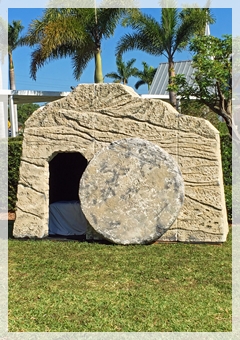 Yesterday I mentioned the wooden cross and rustic nail on my desk that serve as reminders of the terrible price Jesus paid for our salvation. Although early Christian symbols included a dove, ship, lyre, anchor, and fish, the cross has become the universal symbol for Christianity. While Coca-Cola’s logo, Nike’s swish and McDonald’s golden arches may come close, I doubt there is any so recognizable sign in the world. Nevertheless, a gruesome instrument of Roman torture seems an odd symbol for a faith that preaches such things as reconciliation, sacrifice, forgiveness, hope, love, and peace. While I’d never wear a miniature gallows, guillotine, or electric chair on a chain around my neck, I do wear a cross. Although it symbolizes everything that happened to Jesus on that dark Friday two thousand years ago, the cross would be meaningless if the tomb had not been empty Sunday morning.
 After warning us not to put them in our pockets and accidentally take them home (or put them in the dryer if we did), small pieces of paper were given to everyone in attendance at last week’s Good Friday service. Following the sermon, we were asked to write a sin (or sins) for which we repent on the papers, come forward, and nail them to a cross resting on the steps before the altar. Listening to the hammering echoing in the sanctuary, I thought of what it must have sounded like two thousand years ago when Jesus and the others were hammered to their crosses: the loud pounding of the hammers, the commotion of the crowd, the mockery of the soldiers, and the cries of agony from the men as those blunt tipped nails pierced their bodies.
 They [the Pharisees] asked him, “Why do your disciples disobey our age-old tradition? For they ignore our tradition of ceremonial hand washing before they eat.” Jesus replied, “And why do you, by your traditions, violate the direct commandments of God?” [Matthew 15:1b-3 (NLT)]
 The Lord does whatever pleases him throughout all heaven and earth, and on the seas and in their depths. [Psalm 135:6 (NLT)]
 Last month, my husband and I attended a “Sweetheart” dinner at church. The men were in charge of the entire event and there were a few rough spots in the night. Then again, at the risk of being accused of political incorrectness or gender bias, most of the men probably were novices at that kind of event planning. Unlike the men, we women have had decades of organizing (and attending) school parties, PTA fund raisers, charity galas, birthday parties, showers, weddings, anniversary bashes, and other assorted celebrations. In spite of the glitches, there was much that went right and the evening was enjoyable and entertaining. Unfortunately, the woman sitting beside me kept criticizing how things were done—from name tags and table assignments to flowers and dessert. Her nit-picking comments became as annoying as the yapping of a bad-tempered dog and I thought of a bumper sticker I’d recently seen: “Wag More, Bark Less!”
 Devotions of the Heart