THE EMPTY TOMB

You are looking for Jesus of Nazareth, who was crucified. He isn’t here! He is risen from the dead! [Mark 16:6 (NLT)]
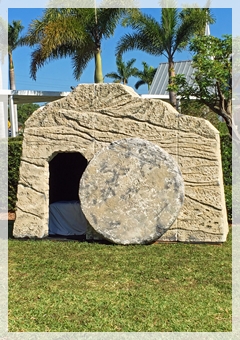
empty tomb - north naples churchYesterday I mentioned the wooden cross and rustic nail on my desk that serve as reminders of the terrible price Jesus paid for our salvation. Although early Christian symbols included a dove, ship, lyre, anchor, and fish, the cross has become the universal symbol for Christianity. While Coca-Cola’s logo, Nike’s swish and McDonald’s golden arches may come close, I doubt there is any so recognizable sign in the world. Nevertheless, a gruesome instrument of Roman torture seems an odd symbol for a faith that preaches such things as reconciliation, sacrifice, forgiveness, hope, love, and peace. While I’d never wear a miniature gallows, guillotine, or electric chair on a chain around my neck, I do wear a cross. Although it symbolizes everything that happened to Jesus on that dark Friday two thousand years ago, the cross would be meaningless if the tomb had not been empty Sunday morning.

As we walked out of worship service on Easter morning, we came upon a large replica of a stone tomb. The boulder that had covered its opening since Friday was rolled away and it was empty except for some linen cloth resting on a ledge. Like the women who came early that first Easter morning (and Peter and John who arrived later), a few curious children entered the tomb. No angel was there to reassure them, but they didn’t need one. They’d come from Sunday school and know the Easter story well. At worship services, they’ve joined their parents in saying: “Christ has died; Christ is risen; Christ will come again.” Rather than frighten them, that dark empty tomb reassured them of Jesus’s continual presence in their lives.

Jesus’s death upon the cross is important but it is His rising from the dead that demonstrates triumph over evil, sin, hate, and death. It is the empty tomb that allows us to say these words in the Apostle’s Creed: “I believe in Jesus Christ…[who] was crucified, died and was buried; he descended to the dead. On the third day he rose again… I believe in…the resurrection of the body and the life everlasting.”

Out of curiosity, I searched the stock of several Christian supply stores using the word “tomb.” There were plenty of books, choral collections, CDs, and songs with “tomb” in the title, some Easter stickers depicting an empty tomb, and even a “Raiders of the Empty Tomb” kit, but there were no empty tomb t-shirts, paper weights, jewelry, or wall décor. Apparently, there is no danger of an empty tomb replacing the cross as the universal symbol of Christianity. Nevertheless, when we see a cross, let us never forget that the story of God’s love for us did not end at Golgotha. It didn’t even end with the empty tomb three days later. The story of God’s presence, grace and love continues today.

Christians do not believe in the empty tomb, but in the living Christ. [Karl Barth]
So you see, just as death came into the world through a man, now the resurrection from the dead has begun through another man. Just as everyone dies because we all belong to Adam, everyone who belongs to Christ will be given new life. But there is an order to this resurrection: Christ was raised as the first of the harvest; then all who belong to Christ will be raised when he comes back. [1 Corinthians 15:21-23 (NLT)]

Copyright ©2018 jsjdevotions. All rights reserved.

GONE IN A FLASH – EASTER MONDAY

And just as each person is destined to die once and after that comes judgment, so also Christ was offered once for all time as a sacrifice to take away the sins of many people. He will come again, not to deal with our sins, but to bring salvation to all who are eagerly waiting for him. [Hebrews 9:27-28 (NLT)]

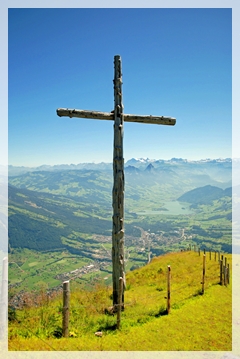
Zermatt - Switzerland - crossAfter warning us not to put them in our pockets and accidentally take them home (or put them in the dryer if we did), small pieces of paper were given to everyone in attendance at last week’s Good Friday service. Following the sermon, we were asked to write a sin (or sins) for which we repent on the papers, come forward, and nail them to a cross resting on the steps before the altar. Listening to the hammering echoing in the sanctuary, I thought of what it must have sounded like two thousand years ago when Jesus and the others were hammered to their crosses: the loud pounding of the hammers, the commotion of the crowd, the mockery of the soldiers, and the cries of agony from the men as those blunt tipped nails pierced their bodies.

Those slips of paper were made of nitrocellulose; often used by magicians, they are commonly known as flash papers. Once we’d nailed our papers to the cross, the pastor ignited them and they instantly disappeared in a brilliant display of fire. Nothing, neither smoke nor ash, was left of them. What a powerful illustration of the way Jesus’s blood, shed on the cross as those nails were hammered into Him, made our sins disappear forever.

Next to the small olive wood cross on my desk, I now have a three-inch square-cut nail, a souvenir from Good Friday’s service. The cross, with its distinctive grain, artistic shape, and smooth finish, is so beautiful that it’s easy to forget it represents an instrument of torture. The dark rustic nail beside it will better remind me of the sacrifice Jesus made for all of us. Paying the price for our sins, His death brought us back into fellowship with God the Father. After the joy of Resurrection Sunday, however, it’s easy to forget the magnitude of that sacrifice until Lent rolls around next year. Let us never forget the miracle of forgiveness that occurred when a suffering bleeding and totally sinless Jesus endured torture and death for the forgiveness of our sins.

He has redeemed me, a lost and condemned human being. He has purchased and freed me from all sins, from death, and from the power of the devil, not with gold or silver but with his holy, precious blood and with his innocent suffering and death. [Martin Luther]

Christ suffered for our sins once for all time. He never sinned, but he died for sinners to bring you safely home to God. He suffered physical death, but he was raised to life in the Spirit. [1 Peter 3:18 (NLT)]

Now all of us can come to the Father through the same Holy Spirit because of what Christ has done for us. [Ephesians 2:18 (NLT)]

Copyright ©2018 jsjdevotions. All rights reserved.

HONOR THY FAMILY

mute swans and cygnetsThey [the Pharisees] asked him, “Why do your disciples disobey our age-old tradition? For they ignore our tradition of ceremonial hand washing before they eat.” Jesus replied, “And why do you, by your traditions, violate the direct commandments of God?” [Matthew 15:1b-3 (NLT)]

When the Pharisees asked Jesus why his disciples ignored tradition and didn’t wash their hands before eating, theirs was not a sanitation or health question. Rather than dirt, they were concerned about defilement. More interested in washing their hands than purifying their hearts, they believed hands could become ritually unclean even by touching someone as “unclean” as a Gentile or tax collector. Eating with unwashed hands meant that the sinner’s impurity was passed to the food which would defile the person eating it. Some Pharisees even considered eating with unwashed hands as sinful as sex with a prostitute. Although Salmonella and E. coli can be passed along on someone’s hands to their food, someone’s sins certainly can’t.

Jesus responded to their question with one of His own when He asked the Pharisees why they violated God’s commandments. After all, breaking a man-made tradition is hardly the same as breaking one of God’s direct commands. The Pharisees had a tradition called korban (meaning “a gift” or “offering”).  When a korban vow was made, the Pharisee transferred all of his assets to the temple but retained the use of them until his death (sort of a “life estate”). Those assets could not be transferred or used to benefit anyone else. As a result, while the Pharisee could live quite comfortably, he could not help the poor, disadvantaged or even his parents. The commandment they were neglecting was the fifth one—that of honoring one’s father and mother. A wealthy Pharisee’s parents could be in dire financial straits and yet he could self-righteously ignore their pleas for help. As so often happened with the Pharisees, they supplanted God’s command of honoring parents with a law that gave them prestige and honored only them!

Willing to neglect their family responsibilities in the name of religion, the Pharisees had misplaced priorities. I thought of them when one of our pastors proposed we ask ourselves what things we value the most, in what order we put them, and how we allot our resources to them. He then shared his experience of being called into a council meeting at another church several years ago. When questioned about the amount of time he gave the church, his response was that he lost one family when he put the church first and he was not about to lose his new one the same way. Family would always come before the church. Note—he didn’t say God but “the church” and there can be a big difference between the two.

In effect, the Pharisees put the church or religion before both God and family. If we look at those Ten Commandments, the first four have to do with our relationship with God; the rest have to do with our relationship to other people and parents are at the top of that list. It would seem that, after God, our next priority should be family; after all, once done with creation, God created the family unit (and not the church).

While we probably won’t pledge our entire estate to the church while watching our parents lose their homes or beg on the street, I wonder if, as our pastor once did, we occasionally misplace our priorities. Do we allow our church responsibilities to overshadow our family ones? There are lots of worthy causes and, sometimes, we’re torn as to where to put our resources. While we’re never too busy for God, God work and church work aren’t always the same; there is a fine line between the two. Although I don’t pretend to know where it is, I think the Holy Spirit will let us know when we’ve crossed it. The Pharisees turned a deaf ear to the needs of their families; we must never do the same.

If God cared only about religious activities, then the Pharisees would have been heroes of the faith. [Francis Chan]

But those who won’t care for their relatives, especially those in their own household, have denied the true faith. Such people are worse than unbelievers. [1 Timothy 5:8 (NLT)]

Copyright ©2018 jsjdevotions. All rights reserved.

GOD’S GOVERNMENT

Mt. RushmoreThe Lord does whatever pleases him throughout all heaven and earth, and on the seas and in their depths. [Psalm 135:6 (NLT)]

You will be secure under a government that is just and fair. Your enemies will stay far away. You will live in peace, and terror will not come near. [Isaiah 54:14 (NLT)]

Every nation has some system of government and I wonder what system is used in God’s Kingdom. Since He doesn’t govern by committee or with a privileged ruling class, it isn’t an oligarchy or an aristocracy. He is a King, has a Kingdom, and can exercise absolute power, yet His is not a monarchy. His power didn’t come from conquest or birthright, no one gave Him the crown, and no royal scion will follow Him; His reign always has been and forever will be. With all those Old Testament rules, perhaps His is a dictatorship, albeit a benevolent one, in which God exercises absolute power for the good of the population as a whole. That sort of rule, however, would be a one-size-fits-all government. A God who has numbered the hairs on our heads and written our names on his hand knows that one size can never fit all of his unique children.

God’s Kingdom isn’t like our nation, a government “of the people, by the people, and for the people,” with its three branches of government and the checks and balances that come with it. In God’s government, all three branches are rolled into one; He makes the rules, implements them, and decides how they are to be interpreted. There’s no need for checks and balances; God can’t step over the boundaries because He has none. His reign is not dependent upon re-election or approval rating, the majority does not rule, His word is law, and the only being God needs to please is Himself. He didn’t consult with Adam and Eve about the forbidden fruit rule nor with Sodom and Gomorrah about their destruction. The Ten Commandments were not created in committee, voted on by the Israelites, ratified by Moses or tested by an Israelite court. God doesn’t need our advice, consent, or support to make the sun rise or set. Clearly, He runs neither democracy nor republic.

With any sort of earthly government, the ruler’s power is limited to his life span and his nation’s border. God’s power, however, is unlimited. He is the eternal Sovereign God over the entire universe. His is a never-ending government of love, forgiveness, righteousness, peace and justice. Unlike other forms of government, His is truthful, dependable, and free of any corruption or bureaucracy. I don’t think there is a word that describes God’s reign except, perhaps, “perfect.” After all, God is God and we are not.

For the Lord is our judge, our lawgiver, and our king. He will care for us and save us. [Isaiah 33:22 (NL)]

May your Kingdom come soon. May your will be done on earth, as it is in heaven. [Matthew 6:9 NLT)]

Copyright ©2018 jsjdevotions. All rights reserved.

MORE WAG, LESS BARK!

Finally, brethren, whatever is true, whatever is honorable, whatever is just, whatever is pure, whatever is lovely, whatever is gracious, if there is any excellence, if there is anything worthy of praise, think about these things. [Philippians 4:8 (RSV)]

 My son, sweeten thy tongue and make savory the opening of thy mouth; for the tail of a dog gives him bread, and his mouth gets him blows. [Story of Ahikar]

dogLast month, my husband and I attended a “Sweetheart” dinner at church. The men were in charge of the entire event and there were a few rough spots in the night. Then again, at the risk of being accused of political incorrectness or gender bias, most of the men probably were novices at that kind of event planning. Unlike the men, we women have had decades of organizing (and attending) school parties, PTA fund raisers, charity galas, birthday parties, showers, weddings, anniversary bashes, and other assorted celebrations. In spite of the glitches, there was much that went right and the evening was enjoyable and entertaining. Unfortunately, the woman sitting beside me kept criticizing how things were done—from name tags and table assignments to flowers and dessert. Her nit-picking comments became as annoying as the yapping of a bad-tempered dog and I thought of a bumper sticker I’d recently seen: “Wag More, Bark Less!”

Bad tempered dogs (and people) are nothing new; a similar proverb dates back to 500 B.C. in an Aramaic papyrus found in Egypt called the Story of Ahikar. “Wag More, Bark Less!” may be bumper sticker philosophy, but I wish more people (including me) did just that. After reading the qualifications and concerns of the candidates for our property association board, I was struck by how many were unpleasantly barking and nipping at each other rather than wagging their tails and showing me how well they’d work with one another and our management company. An on-line community newsletter was so filled with bark (and bite) that we stopped subscribing. Rarely are the letters to the editor in the newspaper anything but bark in the way of anger and criticism. While waiting at the bakery counter yesterday, an impatient woman yelled at the harried clerk and stormed away in a huff. Sometimes, it feels like we’re in a kennel full of angry upset dogs—yapping, baying, growling and snarling! Worse, once one dog (or person) starts barking, other dogs (and people) tend to join in the unpleasant clamor.

Like the woman beside me at that dinner, there are times I bark or snarl in disparagement, annoyance or anger rather than wag in happiness, appreciation, or compassion. In his letter to the Philippians, the Apostle Paul reminds us that we are responsible for what we put in our minds. Even in the bleakest of circumstances or worst of conditions, there is some small thing worthy of praise. Our job, as Christians, is to find it and think about it! Fortunately, we have the Holy Spirit to help us in that task. Moreover, as my mother used to say, “If you can’t say something nice, say nothing at all!” Thankfully, the Spirit gives us the self-control to do just that! If we can’t wag, at least we can muzzle ourselves so we don’t bark!

But the fruit of the Spirit is love, joy, peace, patience, kindness, goodness, faithfulness, gentleness, self-control; against such there is no law. … If we live by the Spirit, let us also walk by the Spirit. Let us have no self-conceit, no provoking of one another, no envy of one another. [Galatians 5:22-23, 25-26 (RSV)]

Copyright ©2018 jsjdevotions. All rights reserved.

GONE BANANAS

Passion flowerI have told all your people about your justice. I have not been afraid to speak out, as you, O Lord, well know. I have not kept the good news of your justice hidden in my heart; I have talked about your faithfulness and saving power. I have told everyone in the great assembly of your unfailing love and faithfulness. [Psalm 40:9-10 (NLT)]

We recently attended a program at our local zoo about giant armadillos. The speaker has spent the last seventeen years in the Brazilian Pantanal wetlands conducting research on several species ranging from peccaries to iguanas. Seven years ago, he became enamored by the elusive giant armadillo and it has been his focus ever since he realized this prehistoric creature (about five feet long and weighing up to 130 pounds) is a keystone species. With its many burrows (a new one every two days), it plays a crucial engineering role in the ecosystem; many other animals depend upon those burrows for their survival. The biologist’s enthusiasm for his topic was compelling and contagious. With his incredible passion for these amazing and endangered animals, he admitted to speaking about them whenever and wherever the opportunity arises.

Like many other scientists, prior to meeting the giant armadillo, this biologist did research, wrote a paper, published it, and went on to another project. The more he learned about the giant armadillo, however, the more concerned he became about its survival. Realizing that academic research alone would not save them, he began sharing his passion. He educated people about these secretive and endangered animals and lobbied for changes in land management, conservation, hunting practices, superstitions and even bee keeping. Scientific treatises alone won’t save this animal but sharing its story just might!

Listening to this biologist speak with such fervor, I couldn’t help but wonder why we Christians rarely demonstrate such passion for Jesus. Much of the time, we seem rather lukewarm about God and rarely show that same zeal about our Savior. Moreover, like research scientists, we are often content to limit our activities to the theoretical rather than the practical. But, just as field work and scientific papers alone will not save the giant armadillo, our neighbor will not get saved by our church attendance and Bible study. Our passion, like that biologist’s, must be evident. He’s trying to save animals, but we’re trying to save souls!

The late Christian musician Keith Green is reported to have said the definition of a Christian is someone who’s bananas for Jesus! I imagine that within an hour of meeting this biologist, anyone would know that he’s bananas for giant armadillos. I wonder, within an hour of meeting me, would anyone know I’m bananas for Jesus? How about you?

Jesus replied, “‘You must love the Lord your God with all your heart, all your soul, and all your mind.’ This is the first and greatest commandment.” [Matthew 22:37-38 (NLT)]

Copyright ©2018 jsjdevotions. All rights reserved.