NO INNOCENT BYSTANDERS

Anyone who isn’t with me opposes me, and anyone who isn’t working with me is actually working against me. [Matthew 12:30 (NLT)]

white tail deerOur family business recently had their annual summer picnic. As part of the festivities, the employees participated in several team-building activities. Various entertaining games, relay races, and obstacle courses required the team members to collaborate and cooperate in order to complete each task and the afternoon ended with an all-out water balloon battle. Although my husband enjoyed the barbecue, at 75, he no longer participates in the games. He stood on the sidelines with those employees who, because of physical limitations, could only observe the day’s antics. Safe from the water balloons, they each were provided with a tee-shirt identifying them as an “Innocent Bystander.”

Matthew 12 and Luke 11 both tell of the scribes and Pharisees confronting Jesus: questioning, disputing and doubting His good work. When they accused him of being a demon, Jesus explained the absurdity of their claim. After pointing out that Satan would hardly give someone the power to destroy any of his kingdom, Jesus demonstrated the inconsistency of their argument by reminding them that even the Pharisees had engaged in exorcisms. Telling them that His work of casting out demons announced the coming of the Kingdom of God, Jesus explained there is no middle ground. Anyone who wasn’t for Him opposed Him and anyone who didn’t work with Him was actually working against Him.

The war between good and evil continues today and, unlike Switzerland and my husband during the games, we are not allowed to be impartial spectators. We are either on God’s side with Jesus or on the side of Satan. If we are not actively gathering souls for God’s kingdom, we are working against Him by scattering them. Either we are friends or foes, followers or opponents, soldiers or deserters, loyal subjects or traitors, supporters or saboteurs, allies or adversaries, builders or destroyers, sheep or goats. There are only two possibilities: believe in and follow Jesus or reject Him. While we can be innocent bystanders at a corporate picnic and stand safely on the sidelines without joining a team, Jesus made it clear that there are no innocent bystanders watching from neutral territory when it comes to Him.

 You not only choose between two ways of life but you choose between two masters. [Billy Graham]

God sent his Son into the world not to judge the world, but to save the world through him. There is no judgment against anyone who believes in him. But anyone who does not believe in him has already been judged for not believing in God’s one and only Son. … And anyone who believes in God’s Son has eternal life. Anyone who doesn’t obey the Son will never experience eternal life but remains under God’s angry judgment. [John 3:17-18,36 (NLT)]

Copyright ©2018 jsjdevotions. All rights reserved.

CARE FOR THE LAMBS

And anyone who welcomes a little child like this on my behalf is welcoming me. But if you cause one of these little ones who trusts in me to fall into sin, it would be better for you to have a large millstone tied around your neck and be drowned in the depths of the sea. [Matthew 18:5-6 (NLT)]

tiger swallowtailEarlier this week, the news broke that church leaders in six Pennsylvania Roman Catholic dioceses have protected more than 300 “predator priests.” More concerned with protecting the church and abusers than helping the more than 1,000 victims or preventing further abuse, they failed to report allegations, discouraged victims from reporting abusers, conducted their own biased and faulty inquiries, pressured law enforcement to delay or close investigations, and spun their own versions of the events. Earlier this summer, the Archdiocese of St. Paul and Minneapolis agreed to a $210 million settlement to 450 victims of clergy sexual abuse there. It’s not just the Roman Catholic Church that has failed in this arena. It was just revealed that Willow Creek, a non-denominational Protestant mega-church, paid $3.25 million to settle two lawsuits over sex abuse by a church volunteer. No amount of money, however, can remove the trauma of abuse.
This is neither a Catholic nor a Protestant problem; it is everyone’s problem and it certainly is not limited to churches. We’ve seen institution after institution put reputation before serving and protecting our children. A growing number of Olympic athletes have joined the U.S. women’s gymnastics team in allegations of sexual abuse in their sports. The Chicago Tribune recently reported that the Chicago Public Schools failed to protect their students from sexual abuse and assault. Among other things, ineffective background checks didn’t protect the children from offenders and abuse was not reported. Dozens of lawsuits have been filed against the Boy Scouts over sex abuse and they’ve paid out millions of dollars in settlements. Recently, I watched the news in horror as eleven malnourished children (and the remains of a twelfth) were discovered in a New Mexico compound. Earlier this year, a 17-year old escaped from her house of horrors to make the 911 call that rescued her twelve shackled and severely malnourished siblings from their California home. Sadly, these are but a few of the sickening tales of child abuse we find in the news.

If we ever questioned that we live in a fallen world, these horrifying examples leave us no doubt. Child abuse in any form is the work of Satan: the one who came to “steal and kill and destroy.” He is destroying our young people when he steals their innocence, their physical health, their emotional well-being or takes their lives. Made in God’s image, children are not meant to be used and abused; they are meant to be nurtured and loved.

Whether or not we know those who’ve been hurt and abused, they all are our children and this is our problem. As Christ’s body on earth, we must open our eyes to the children around us and never be silent bystanders. As His body, we can’t stand idly by when abuse of any kind is suspected and the church must never hide the ugly truth even when it occurs within our walls. Abuse can’t be swept under the rug nor can we send offenders off to another parish, school, gym, or scout troop with little more than a rap on the knuckles. Moreover, untrained in forensic interview techniques, we are not the ones to conduct internal investigations. Neither judge nor jury, it’s not our job to determine the validity of an accusation; abuse is both a sin and a crime and our job is to report suspected crimes! We have a God-ordained responsibility to protect and preserve all children (not just the ones in our homes).

We all are called to be shepherds. Father in Heaven, show us how to protect your lambs.

Care for the flock that God has entrusted to you. Watch over it willingly, not grudgingly—not for what you will get out of it, but because you are eager to serve God. [1 Peter 5:2 (NLT)]

Copyright ©2018 jsjdevotions. All rights reserved.

SACRIFICED TO THE GODS

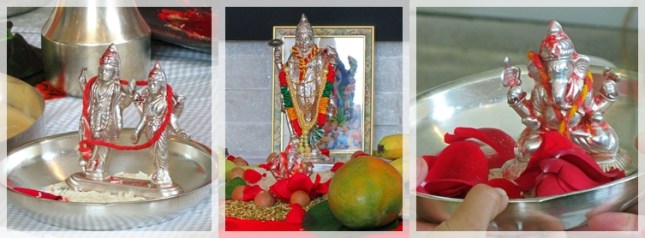
hindu pujaSo then, about eating food sacrificed to idols: We know that “An idol is nothing at all in the world” and that “There is no God but one.” For even if there are so-called gods, whether in heaven or on earth (as indeed there are many “gods” and many “lords”), yet for us there is but one God, the Father, from whom all things came and for whom we live; and there is but one Lord, Jesus Christ, through whom all things through whom we live. [1 Corinthians 8:4-6 (NIV)]

If the multiple gods of Hinduism could be explained in one sentence it is the belief in one supreme being, Krishna, who has appointed many demi-gods with various powers and abilities. I mention this because one of my sons is married to a lovely woman whose heritage is Indian/Hindu. While he and his wife practice neither Christianity nor Hinduism, they try to honor the traditions of both sets of their more religious parents. Saturday, we attended a puja (ritual) to bless their new home. An altar had been placed in front of the fireplace and on it were several statues of Hindu gods and a tray with items like mango leaves, ghee, coconuts, and money. Red threads were tied around wrists and red tilaks applied to the participants’ foreheads, prayers and mantras were chanted in Sanskrit, and Ganesh, Vishnu, and Lakshmi were among the several deities honored. During the puja, things like water, rose petals, milk, uncooked rice, nuts, wheat, fruits, and assorted sweets were offered to all the idols.

My husband and I (as the only two practicing Christians out of thirty in attendance) did not participate in the puja and quietly sat in the back as observers. The ceremony ended with the distribution of prasadam: the remains of the food offerings. When we were handed plates with an assortment of nuts and dried fruits, a beautiful mixture of mango and other fresh fruit, a scoop of cooked wheat, and sweet kaju pista rolls made of cashew and pistachio flour, I began to understand the controversy faced by the early church over food offered to pagan gods. Knowing this was food had been offered to several idols, “What,” I wondered, “would the Apostle Paul say?”

Idols are inanimate and powerless to change food in any way; while they can corrupt hearts, they can’t corrupt food. We weren’t in danger of corrupted hearts and the puja hadn’t tainted the food. Moreover, as ignorant of our faith as we are of theirs, my daughter-in-law’s family wouldn’t judge us as hypocrites for eating the food but they would judge Christianity harshly if we were judgmental or inconsiderate and failed to be respectful of their traditions. This was not the time to evangelize, discuss the first and second commandments, or refuse food offered to us in love. The Apostle Paul wrote of sacrificial meat, eating in pagan temples, not endangering the faith of new Christians, and the relationship between Jews and Gentiles but this seemed to be one of those situations neither clearly addressed nor expressly prohibited in Scripture. It was time to let our consciences guide us.

Christians must accept that people will have different beliefs. We don’t have to accept those beliefs but we must respect their right to have them. Don’t misunderstand; while I joined my extended Hindu family in wishing peace, prosperity, and serenity for my son’s family in their new home, as fascinating as the puja was, I found it distasteful and disturbing. Nevertheless, knowing that we were not endorsing Hinduism or idolatry, we graciously accepted our plates of food.

Were we right? I don’t know. I do know that we let love guide us as we, like many others in today’s multi-cultural world, tried to navigate through a gray area to find a way to honor both God and family.

Tolerance isn’t about not having beliefs. It’s about how your beliefs lead you to treat people who disagree with you. [Tim Keller]

For the Kingdom of God is not a matter of what we eat or drink, but of living a life of goodness and peace and joy in the Holy Spirit. If you serve Christ with this attitude, you will please God, and others will approve of you, too. [Romans 14:17-18 (NLT)]

Copyright ©2018 jsjdevotions. All rights reserved.

UP IN FLAMES

In the same way, the tongue is a small thing that makes grand speeches. But a tiny spark can set a great forest on fire. And the tongue is a flame of fire. It is a whole world of wickedness, corrupting your entire body. It can set your whole life on fire, for it is set on fire by hell itself. [James 3:5-6 (NLT)]

great blue heronRecently, a pastor shared a troubling experience while at the annual conference for his denomination. Along with other ordained ministers, he was to vote as to whether or not candidates for the ministry would be ordained. While usually a gratifying experience as this ministerial board accepts people into their vocation, on occasion the vote can be heartbreaking. If a candidate receives a negative recommendation from his supervisor, he or she is permitted to offer a defense before the vote is taken. At the last conference, such an instance occurred and, sadly, one individual did not receive an affirmative vote for ordination.

In their deliberations of the ministerial candidates, the board considers qualities of faith including evidence of God’s grace in the candidates’ lives, their ability to communicate the Christian faith, their worthiness of people’s faith and confidence, and their accountability to the church, its standards, authority and discipline. Candidates are expected to take responsibility for their actions and exercise self-control, emotional maturity and social responsibility. Unfortunately, this candidate had responded to an unfavorable assessment by a superior with a social media diatribe and Facebook rant. Foolishly, he took a private evaluation into a public forum and launched an attack; as a result, his several years spent in university, seminary and the ministry went up in flames.

In the days before social media (or as this pastor calls it—“unsocial media”), James wrote of how an untamed tongue can set our world on fire. Nowadays, that applies to untamed fingers flying across a keyboard, as well. The pastor who shared this story of a future turned upside down added that he asks his staff to wait a full twenty-four hours before responding to negative comments and always to lead their response with an expression of appreciation for the other person’s words. He also admitted to not always following his own advice!

It’s not just potential candidates for the ministry, pastors, and their staff who should maintain high standards of holy living in the world—we all are called to do just that. Those in the ministry may lose their careers with untamed tongues, but we all can lose relationships, respect, reputations, and our ability to be effective witnesses for Christ. Simply put, if we can’t control the words we use and the way we use them, it appears that other areas in our lives are equally out of control. But, when we allow the Holy Spirit to control our behavior, we have no need to worry about seeing our hopes and dreams go up in flames.

Understand this, my dear brothers and sisters: You must all be quick to listen, slow to speak, and slow to get angry. Human anger does not produce the righteousness God desires. … If you claim to be religious but don’t control your tongue, you are fooling yourself, and your religion is worthless. [James 1:19-20 (NLT)]

For God has not given us a spirit of fear and timidity, but of power, love and self-discipline. [2 Timothy 1:7 (NLT)]

Copyright ©2018 jsjdevotions. All rights reserved.

ALL FOR THE GOOD

And we know that God causes everything to work together for the good of those who love God and are called according to his purpose for them. [Romans 8:28 (NLT)]

“Blessed are You, Lord our God, King of the Universe, the True Judge,” is a blessing often said by Jews when they undergo a death or tragedy. “This is all for the good,” or “Blessed is the true judge,” is often said by other Jews in response to their tragic news. Rather than being about God’s final judgment of a person, these words remind them that only God can judge whether events are good or bad. To illustrate this point, the Talmud has a story about the second century sage, Rabbi Akiva. One night, the rabbi, along with his rooster and donkey, arrived in a village. When no one would give Akiva a place to stay, the rebbe said, “All that God does, He does for the good.” He then walked to a field outside of town, set up camp, and lit his lantern. That evening, a gust of wind knocked over the lantern breaking it, a fox came and ate the rooster, and a lion came and killed the donkey. In spite of all that, Akiva said, “All that God does, He does for the good!” Just before dawn, marauders came and attacked the village but, camped in the field without light, crowing rooster or braying donkey to reveal his presence, the rabbi remained safe.

The Talmud explains this story by saying that we must bless God for the bad news that comes our way in the same manner we bless Him for the good things that befall us. Indeed, when Scripture tells us we are told to love God with our whole heart, soul and strength it doesn’t mention any exceptions for circumstances we don’t like. While it’s easy to love God with our entire being when all is good, we must also love Him that same way in our suffering, sorrow and misfortune. Rest assured, in the long run, whatever happens to us is for our good. That, however, does not mean everything that happens to us will be good. Indeed, even when we don’t know why, pain, grief and adversity are blessings. All that God does, He does for the good! Blessed be the true judge.

God judged it better to bring good out of evil than to suffer no evil to exist. [Saint Augustine]

Can anything ever separate us from Christ’s love? Does it mean he no longer loves us if we have trouble or calamity, or are persecuted, or hungry, or destitute, or in danger, or threatened with death? … And I am convinced that nothing can ever separate us from God’s love. Neither death nor life, neither angels nor demons, neither our fears for today nor our worries about tomorrow—not even the powers of hell can separate us from God’s love. No power in the sky above or in the earth below—indeed, nothing in all creation will ever be able to separate us from the love of God that is revealed in Christ Jesus our Lord. [Romans 8:35,38-39 (NLT)]

Copyright ©2018 jsjdevotions. All rights reserved.

TELL THEM WHY

In the same way, let your light shine before others, so that they may see your good works and give glory to your Father who is in heaven. [Matthew 5:16 (ESV)]

monarch butterfly - whorled milkweed

“Simply by being in your presence, non-Christians ought to be able to tell that you have spent time in God’s presence,” were the week’s words of wisdom in my email. In Bible study, one woman echoed the week’s wisdom when saying that she behaved so that the light of Christ could be seen in her conduct all day. Although actions speak louder than words and all of our actions should shout “Praise the Lord!” I wonder if, by depending solely on our examples, we are taking the easy way out of Jesus’ command to let our lights shine. After all, what good does our light do if no one ever learns the source of its power? Eventually, we need to open our mouths and share the gospel message with words as well as actions.

“Christian” as a noun means someone who professes specific belief in the doctrine of Christianity. When “Christian” is used as an adjective merely to describe good behavior (i.e. “he did the Christian thing”), the word loses its power. After all, we haven’t cornered the market when it comes to being good people. Being respectful, helpful, caring or kind is not limited to Christians. Some of the most compassionate, loving, moral, and generous people I know are of other faiths or of no faith at all. While I’d like to think that believers usually exhibit better behavior than non-believers, the difference between Christians and non-Christians is not behavior; the difference is Christ! Unless we open our mouths and talk about Jesus, people won’t know what makes us the way we are.

When reading the cast notes in a Playbill recently, one actress finished her brief resume with these words: “All glory to God! 1 John 4:19.” Hopefully, her demeanor among the rest of the cast and crew reflects the light of Christ. But, just in case they weren’t sure from where her light comes, she told them (as well as the audience): “We love because He first loved us.” Indeed, she said, “Praise the Lord!” and told us why.

Preach the Gospel at all times, and when necessary, use words. [St. Francis of Assisi]

And he said to them, “Go into all the world and proclaim the gospel to the whole creation.” [Mark 16:15 (ESV)]

Go therefore and make disciples of all nations, baptizing them in the name of the Father and of the Son and of the Holy Spirit, teaching them to observe all that I have commanded you. And behold, I am with you always, to the end of the age. [Matthew 28:19-20 (ESV)]

Copyright ©2018 jsjdevotions. All rights reserved.