CLOSED MINDS

Again I say, don’t get involved in foolish, ignorant arguments that only start fights. A servant of the Lord must not quarrel but must be kind to everyone, be able to teach, and be patient with difficult people. Gently instruct those who oppose the truth. Perhaps God will change those people’s hearts, and they will learn the truth. [2 Timothy 2:23-25 (NLT)]

killer whaleWhen discussing whales, the 3rd grade science teacher insisted that because of the whale’s small throat it was physically impossible for one to swallow a human. Disagreeing, the little girl told her that Jonah had been swallowed by a whale. When the teacher insisted it was just a silly story, the girl said that when she got to heaven she would ask Jonah. ”Well,” replied the teacher scornfully, “What if Jonah isn’t there? What if he went to hell?” The little girl politely answered, “Then I guess you can ask him!”

Last year, we took a bus tour of the Canadian Rockies and, at times, our tour guide and bus driver must have felt like they were herding cats. Although there were less than forty in our group, I compared us to the two million Israelites of Exodus and them to Moses and Aaron who led those “stiff-necked” people for forty years. When people weren’t ready on time, asked already answered questions, complained about the food, whined about accommodations, didn’t follow directions, wanted special treatment and misplaced their possessions, I appreciated the frustrations the brothers must have had leading the Israelites to the Promised Land. Overhearing my comment, a fellow traveler took me aside. After advising me that he didn’t want to disparage my faith, he added, “But really—two million people? Forty years? How can you possibly believe that? How could they all be fed?” My response was easy: “God provided manna!” Rather than continue the conversation, I smiled and walked away. This man didn’t want to talk miracles or God’s provision and, in spite of his words to the contrary, like the teacher in the joke, he really did want to disparage my faith.

As for that whale, according to several sources, including the Smithsonian, while most species of whales (like the killer whale pictured) couldn’t swallow a human, the exception is the sperm whale. Capable of swallowing a whole giant squid, it could easily swallow a man. In actuality, however, both the girl and the teacher were wrong. The Hebrew Bible says neither whale nor fish but rather dag gadôl  which means a great sea creature. The Greek translation was kêtei megalô, meaning a mega-sized ketos or huge sea serpent. The ketos was a sort of dog-headed sea dragon and several references to it are found in both art and non-Biblical literature from 700 BC through 500 AD. Whether the leviathan mentioned in Job, Psalms, and Isaiah is the same creature as that in Jonah and whether it was fish, reptile, whale, or some extinct form of sea monster, we really don’t know. Just because we don’t know, however, doesn’t mean it didn’t happen. Would the teacher have been interested in this answer? I think not. Like the man who spoke to me, her mind was already made up.

There always will be non-believers who are more interested in proving we’re wrong than hearing our answers. Wanting to display their cleverness and our naiveté, they ask questions like, “Why aren’t there dinosaurs in the Bible? How did Noah get those animals in the ark? How did the penguins get to the ark from Antarctica?” and, “If God is so all-powerful, why did it take Him six whole days to create the world?” The Bible is filled with a slew of fantastic and extraordinary accounts that defy easy explanation and I’m not sure it’s worth getting into a debate about such things. In most cases, even if we answered these types of questions to the skeptics’ complete satisfaction, it wouldn’t make a difference to them. All we can do is decline to accept their challenge with a simple and gracious answer. Jesus told the disciples to shake the dust from their feet as they left any town that refused to welcome them. Sometimes, we must do the same thing.

Their minds are full of darkness; they wander far from the life God gives because they have closed their minds and hardened their hearts against him. [Ephesians 4:18 (NLT)]

Instead, you must worship Christ as Lord of your life. And if someone asks about your hope as a believer, always be ready to explain it. But do this in a gentle and respectful way. Keep your conscience clear. Then if people speak against you, they will be ashamed when they see what a good life you live because you belong to Christ. [1 Peter 3:15-16 (NLT)]

Copyright ©2018 jsjdevotions. All rights reserved.

LET THE VINEYARDS BE FRUITFUL

We give thanks for the cup of blessing, which is a sharing in the blood of Christ. And the bread that we break is a sharing in the body of Christ. Because there is one loaf of bread, we who are many are one body, because we all share that one loaf. [1 Corinthians 10:16-17 (NCV)]

Let the vineyards be fruitful, Lord,
And fill to the brim our cup of blessing.
Gather a harvest from the seeds that were sown,
That we may be fed with the bread of life.
Gather the hopes and dreams of all;
Unite them with the prayers we offer now.
Grace our table with Your presence, and give us
A foretaste of the feast to come. [John W Arthur]

monarch butterfly - common milkweedWhen the ushers brought the offering plates forward, the congregation rose and sang “Let the Vineyards be Fruitful.” Often used in Lutheran churches as an offertory hymn when the gifts are presented at the altar, its references to vine, bread, and table make it especially appropriate on Communion Sundays.
As I sung those familiar words about fruitful vineyards, seeds and harvest, I was struck by the somewhat incongruous words in the middle of the song: “Gather the hopes and dreams of all; Unite them with the prayers we offer now.” I envisioned the congregation’s hopes, dreams, needs, and concerns piled high on top of the offering envelopes in those plates and realized we were presenting more than our checks and cash; we were offering our petitions for things like healing, reconciliation, peace, guidance, recovery, relief, purpose, increase, wisdom, strength, and restoration. While the particulars differed from person to person, our various hopes and dreams were being gathered, united into one prayer, and given to God. It wasn’t until I re-read the hymn’s words after church that I understood what that prayer asked or that our words referred both to the day’s simple meal of wafer and wine as well as to the eternal feast at Christ’s return. In our unified prayer, we were asking that Jesus grace us with His presence and give us a preview of the magnificent banquet that is yet to come in the Kingdom of God.

I’ve probably sung the words to this simple hymn hundreds (if not thousands) of times but last Sunday, as those words exited my mouth, they also settled into my heart and mind in a new way. I doubt that I will sing it again without picturing the congregation’s assorted prayers spilling over the sides of the collection plates and then melding into one unified prayer for both His presence and the coming of His Kingdom. Just as reading a book of the Bible once (or even several times) doesn’t mean we’ve fully grasped the meaning of the passages, the same goes for the hymns we sing or the liturgy we recite during worship. When Jesus warned us about meaningless repetition or babbling on in our prayers, repetition wasn’t necessarily the problem. After all, both the persistent neighbor and widow in His parables repeated their pleas and He repeated the same prayer three times in Gethsemane. The problem occurs when we repeat our words mindlessly or automatically. Let us always remember that knowing the words by heart doesn’t necessarily mean our hearts know the depth of their meaning.

The Lord All-Powerful will prepare a feast on this mountain for all people. It will be a feast with all the best food and wine, the finest meat and wine. On this mountain God will destroy the veil that covers all nations, the veil that stretches over all peoples; he will destroy death forever. The Lord God will wipe away every tear from every face. He will take away the shame of his people from the earth. The Lord has spoken. [Isaiah 25:6-8 (NCV)]

Copyright ©2018 jsjdevotions. All rights reserved.

MEH

When the master of the house has locked the door, it will be too late. You will stand outside knocking and pleading, “Lord, open the door for us!” But he will reply, “I don’t know you or where you come from.” [Luke 13:25 (NLT)]

Not to decide is to decide. [Woodrow Kroll]

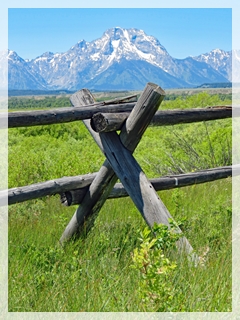
Tetons - Wyoming“Meh,” the verbal equivalent of a shoulder shrug, was added to the dictionary in 2008. Popularized by The Simpsons, it is a decisive assertion of non-commitment (or as decisive as having no opinion about something can be.) The New York Times used to run a list with the tagline, “Not hot. Not not. Just meh.” The list has included assorted celebrities and such things as Harrison Ford’s earring, petting zoos, Febreze, stocking stuffers, Tufts University, pumpkin ale, mugs with slogans, and the Golden State Warriors. The magazine’s culture editor, Adam Sternbergh, said the list was meant “to celebrate all those things in life that [are]…neither adored nor reviled, but, simply, meh.”

Whether we say “meh,” or dismissively use words and phrases like “whatever, it is what it is, I don’t care, not my problem, booooring, who cares” and “so what” we’re expressing indifference and an unwillingness to think about something. Apathy and disinterest are insulting: we don’t care enough to muster up any sort of approval, support, or regard for something but we also don’t care enough to dislike, oppose, or reject it.

Some in the media call Millennials “The Meh Generation,” but I fear that indifference, cynicism, disillusionment and jadedness are not limited to those born between 1982 and 2002. They’re not the only ones who find it easier to live together than commit to marriage or to walk away from a marriage than fight to save a family. They’re not the only ones who find it simpler to go along with the crowd than to stand up and speak or to accept what’s wrong rather than try to make it right. They’re certainly not the only ones who’ve decided the concept of sin is out of date, right and wrong is relative, or that anything goes as long as they aren’t the ones who get hurt. An ostrich puts its head in the sand to turn eggs but we put our heads there to avoid seeing what we don’t want to see. And, sadly, way too many in this world would put Jesus on “The Meh List” because He is “neither adored nor reviled, but, simply, meh.”

Jesus spoke of going through the gate to God’s Kingdom. At some point, we can’t ignore the gate’s presence or fail to form an opinion about the gatekeeper. We can no longer remain impartial, dispassionate or wishy-washy; a decision about following the shepherd has to be made. While neither death nor taxes can be avoided, remember that only the IRS grants extensions! Adore Jesus or revile Him but don’t simply shrug your shoulders and say, “Meh!”

I believe in my soul that there are more at this day being lost for want of decision than for any other thing. [Dwight L. Moody]

You can enter God’s Kingdom only through the narrow gate. The highway to hell is broad, and its gate is wide for the many who choose that way. But the gateway to life is very narrow and the road is difficult, and only a few ever find it. [Matthew 7:13-14 (NLT)]

Copyright ©2018 jsjdevotions. All rights reserved.

THE HACKER

Stay alert! Watch out for your great enemy, the devil. He prowls around like a roaring lion, looking for someone to devour. Stand firm against him, and be strong in your faith. [1 Peter 5:8-9b (NLT)]

red shouldered hawkAfter asking us how we protect our personal safety, the cyber-security specialist asked how we protect ourselves from cyber attacks. One woman proudly told how Microsoft had recently saved her from a hacking attempt. After a message popped up telling her to call them, she gave them remote access to her computer. The necessary patch and technical advice only cost $700 and now her computer was secure. Until the speaker told her, she didn’t know the hack was the $700 she’d spent, access to her credit card, and possible malware now active on her computer. While she never would have allowed a complete stranger into her home, she unwittingly opened the door to a criminal and welcomed him into her life.

Following the seminar, I couldn’t help but think about Satan. Scripture describes him as a serpent, lion, liar, thief, and tempter with adjectives like prowling, cunning and crafty. Those same words describe a hacker rather well. Both Satan and the hacker want to take over our lives and they can do it without our even realizing it’s been done. The weakest link in both cases is the user—us. Outside consultants regularly try to hack into our bank and the good news is that their security software works. Unfortunately, in every test, someone (who clearly knows better) was conned into replying, hyperlinking, or opening an attachment. When Satan comes trolling, how often do we err by ignoring God’s guidelines, not examining the source of the message, going somewhere we shouldn’t, or letting curiosity get the best of us?

Our speaker spoke of maintaining the security of the devices and networks we use. Since new hacking techniques are developed continually, once secured doesn’t mean forever secure; software must be updated to stay current with new threats. Once saved doesn’t mean forever safe, either. We must keep updating our soul’s software with regular prayer, Bible study, and church. Where we use our devices and the sort of data we transmit and receive affects their safety and where we go and what we put into our minds affects our souls. We don’t hang around dangerous neighborhoods but, sometimes, that’s exactly what we do with our computers and phones or our friends and media choices! When the considering the importance of backing up data, I thought of the value of Christian friends who have our backs and both encourage and support us in times of trouble—times when we’re most vulnerable to Satan’s attack.

Two-factor authentication (2FA) was another security feature discussed. Although a website can use 2FA to make sure it is us, we should use 2FA to make sure those great ideas we get have come from God rather than the enemy. A little two-factor authentication in the way of seeing whether those thoughts match up with God’s word and Jesus’s actions could keep us out of a lot of trouble.

Good cyber-security habits include malware protection, virtual private networks, cloud storage, secure routers, password protection, 2FA, and common sense. None of those, however, will protect us if we fail to use them. The same goes for the armor of God. We’ve been given the best protection money can’t buy but God’s armor won’t defend us from the enemy if we don’t put it on!

A final word: Be strong in the Lord and in his mighty power. Put on all of God’s armor so that you will be able to stand firm against all strategies of the devil. For we are not fighting against flesh-and-blood enemies, but against evil rulers and authorities of the unseen world, against mighty powers in this dark world, and against evil spirits in the heavenly places. [Ephesians 6:10-12 (NLT)]

Copyright ©2018 jsjdevotions. All rights reserved.

FULLY AWARE

For I hold you by your right hand—I, the Lord your God. And I say to you, “Don’t be afraid. I am here to help you.” [Isaiah 41:13 (NLT)]

cousinsScientists have found that even a simple hug or the holding of hands can lower both blood pressure and heart rate in stressful situations. Gentle touch also causes a decrease in the stress hormone cortisol and an increase in oxytocin (often called the “cuddling hormone”). Where cortisol might give a “fight or flight” response, oxytocin causes more of a “tend and befriend” one by increasing feelings of trust and connection. Since we were at a funeral and the previous ten days had been a roller coaster of emotion and tension for everyone, the priest’s request to join hands as we stood in prayer benefitted us physically and psychologically as well as spiritually.

While holding hands during prayer wouldn’t be unusual in many evangelical Protestant churches, apparently it is in Roman Catholic ones (especially when done during every prayer) and it has become a point of contention in some dioceses and parishes. Being a rather touchy-feely Protestant, I enjoyed the hand holding and the feeling of solidarity in prayer that came with it. The priest, however, asked us to do more than simply join hands. “Take the hand of the person beside you,” he instructed, “and, fully aware of the soul you are touching, join in prayer.” As I held the hand of the stranger beside me, I thought of those words: “fully aware of the soul you are touching.” I didn’t know the man and will never see him again. From his rosary, I knew we do not attend the same church. Nevertheless, I knew we worshipped the same God and were there for the same reason: to celebrate the life of the man whose body lay in a casket near the altar. As I became more aware of the soul I was touching, my thoughts turned from my own personal sorrow to the sorrow shared by all who were present in the sanctuary. We were one community, united in our thanksgiving for the man we mourned, in our intercessions for his family, in our love for God, and in our belief in the resurrected Christ and the life everlasting.

I appreciate that some people are uncomfortable with the intimacy of holding hands and find doing it during worship an unwelcome innovation. Whether or not we touch one another during prayer is not as important as being fully aware of one another: not just of the people with whom we pray but of all with whom we interact. Fellow travelers through this troubled world, they are struggling as much as we are to navigate the challenges, sorrow, and pain in their paths. Is there some way we can make their journey easier? Sometimes, we find that answer in a simple touch. While we probably won’t bring healing to their bodies, we may bring some healing to their souls.

At the conclusion of the funeral, the deceased’s family followed the casket out of the sanctuary and his sister passed by our pew. My husband stepped into the aisle beside her and they joined hands as they walked out together. Although we hardly know her, fully aware of her mournful soul, he knew her need to be supported during that difficult walk.

Lord, teach us to be fully aware of the souls we encounter each day. Let our words be kind, our actions helpful, and our touch gentle and supportive.

When we honestly ask ourselves which person in our lives means the most to us, we often find that it is those who, instead of giving advice, solutions, or cures, have chosen rather to share our pain and touch our wounds with a warm and tender hand. [Henri Nouwen]

As it happened, Publius’s father was ill with fever and dysentery. Paul went in and prayed for him, and laying his hands on him, he healed him. [Acts 28:8 (NLT)]

Copyright ©2018 jsjdevotions. All rights reserved.

THE GATEWAY SIN

You must not covet your neighbor’s wife. You must not covet your neighbor’s house or land, male or female servant, ox or donkey, or anything else that belongs to your neighbor. [Deuteronomy 5:21 (NLT)]

roseIn spite of many states having legalized its use, countless studies suggest that marijuana is a “gateway drug” meaning that it may lead to the use of other stronger more addictive drugs. I’m not going to enter into that argument but I’d like to use the word “gateway” as it regards to sin. Just like marijuana (when compared to heroin or cocaine) seems innocuous, coveting (when compared to murder or stealing) seems like an insignificant sin. After all, who does it harm? No sin, however, is insignificant and every sin is an offense to God

While desiring God, wisdom, right living, and faith is good, the tenth commandment’s coveting is desiring what God doesn’t want us to have or what rightfully belongs to another. Masquerading as envy, jealousy, resentfulness, lust, longing, selfishness, greed, materialism, desire, craving, bitterness, and even wishful thinking, it is one of the easiest commandments to break. Just as a rose by any other name is still a rose, coveting (no matter what you call it) is still coveting and easily can lead to more sin. Coveting is a “gateway” sin because it can lead us deeper into the enemy’s darkness.

Consider Achan who disobeyed God’s direct command to take none of Jericho’s plunder for himself. Coveting the spoils of war, he stole a beautiful robe, 200 silver coins and more than a pound of gold. His coveting led not just to stealing but also to murder when 36 of his countrymen died in battle and his family was killed in punishment for his sin. David coveted his neighbor’s wife and then committed both adultery and murder to have her. Coveting Esau’s rightful blessing, Jacob stole it from his brother and failed to honor his father. King Ahab coveted the field of Naboth; when Naboth refused to sell it, Ahab’s covetous heart made him so sullen and angry that he refused to eat. His wife Jezebel then hatched a scheme in which two of her minions falsely accused Naboth of cursing both God and king; the man was stoned to death and Ahab claimed his field. Ahab’s coveting led to breaking the commandments about false witness, murder and misusing the name of the Lord. It would seem that when we want something that isn’t ours to have, we’re likely to break several other commandments to get it!

Indeed, coveting is a gateway sin!

Yet true godliness with contentment is itself great wealth. After all, we brought nothing with us when we came into the world, and we can’t take anything with us when we leave it. So if we have enough food and clothing, let us be content. [1 Timothy 6:6 (NLT)]

Copyright ©2018 jsjdevotions. All rights reserved.