SEIZE THE DAY

Even so, I have noticed one thing, at least, that is good. It is good for people to eat, drink, and enjoy their work under the sun during the short life God has given them, and to accept their lot in life. And it is a good thing to receive wealth from God and the good health to enjoy it. To enjoy your work and accept your lot in life—this is indeed a gift from God. [Ecclesiastes 5:18-19 (NLT)]
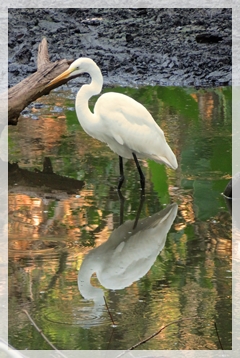
great egretFrom the viewing platform at the marsh, I watched a Cooper’s hawk soar high in the sky. When I turned to leave, I looked down and saw several white egret feathers on the ground below. Whether it was the hawk, a raccoon, or some other predator, the park had one less egret in the pond. Those beautiful white feathers were a stark reminder of how precarious life is, not just for wild birds, but for us all. I was reminded of Ecclesiastes: “For people and animals share the same fate—both breathe and both must die.” [3:19]

Beginning with the words, “Everything is meaningless,” much of Ecclesiastes expresses disappointment, discontent, and a cynical world-weariness. The world is a fallen place where life is unfair: good happens to the bad and bad befalls the good. The future is unknown and filled with uncertainties and satisfaction is not guaranteed. We can strive for a goal and never reach it or attain the goal and discover it wasn’t worth the effort. The pursuit of pleasure, possessions, wealth, achievements, wisdom, or power comes to nothing. As disheartening as the author’s words are, I’m not sure we can really argue with them. Life is capricious and frequently makes no sense and the same destiny—death—awaits both the righteous and wicked. Sadly, sometimes, our efforts really do feel like an exercise in futility.

Yet, hidden in those sobering verses are nuggets of beauty and comfort. Just because life is hard and its meaning is hard to find doesn’t mean life is meaningless. Granted, some seasons of life are perplexing, challenging, or downright unpleasant but, as much as we wish we could control or understand them, they are beyond human control and understanding. The seasons of life are not in our hands but God’s. Rather than knowledge and comprehension of His plan, however, God gives us sort of a consolation prize: the ability to find enjoyment in life. While we can’t control the seasons, we can accept and find contentment in them.

Those feathers on the ground were a reminder to live life with gusto—to accept and enjoy whatever we’ve been given—to seize the day! Yet, Ecclesiastes is not an “eat, drink, and be merry because tomorrow you die!” promotion of hedonism. Woven throughout its verses is one more theme—that of fearing God. We can’t find the meaning to life apart from God and we certainly can’t live life on our own terms. The enjoyment of life neither permits us to disobey God not does it exempt us from His law. Telling us to enjoy life, Ecclesiastes also tells us to fear (i.e., obey, revere, love, serve, honor and worship) God while doing so!
Yet God has made everything beautiful for its own time. He has planted eternity in the human heart, but even so, people cannot see the whole scope of God’s work from beginning to end. So I concluded there is nothing better than to be happy and enjoy ourselves as long as we can. [Ecclesiastes 3:12 (NLT)]

That’s the whole story. Here now is my final conclusion: Fear God and obey his commands, for this is everyone’s duty. Go will judge us for everything we do, including every secret thing, whether good or bad. [Ecclesiastes 12:13 (NLT)]

Copyright ©2018 jsjdevotions. All rights reserved. 

THERE BUT FOR THE GRACE OF GOD…

The human heart is the most deceitful of all things, and desperately wicked. Who really knows how bad it is? [Jeremiah 17:9 (NLT)]

For from within, out of a person’s heart, come evil thoughts, sexual immorality, theft, murder, adultery, greed, wickedness, deceit, lustful desires, envy, slander, pride, and foolishness. [Mark 7:21-22 (NLT)]

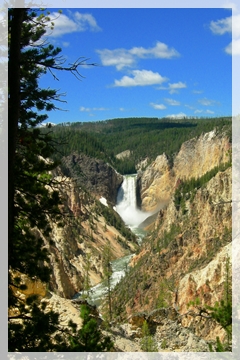
Grand Canyon of YellowstoneI recently saw a play in which the only character, Lisa, presents a monologue about her life and family. The audience learns that her father, Walter, a German-born Jew, escaped to the U.S. as part of the kindertransport effort but that the rest of his family perished at Auschwitz. During her monologue, Lisa tells of taking her then 75-year old father to visit the Auschwitz Memorial. While touring the concentration camp, Walter tells his daughter about attending school with members of the Hitler Youth. Being a Jew, he couldn’t wear one of their uniforms but another boy in his school, a Gentile, refused to wear one. Her father then tells her that, in spite of the horror of Auschwitz and the loss of his family, he is glad he was born a Jew—because he didn’t have the option of becoming a Nazi! Unlike the Gentile boy who refused to join (and suffered because of it), Walter realized that, had he not been Jewish, he might have joined the Nazis. He knew that part of him could have been as merciless and evil as the men who rounded up and exterminated his family.

After the war, Walter returned to Germany as an interrogator of German personnel. In her soliloquy, Lisa tells how he admitted to callously browbeating one prisoner into confessing that he’d rounded up Jews from the Ghetto. Rather than turn the prisoner over to the allies for trial, Walter handed him over to the Russians, men he knew would summarily execute the German in the woods. Perhaps Walter was right; in other circumstances, he might have joined the Hitler Youth.

Hearing this story made me wonder what darkness lurks in my heart. In other circumstances, could I spew hate, inflict pain, ignore my conscience, turn my back on my brothers and sisters, or close my eyes to evil? Could I ever be like Haman (who plotted to exterminate the Jews) or Abimelech (who killed his 70 brothers)? Could I have worn a Hitler Youth uniform? Sadly, in another time, in another place, perhaps my heart could have deceived me to do just that.

Just because I’m capable of evil, however, doesn’t mean I have to be evil. Rather than betray Jesus as did Judas, I could be as faithful as John. Rather than the closed minds and murdering hearts of those who stoned Stephen, I could be as holy and forgiving as the martyred man. While I could be as scheming and immoral as Herodias, I also could be as obedient and fearless as her victim John the Baptist. Yes, I could have joined the Hitler Youth, but I also could have refused to be part of such evil and willingly suffered the consequences.

There is something terribly wrong with our hearts that, if allowed to grow, can become horrendous and unthinkably evil, but there also is something beautifully right with them. We are made in the image of God; deep inside us there is something of Him and He has written his law in our hearts. He gave us the gift of free will and, with every choice, we either become more or less like the person God made us to be. Because our hearts can be deceitful, corrupt, and self-serving they can lead us astray but they don’t have to! When led by the Holy Spirit, our hearts can be so filled with good that there is no room left for evil.

For I was born a sinner—yes, from the moment my mother conceived me. … Create in me a clean heart, O God. Renew a loyal spirit within me. Do not banish me from your presence, and don’t take your Holy Spirit from me. [Psalm 51:5,10-11 (NLT)]

But the Holy Spirit produces this kind of fruit in our lives: love, joy, peace, patience, kindness, goodness, faithfulness, gentleness, and self-control. There is no law against these things! Those who belong to Christ Jesus have nailed the passions and desires of their sinful nature to his cross and crucified them there. [Galatians 5:22-24 (NLT)]

Copyright ©2018 jsjdevotions. All rights reserved.

ONLY HE CAN MAKE A TREE FROG

For ever since the world was created, people have seen the earth and sky. Through everything God made, they can clearly see his invisible qualities—his eternal power and divine nature. So they have no excuse for not knowing God. [Romans 1:20 (NLT)]

A friend sent a link to some of the most beautiful landscapes in the world; you’ve probably gotten a similar one and been amazed by photos of the northern lights in Iceland, the red and orange pillars of Bryce Canyon, or the Glowworm caves in New Zealand. Awestruck by God’s amazing creation, I thought of how He makes Himself known through all that He’s made. Unfortunately, we tend to hear God better when He shouts with the exceptional and impressive than when He whispers with the small and familiar. obedient plant (false dragonhead) - green tree frogWe’re sure to notice God in the Grand Canyon, the multitude of stars in the night sky, or when watching two million wildebeest, zebra and gazelles migrate through the Serengeti. We sense Him in extraordinary or exotic things like the peacock’s splendid tail, Devil’s Tower, or spectacular sunsets and sunrises. But do we notice Him in the commonplace and unremarkable?
Yesterday, I watched, spellbound, as several bees visited the flowers I was photographing. A bee would enter one of the purple tubular blossoms and disappear as it inched its way deep into the corolla to gather pollen and nectar. After backing out, it would move on to another bloom. A perfect fit, it was as if bee and flower had been designed for one another (and they were). The flowers’ scent attracted the bees and, while the bees gathered food for their hive, they pollinated the plants. What was happening in these ordinary flowers growing wild by the road was truly extraordinary!

God’s grandeur is revealed in the giant trees of the redwood forest but His attention to detail is found in the one billion bacteria that live in just one gram of the forest’s soil. His greatness is made known in the 1,600 miles of the Great Barrier Reef but also in the 1,500 species of fish, 5,000 species of mollusks, 17 species of sea snakes and 6 species of turtles living there. We see our ingenious Creator in the enormous African elephant but also in the oxpeckers and cattle egrets that ride on its back and in the lice, ticks and parasites living on the elephant that are eaten by those birds. God’s artistry is revealed in the 28,000 species of orchids and but also in His amazing design of the wasps, bees, flies, moths, ants and gnats that pollinate them.

God teaches us, speaks to us, and provides for us through his creation. Let’s not fail to see His marvelous work in the everyday and mundane: wasps building a nest, mushrooms appearing on the lawn after a rain, maple leaves turning red in autumn, raindrops glistening on a flower petal, or a squirrel gathering nuts. You may remember the first line of Joyce Kilmer’s poem Trees: “I think that I shall never see A poem lovely as a tree.” The last line reads: “Poems are made by fools like me, But only God can make a tree.” Only God can make a tree, but He’s also the only one who can make the lichens and fungi living on its bark, the small tree frog hiding in its leaves, and the sparrow nesting in its branches.

Praise God, from whom all blessings flow!

Nature is the living, visible garment of God. [Johann Wolfgang Von Goethe]

All things bright and beautiful, All creatures, great and small, All things wise and wonderful, The Lord God made them all. [Cecil Francis Alexander]

O Lord, what a variety of things you have made! In wisdom you have made them all. The earth is full of your creatures. … I will sing to the Lord as long as I live. I will praise my God to my last breath! May all my thoughts be pleasing to him, for I rejoice in the Lord. [Psalm 104:24,33-34 (NLT)]

 Copyright ©2018 jsjdevotions. All rights reserved.

SPINNING

Finally, I confessed all my sins to you and stopped trying to hide my guilt. I said to myself, “I will confess my rebellion to the Lord.” And you forgave me! All my guilt is gone. [Psalm 32:5 (NLT)]

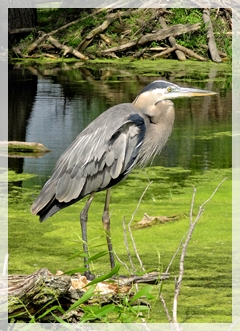
great blue heronHaving just returned from the East Coast, I had a lengthy “to do” list and thought I could fit in a few errands before picking up my mother-in-law for her doctor’s appointment. As I pushed the cart through the store, I glanced down at my watch to check the time and gasped. To my dismay, I’d lost an hour! I should have been picking her up right then; there was no way we would make it to the doctor’s on time. Leaving the cart in the aisle, I rushed to my car. Rather than think how to save the situation, my first thought was how to spin it! Other than my own carelessness and stupidity, what valid excuse could I have for my tardiness? As I started the car, I glanced at the clock on the dash and realized that hour hadn’t disappeared; I’d left it back East. While my watch was still on EST, my car, mother-in-law, the doctor and I were in CST and there was still plenty of time.;
Rather than a complete fabrication, spinning is selectively gathering facts, omitting relevant truths, and then shaping them to support our version of the story. Spinning reshapes people and events with half-truths, diversions, exaggeration, inaccuracies, emotion-laden words, attacks and euphemisms. Spinning gives us “alternative facts.” It calls bombs “lethal defensive weapons,” cheating on emissions tests “possible non-compliance,” adultery an “inappropriate relationship,” embezzlement a “personal failing,” and information we don’t like “fake news.”

Although spinning is just a nicer way of saying deceiving, we all do it. Sometimes, we spin to save someone’s feelings but, far more often, we do it to save ourselves from a reprimand, consequences, embarrassment, or humiliation. The first spinners, of course, were Eve and Adam who spun the apple story to shift the blame. Eve said it was the serpent’s fault and Adam placed the blame on both Eve and God (for giving him the woman in the first place)! Detouring around a troublesome question, Cain spun when he answered God’s question as to the whereabouts of his brother with a question of his own. We spin so we don’t have to admit our failings. Aaron spun the golden calf incident by blaming the evil Israelites rather than his weak leadership.

When we can’t make an accusation disappear, we spin it to explain that what we did wasn’t really that wrong. Told to completely destroy everything in the Amalekite nation, Saul disobeyed by sparing the king’s life. His troops destroyed only what was worthless and took the rest for themselves. When confronted by Samuel, rather than admitting his greed and disobedience, Saul spun the story. Making no mention of the monument he’d set up for himself, he claimed the prohibited plunder was to be a sacrifice to God. Sometimes, we spin when it isn’t even necessary. When Jesus asked the crippled man at Bethesda if he wanted to get well, rather than a simple yes or no, the man blamed his disability on those who wouldn’t help him to the pool.

David had a perfect opportunity to put a spin on his adultery with Bathsheba. When confronted by Nathan, the king easily could have blamed the beauty for seducing him or Joab for misunderstanding his directions regarding Uriah’s fate. Instead, David did what all of us are expected to do: confessed and said, “I have sinned against the Lord.” Although we prefer making excuses and laying the blame for our failures elsewhere, let us never forget that we, like David, must always take full responsibility for our actions.

But the tax collector stood at a distance and dared not even lift his eyes to heaven as he prayed. Instead, he beat his chest in sorrow, saying, “O God, be merciful to me, for I am a sinner.” I tell you, this sinner, not the Pharisee, returned home justified before God. For those who exalt themselves will be humbled, and those who humble themselves will be exalted. [Luke 18:13-14 (NLT)]

Copyright ©2018 jsjdevotions. All rights reserved.

ONLY JESUS SAVES

God saved you by his grace when you first believed. And you can’t take credit for this; it is a gift from God. [Ephesians 2:8 (NLT)]

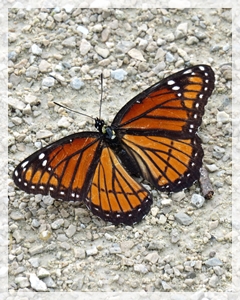
viceroy butterflyUnlike the bruised and broken butterflies in yesterday’s devotion, this one looked perfect as it lay on the trail. When we approached, the Viceroy fluttered its wings but only managed to skim a few inches across the gravel. As intact as it looked, one wing was entirely useless. To protect it from walkers’ feet and speeding bicycles, we managed to get the creature off the trail into the grass. Unfortunately, without some sort of butterfly super-glue to reattach the loose wing, while we could help, we couldn’t save it.
Although it was easy to see that saving the butterfly was not within our purview, I’m not sure we understand that about our friends and loved ones. As much as we might want to, we can’t save the people around us. We can’t keep Terry from gambling, stop Mary from dating abusive men, make John quit drinking, or salvage Joan’s failing marriage. Seeing their potential and possibility, we want their lives to be better; they, however, are not our repair projects and their transformation is not our job. We can’t fix our loved ones, change their lives or save them from their own bad decisions. What we want for others is meaningless unless they want it for themselves. We can love them, share God’s word, help to bear their burdens, refuse to enable their destructive choices, and counsel, encourage and pray for them. What we can’t do is save them.

Just as we can’t save the addict from his addiction or the fool from his decisions, we can’t save non-believers from their non-belief. When we share the gospel message, we can impart knowledge but we can’t make people think; we can show people the truth, but we can’t make them believe. Just as we can lead a horse to water but can’t make it drink, we can lead people to Jesus but can’t make them drink of His living water. We can give our testimony, but it is God who opens their hearts. We can sow the seed (and even water and fertilize it) but it is up to that seed and God as to whether or not it will sprout. Let us remember that Jesus will save anyone but not everyone will choose to be saved. Unfortunately, many will reject His offer of salvation. We can witness and pray for their salvation but we can’t save them. We aren’t their savior—Jesus Christ is! In actuality, He’s already done the saving; it’s just up to people to receive His gift of grace.

You will find all true theology summed up in these two short sentences: Salvation is all of the grace of God. Damnation is all of the will of man. [Charles Spurgeon]

For this is how God loved the world: He gave his one and only Son, so that everyone who believes in him will not perish but have eternal life. God sent his Son into the world not to judge the world, but to save the world through him. … And anyone who believes in God’s Son has eternal life. Anyone who doesn’t obey the Son will never experience eternal life but remains under God’s angry judgment. [John 3:16-17, 36 (NLT)]

Copyright ©2018 jsjdevotions. All rights reserved.

BEWARE THE YEAST

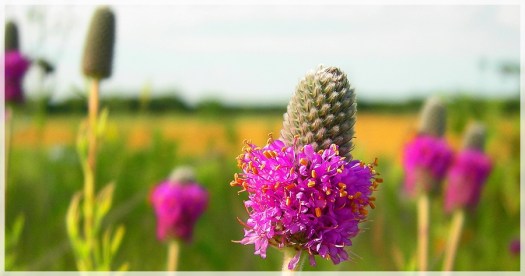
purple prairie clover“Watch out!” Jesus warned them. “Beware of the yeast of the Pharisees and Sadducees.” [Matthew 16:6 (NLT)]

In Biblical days, rather than using a packet of Fleishman’s yeast for leavening, people kneaded a small amount of old fermented dough called a starter or seor into fresh dough. When a yeast starter gets contaminated by bacteria, however, it gets a moldy odor of decay and, if mixed into new dough, its foulness will spread; the resulting bread will be unpleasant and inedible.

We’re all familiar with Jesus’ warning to the disciples to beware the yeast of the Pharisees. They weren’t bakers so what was their yeast? I’d always thought of it as the Pharisees’ hypocrisy and false teachings. And, while both of those can spread and spoil like bad leavening, I think there’s more to his caution.

The Pharisees and Sadducees, disregarding all of Jesus’ previous miracles, had demanded an impressive miraculous display from Him. Jesus wasn’t an entertainer and His miracles were never for show. Knowing nothing would convince the religious leaders, He refused and left. Shortly after that, Jesus and the disciples departed to the other side of the lake. It was when the disciples realized they’d failed to bring provisions that Jesus first warned them about the yeast of the Pharisees. Thinking He was talking about bread, they then started arguing with one another about not having anything to eat. Imagine their conversation as they pointed accusing fingers at one another for having no food—each man trying to shift the blame for the oversight to someone else. Totally misunderstanding Jesus’ warning, they were bickering about bread and worrying about their next meal when Jesus had just fed thousands with only a few loaves and fish. Our Lord was probably rolling His eyes at their blind foolishness. Like the Pharisees, what part of His many miracles didn’t they understand? Twice they’d ended up with several baskets of leftovers after feeding a multitude; certainly lack of bread shouldn’t pose a problem for just twelve men. Reminding them of His previous miracles of provision, Jesus told them He wasn’t speaking of bread. When He again told them to beware of the yeast of the Pharisees, they finally understood He was speaking of their unbelief.

Although Jesus warned them of this very thing before they’d started to argue, like the Pharisees, they ignored what they knew of Him and His miracles. Instead of allowing their belief to grow into trust, they allowed doubt to taint their faith and their relationship with one another in the same way that bad yeast contaminates bread. A little bit of uncertainty and skepticism swelled into fear, anger, and criticism. They were squabbling about bread for supper when they had the bread of life right beside them.

We all must beware the yeast of the Pharisees: not just false teaching and hypocrisy but also lack of trust!

Faith is not belief without proof, but trust without reservation. [D. Elton Trueblood]

Jesus replied, “I am the bread of life. Whoever comes to me will never be hungry again. Whoever believes in me will never be thirsty. But you haven’t believed in me even though you have seen me. [John 6:35-36 (NLT)]

Copyright ©2018 jsjdevotions. All rights reserved.