
For ever since the world was created, people have seen the earth and sky. Through everything God made, they can clearly see his invisible qualities—his eternal power and divine nature. So they have no excuse for not knowing God. [Romans 1:20 (NLT)]
A friend sent a link to some of the most beautiful landscapes in the world; you’ve probably gotten a similar one and been amazed by photos of the northern lights in Iceland, the red and orange pillars of Bryce Canyon, or the Glowworm caves in New Zealand. Awestruck by God’s amazing creation, I thought of how He makes Himself known through all that He’s made. Unfortunately, we tend to hear God better when He shouts with the exceptional and impressive than when He whispers with the small and familiar. 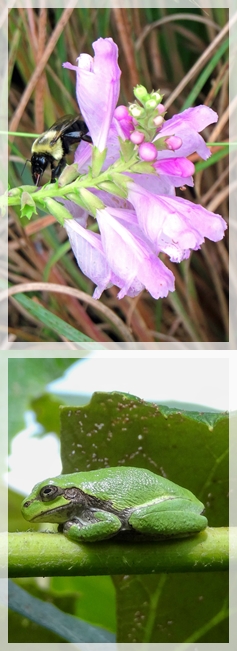 We’re sure to notice God in the Grand Canyon, the multitude of stars in the night sky, or when watching two million wildebeest, zebra and gazelles migrate through the Serengeti. We sense Him in extraordinary or exotic things like the peacock’s splendid tail, Devil’s Tower, or spectacular sunsets and sunrises. But do we notice Him in the commonplace and unremarkable?
Yesterday, I watched, spellbound, as several bees visited the flowers I was photographing. A bee would enter one of the purple tubular blossoms and disappear as it inched its way deep into the corolla to gather pollen and nectar. After backing out, it would move on to another bloom. A perfect fit, it was as if bee and flower had been designed for one another (and they were). The flowers’ scent attracted the bees and, while the bees gathered food for their hive, they pollinated the plants. What was happening in these ordinary flowers growing wild by the road was truly extraordinary!
God’s grandeur is revealed in the giant trees of the redwood forest but His attention to detail is found in the one billion bacteria that live in just one gram of the forest’s soil. His greatness is made known in the 1,600 miles of the Great Barrier Reef but also in the 1,500 species of fish, 5,000 species of mollusks, 17 species of sea snakes and 6 species of turtles living there. We see our ingenious Creator in the enormous African elephant but also in the oxpeckers and cattle egrets that ride on its back and in the lice, ticks and parasites living on the elephant that are eaten by those birds. God’s artistry is revealed in the 28,000 species of orchids and but also in His amazing design of the wasps, bees, flies, moths, ants and gnats that pollinate them.
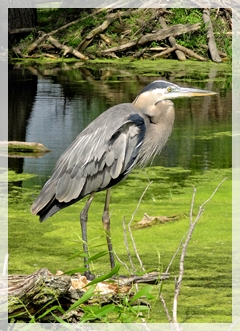
God teaches us, speaks to us, and provides for us through his creation. Let’s not fail to see His marvelous work in the everyday and mundane: wasps building a nest, mushrooms appearing on the lawn after a rain, maple leaves turning red in autumn, raindrops glistening on a flower petal, or a squirrel gathering nuts. You may remember the first line of Joyce Kilmer’s poem Trees: “I think that I shall never see A poem lovely as a tree.” The last line reads: “Poems are made by fools like me, But only God can make a tree.” Only God can make a tree, but He’s also the only one who can make the lichens and fungi living on its bark, the small tree frog hiding in its leaves, and the sparrow nesting in its branches.
Praise God, from whom all blessings flow!
Nature is the living, visible garment of God. [Johann Wolfgang Von Goethe]
All things bright and beautiful, All creatures, great and small, All things wise and wonderful, The Lord God made them all. [Cecil Francis Alexander]
 Having just returned from the East Coast, I had a lengthy “to do” list and thought I could fit in a few errands before picking up my mother-in-law for her doctor’s appointment. As I pushed the cart through the store, I glanced down at my watch to check the time and gasped. To my dismay, I’d lost an hour! I should have been picking her up right then; there was no way we would make it to the doctor’s on time. Leaving the cart in the aisle, I rushed to my car. Rather than think how to save the situation, my first thought was how to spin it! Other than my own carelessness and stupidity, what valid excuse could I have for my tardiness? As I started the car, I glanced at the clock on the dash and realized that hour hadn’t disappeared; I’d left it back East. While my watch was still on EST, my car, mother-in-law, the doctor and I were in CST and there was still plenty of time.;
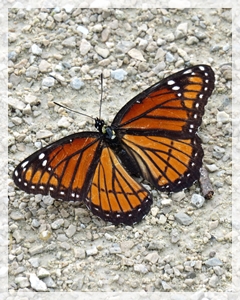 Unlike the bruised and broken butterflies in yesterday’s devotion, this one looked perfect as it lay on the trail. When we approached, the Viceroy fluttered its wings but only managed to skim a few inches across the gravel. As intact as it looked, one wing was entirely useless. To protect it from walkers’ feet and speeding bicycles, we managed to get the creature off the trail into the grass. Unfortunately, without some sort of butterfly super-glue to reattach the loose wing, while we could help, we couldn’t save it.
 “Watch out!” Jesus warned them. “Beware of the yeast of the Pharisees and Sadducees.” [Matthew 16:6 (NLT)]
 You will experience all these blessings if you obey the Lord your God: Your towns and your fields will be blessed. Your children and your crops will be blessed. The offspring of your herds and flocks will be blessed. Your fruit baskets and breadboards will be blessed. Wherever you go and whatever you do, you will be blessed. [Deuteronomy 28:2-6 (NLT)]
 In 1978, Merck Research Laboratories was approached by a scientist who thought a drug he was developing to treat parasitic infections in animals might be useful in treating a parasitic infection in humans. Called onchocerciasis or river blindness, it is transmitted through the bite of black flies and had no known cure. The pharmaceutical company faced a dilemma. Since onchocerciasis is found only in third world areas, the people needing the medication could never afford to buy it. How could the company expend money to develop a drug they’d never be able to sell? Nevertheless, they did and, in 1987, Merck announced that, for as long as was necessary, they would give away the drug (Mectizan®) for the treatment of onchocerciasis to any country that needed it. Eleven years later, they expanded their commitment and started donating Mectizan® for the treatment of Lymphatic filariasis, a mosquito-transmitted disease which can develop into elephantiasis. Since 1987, more than a billion treatments have been donated to thirty-three countries and the World Health Organization forecasts that both diseases could be eradicated by 2020.
 Devotions of the Heart