
He burned down the Temple of the Lord, the royal palace, and all the houses of Jerusalem. He destroyed all the important buildings in the city. Then he supervised the entire Babylonian army as they tore down the walls of Jerusalem on every side. [2 Kings 25:9-10 (NLT)]

Jerusalem was heavily fortified and completely protected by walls over thirty-nine feet high and eight feet thick. In 586 BC, the Babylonian forces of King Nebuchadnezzar breached those seemingly impregnable walls and Jerusalem was burned, the city’s walls torn down, and the people taken captive. The city’s walls were rebuilt by Nehemiah 141 years later but they were again breached in 70 AD by the Romans who destroyed the city, demolished the second Temple, and massacred much of the population.
Published in 1682, John Bunyan’s allegory The Holy War tells of another fortified city’s fall. Bunyan’s walled city of Mansoul had five gates: Eye-gate, Ear-gate, Mouth-gate, Nose-gate and Feel-gate. Rather than Babylonians or Romans, Mansoul’s enemy was Diabolus. Unlike Jerusalem’s, Mansoul’s gates could not be breached or opened from the outside. They could only be forced if someone within the city allowed it. In short, sin could only enter if someone permitted its entrance. Diabolus and his then invisible army sat down in front of Ear-gate and assaulted it with fraud, guile, and hypocrisy. With the deaths of Captain Resistance and Lord Innocence, the townspeople looked at the tree of forbidden fruit, tasted it, forgot their good King Shaddai, opened both Ear and Eye-gate, and Mansoul came under the rule of Diabolus.
The Holy War is a none too subtle allegory that makes its point: walled cities can fall and city gates can be breached, if not from the outside, then from within. Like the city of Mansoul, sin will tempt and try to seduce us but it can’t force its way into our lives; it only enters by invitation. We alone are the ones who determine what we look at, hear, touch, feel, smell, say and do. Satan didn’t force Eve to eat that fruit, Cain to kill Abel, Jacob to deceive his father, the Israelites to worship a golden calf, Samson to dally with Delilah, David to take Bathsheba, Jonah to run away from Nineveh, King Ahaz to sacrifice his son, Herod to decapitate John, Judas to betray Jesus, or Peter to deny Him. These people freely opened their gates to temptation and allowed sin entrance into their lives.
An inevitable part of life, temptation is not a sin; it is a trial of faith. Mansoul’s sin was not in hearing the lies of Diabolous—it lay in believing and acting upon them. Sin happens when we drop our guard, open our gates, and allow it into our lives. God has given us a conscience, self-discipline, His word, and the Holy Spirit to defend our gates; whether or not we open ourselves to sin always remains our choice. Let us be cautious as to who and what enters our gates!
Temptation is the devil looking through the keyhole. Yielding is opening the door and inviting him in. [Billy Sunday]
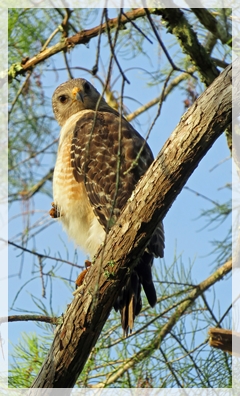 Seeing a red-shouldered hawk perched up in a nearby tree, I focused in on it only to see him suddenly duck his head to avoid being attacked by small bird and then drop again as another tiny bird swept down at him. Those two gnatcatchers boldly harassed the hawk as it kept bobbing and weaving to dodge them. Fiercely territorial, gnatcatchers are unafraid to confront predators and, apparently, the hawk was infringing on their territory. Eventually, the hawk admitted defeat and flew off to another tree. I later asked one of the Audubon docents why the large hawk didn’t fight back against the tiny birds and was told that the hawk knows it can’t win. Being so small, the fast and agile gnatcatcher easily can out maneuver the bigger bird. For the hawk, the energy spent trying to catch the gnatcatcher isn’t worth it; fleeing makes more sense than staying. After settling in another tree not far away, the hawk spotted a crayfish. After sweeping down to catch it, he returned to his new perch and enjoyed a peaceful breakfast (without any annoying gnatcatchers).
 Commissioned in 1946, the USS Midway served the entire length of the Cold War, during the Vietnam War, and in Operation Desert Storm. Decommissioned in 1992, this retired Naval aircraft carrier is now a museum in San Diego. It was fascinating to wander through this floating city and see the flight deck, bridge, hangar bay, engine room, crew quarters, ready room, and sick bay and inspiring to speak with vets who actually served aboard the ship. Unfortunately, not all of the sailors who boarded that ship during its 46 years of service walked off it. For some, if they returned home at all, it was in a box.
 When John Bunyan wrote The Pilgrim’s Progress, he was concerned both with the godless unbeliever and the casual and superficial believer: the nominal or counterfeit Christian. We all know them: people who may look and talk a lot like Christians but don’t live like one. Without even realizing it, we may even be one!
 By 1658 in England, it had become illegal to conduct a religious service differing from the Church of England’s official liturgy or for “one not in Episcopal orders” to address a congregation. A Puritan, John Bunyan, was arrested for preaching the gospel without a license. After three months in the Bedford jail, he was offered his freedom if he’d agree not to preach publicly. He refused saying, “If I was out of prison today, I would preach the gospel again tomorrow by the help of God.” Bunyan spent twelve years imprisoned. During that time, he wrote The Pilgrim’s Progress. No country cub prison, the Bedford jail was overcrowded, unsanitary, unheated, and the plague of 1665 claimed forty prisoners as victims. Years later, Bunyan wrote: “Satan can make a jail to look like hell itself.” Although all looked hopeless for the man, he found strength in prayer and in his writing.
 When we’re told to “Be still” in Psalm 46, we tend to think in terms of stopping movement—our busyness, frantic activity, or agitated actions. We associate it with a director yelling, “Cut!” the ref blowing his whistle, or a frustrated parent’s “Cut it out!” Being still can entail all of that, but it is much more. The root of the original Hebrew word used for “still” is the verb rapa which means to be faint, forsake, or sink down. When used as the imperative ra’pha’h, as it is in Psalm 46, it means to drop or release our concerns, to become weak, or surrender. While most Bible versions translate this as “Be still,” some translate as desist, stop fighting, cease striving, be quiet, or be at peace. In short, we’re being told to stop anxiously fighting a situation and leave the matter to God—to relax our grip on things, stop worrying and let it be.
 Devotions of the Heart