
“There is still one thing you haven’t done. Sell all your possessions and give the money to the poor, and you will have treasure in heaven. Then come, follow me.” But when the man heard this he became very sad, for he was very rich. [Luke 18:22-23 (NLT)]
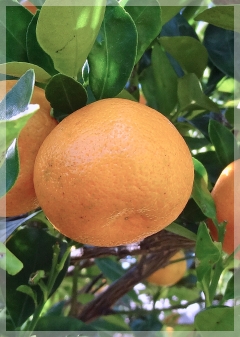 “What’s your orange?” the teacher asked her remote learning class. Before having them answer, she explained the “monkey trap.” In Southeast Asia, hunters capture monkeys by drilling a hole in a pumpkin. The hole is just large enough for a monkey’s hand but too small for his fist. They secure the pumpkin to a tree, put a piece of sweet juicy orange inside the gourd, then retreat and wait. Eventually, an unsuspecting monkey comes along, smells the orange, and reaches through that small hole into the pumpkin. Once he’s grabbed hold of the orange, however, his fist can’t get back through the same hole. The monkey pulls and pulls but can’t free his hand. While he’s struggling to pull out his orange-filled fist, hunters easily throw a net over him. Not understanding that he can’t have both his freedom and the orange, he loses them both. After telling this story, the teacher again asked her students, “What is your orange? What is it you can’t release?”
This lesson was part of an expanded on-line curriculum at my grand’s high school. Its purpose is to address the emotional issues encountered by the teens in this strange time of social distancing and on-line classes. Whether the “monkey trap” is an actual technique or simply a parable, its lesson applies to Christians as well as pandemic teens. Do we have an orange (or two)?
We’ve all asked God to save us from one predicament or another but, after promising we’ll do anything He asks, we often add a condition to that prayer and tell God not to ask us to give up the “orange.” We’re deep in debt but we tell God not to ask us to sell the boat or downsize the house. When our marriage is in trouble, we tell God not to ask us to give up the internet flirtation or the nights out with the guys. We’re having ethical challenges at work but tell God not to ask us to give up the well-paid position. Like the orange, some things are a whole lot easier to grab than to let go!
Like the monkey, we’re often held hostage by whatever our “orange” is: whether it’s alcohol, drugs, food, gambling or another addiction; an unhealthy relationship, money, possessions, or prestige; or emotions like resentment, worry, anger, arrogance, remorse, pain from past hurts, guilt, or self-doubt. Whatever we’re holding tightly in our heart keeps us from being truly free to enjoy the abundance and peace Jesus offers. Until we let go of that “orange,” there’s no room for God’s blessings.
The gospels tell of the rich young ruler who asked what he must do to inherit eternal life. Jesus’ answer that he must give away all his wealth makes us all uncomfortable. Does God really expect us to give away everything? Giving away all we possess, however, isn’t a universal requirement and Jesus didn’t ask that of anybody else. What Jesus asked the man to do was to give up the thing that possessed him: his orange. That’s what He asks of us, as well. Every person has his own “orange;” we must recognize it for the trap it is, open our hands, and let it go. The rich young ruler’s “orange” was his wealth; what’s yours?
If you have not chosen the Kingdom of God first, it will in the end make no difference what you have chosen instead. [William Law]
 My daughter-in-law sent photos of the family’s day at the apple orchard. The grands picked apples, pet the farm animals, climbed the tractors, raced the pedal karts, did the zip-line, raced through the corn maze, traversed the goat bridge, and enjoyed their fill of donuts and apple cider. It was a fun-filled but exhausting day. The last picture was of my son carrying the youngest grand (who’d fallen asleep on the ride home) into the house.
 Back in 1963, Bob Luman sang “You can take the boy from the country, But you can’t take the country from the boy.” Along the same line, Brookes & Dunn sang that while you could take the girl out of the honkey-tonk, you couldn’t take the honkey-tonk out of the girl. I wonder if Moses thought about singing, “You can take the people out of Egypt, but you can’t take Egypt out of the people!”
 I’ve learned something about my housekeeping habits during this pandemic. Like many, when it first began, I took my pent up energy and enthusiastically cleaned, arranged, sorted and scrubbed. Cupboards and baseboards were wiped, windows were washed, furniture moved, fan blades dusted, files sorted, and every closet, cupboard, and drawer organized. That, however, was many months ago. I now realize that hospitality was my real reason for cleaning house. Pre-pandemic, we frequently entertained, neighbors regularly stopped over, and houseguests often occupied one of the bedrooms. Being ready for visitors at a moment’s notice was my incentive for keeping the house spic-and-span. Guests, however, are a thing of the past and only repairmen get beyond the front door! While our house is still presentable, it’s not the way it used to be. With just the two of us, I’ve lost my motivation and become far more tolerant of things like dust, disorder, and dirty windows!
 Because we heard the fan running, we didn’t realize the AC wasn’t working until we returned home after being gone most of the day. By then, the inside temperature of 86 told us we were in trouble. A check outside told us the AC compressor wasn’t operating and the blackened grass near it told us why: a lightning strike during the previous night’s storm! Although the fan could still operate, without the power of the compressor, all it did was blow hot air!
 Devotions of the Heart