
Don’t fret or worry. Instead of worrying, pray. Let petitions and praises shape your worries into prayers, letting God know your concerns. Before you know it, a sense of God’s wholeness, everything coming together for good, will come and settle you down. It’s wonderful what happens when Christ displaces worry at the center of your life. [Philippians 4:6-7 (MSG)]
Here’s a little song I wrote, You might want to sing it note for note,
Don’t worry, be happy. In every life we have some trouble
But when you worry you make it double. Don’t worry, be happy,
Don’t worry, be happy now. [Bobby McFerrin]
 “Don’t worry, be happy,” sang Bobby McFerrin. Right now, for many of us, that’s easier sung than done. This pandemic has turned our lives upside down. Between rising numbers of COVID cases and concern about on-line schooling, money troubles, closing businesses, political divisiveness, and quarantining, it’s hard not to worry!
The word “worry” comes from the old English wyrgan meaning “to strangle” which led to the Middle English meaning “to slay, kill or injure by biting and shaking the throat” (as a dog or wolf might to a lamb). By the 17th century, the verb “worry” also meant “to bother, distress or persecute” and, by the 19th century, the noun meant “anxiety arising from cares or troubles.” All of these meanings ring true. Worry can strangle us with fear and indecision or seize and tear us apart by destroying our confidence, health and relationships. With the ferocity of a wolf, it can intimidate us, attack our plans, shake our faith, and hound our every thought. Fretfulness, sleepless nights, stress, and angst—all come from worry.
While “worrywart” is often used to describe someone who worries excessively by dwelling on the possibility of trouble or difficulty, it originally meant something else entirely. In 1922, Out Our Way, a comic strip depicting rural American life drawn by J.R. Williams, made its debut and a recurring character was the Worry Wart, a young boy (who frequently was accompanied by his mangy dog). Worry Wart wasn’t a worrier; instead, he was a pest who frustrated and worried his parents. Oblivious to the world around him, his schemes and foolhardy actions annoyed others and caused them anxiety!
The term “worrywart” may have gotten its present meaning in 1956 when it was used by Ivan Belknap in a book outlining problems in state mental hospitals. “Worrywart” was used to describe a particularly delusional kind of patient who’d abandoned all reasonable thinking. We don’t have to be patients in an asylum to abandon reasonable thinking; all we have to do is worry! With worry, a simple problem can turn into a major disaster and fill our minds with all sorts of horrible and improbable scenarios. Worse, because our worry often causes those around us their own stress and anxiety, we become as disruptive and bothersome as the original Worry Wart. Worry doesn’t just drive us crazy; because it’s as contagious as measles or COVID, it drives everyone around us crazy, too!
Every day we have a choice; trust God or worry. When we’re unwilling to trust Him to handle things, worry is the inevitable result. Since worry does nothing but steal our joy and rob us of a good night’s sleep, trust seems the better choice. Trusting God with the future, however, means ceding control of tomorrow (and every day after) to Him. That’s difficult if we secretly harbor the belief that we are the ones running the universe. Fortunately, we’re not—that’s God’s job, and His alone. Today, let’s hand Him our worries and choose to trust Him with our concerns.
Father, keep us from worry and from causing others to grow anxious. Lighten our heavy hearts and the hearts of those around us. Help us all to surrender our concerns, burdens and fears to you. Fill us with your peace.
Worry does not empty tomorrow of its sorrow; it empties today of its strength [Corrie ten Boom]
For peace of mind, resign as general manager of the universe. [Larry Eisenberg]

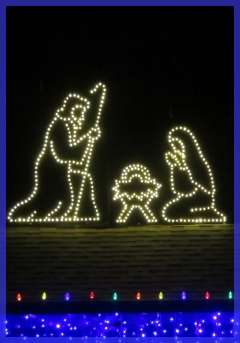 Two nights ago, we joined a long line of vehicles slowly wending their way through a nearby neighborhood famed for its over-the-top holiday light display. Each street follows a theme and over 300 homes are brightly decorated. The streets were aglow with meteor shower, icicle, garland, fairy, net, star, blinking, ball and laser lights along with illuminated blow molds, inflatables, and cut-outs of everything from Santa exiting an outhouse to the Grinch, igloos to elves, and candy canes to Olaf and the Minions. As bright as that neighborhood’s display was, it pales in comparison to one done by the Gay family in Lagrangeville, NY. Holders of the Guinness world record for holiday lights on a residential property, their 2020 display uses more than 670,000 lights that are choreographed to 256 songs.
 Colors have been used to differentiate liturgical seasons since the 4th century and, by the 12th century, Pope Innocent systemized their use in the church. Originally Advent was about penance, prayer and fasting in preparation for baptism so purple (the color associated with sacrifice and repentance from sin) was its liturgical color. Like the Advent wreath, however, liturgical colors are merely traditions and have no basis in Scripture. Most denominations have added more colors to the original five.
 My New York Times newsletter has a section called “What You’re Doing” in which readers share how they’re dealing with the pandemic—everything from dreaming up innovative waffle recipes to sending “karaoke grams” to friends on their birthdays. Today, M.B. wrote that she’d started 2020 with a line-a-day diary. Since March, however, she’d filled the diary with “dire COVID milestones, illness among family and friends, anger at deniers, and mourning for the loss of normal life, vacations, and more.” Tiring of her negativity on Thanksgiving Day, M.B. turned that line-a-day diary into a daily gratitude journal and reported having a positive attitude that will carry her through the pandemic.
 When I was in college, most of the girls in my sorority house played bridge. After watching a few games, newcomers would sit in and learn from the more experienced players as they played. We novices lost a lot of games in the process but, eventually, we became good players. One friend, however, wanted to start as an expert. She sat alone in her room with a deck of cards and a bridge book trying to teach herself. Unwilling to make rookie mistakes, she wouldn’t play a hand until she was a skilled player; that day never came. She wasn’t much different from the people who say they’ll join a gym once they’ve gotten in better shape; rarely does that day come either.
 Devotions of the Heart