
Curse that day for failing to shut my mother’s womb, for letting me be born to see all this trouble. Why wasn’t I born dead? Why didn’t I die as I came from the womb? [Job 3:10-11 (NLT)]
 After Satan took Job’s loved ones and wealth, the grieving man remained a pillar of patience and faith. Rather than blaming God, the stoic man acknowledged God’s sovereign authority saying, “The Lord gave me what I had, and the Lord has taken it away. Praise the name of the Lord!” [1:21]
Things took a turn for the worse when Satan attacked Job’s body. With boils from head to foot, Job’s body was covered with scabs, pus oozed from his sores, his skin was black and peeling, and maggots fed on him. As if that weren’t enough, the man suffered from insomnia, nightmares, fever, and pain in his bones. His symptoms sound as horrific and deadly as Ebola Hemorrhagic Fever.
When Job’s wife told him to curse God and die, the faithful man responded, “Should we accept only good things from the hand of God and never anything bad?” [2:10] Although he seemed resigned to his fate, the despondent Job came dangerously close to falling into Satan’s trap when, in Job 3, he questioned God’s wisdom in giving him life.
I can understand someone like Job, someone suffering terribly who sees no end to the misery, wishing for a quick end to his life and praying for the release offered by death. What I find difficult to understand is Job’s wish that he’d never been born. Cursing the day of his birth and the night of his conception, the despairing man literally wished his life erased from its existence.
Until Satan’s attack, Job’s life appears to have been picture perfect for decades. With his many servants and more than 10,000 head of livestock, he was the richest man around. The father of seven sons and three daughters, he probably had numerous grandchildren. The family regularly gathered together for long feasts so they must have enjoyed each other’s company. A prominent man, well-respected in the community, Job was principled, generous and charitable. In spite of having everything his heart desired, Job’s heart remained set on God and the Lord called him, “the finest man on earth…blameless…a man of complete integrity.” [1:8] Yet, by cursing his very existence, Job wanted to obliterate all the blessings and joy that existed between his birth and his affliction.
In his pain, Job forgot about growing up in a loving home, playing with his brothers and sisters, the bliss of young love, the wonder of touching his wife’s belly and feeling his unborn child move, the delight of holding his children in his arms, the laughter of his family, the satisfaction that came from being able to right a wrong or help the poor, and the joy of bouncing a grandchild on his knee. If he’d never been born, he would have missed sunrises and sunsets, the taste of grapes, the sound of birds’ songs, the pleasure of a kiss, and the joy of praising the Lord. Although Job began his story as a sterling example of accepting of God’s will when disaster strikes, cracks developed in his spirit as his suffering intensified.
Job’s outburst of despair, however, does not mean that Satan won. While Job cursed his day of birth, he never cursed God. Moreover, even though he wondered why people who longed for death continued to live, Job never considered suicide. Because he operated on a false retribution theology, Job believed that God had forsaken him. Rather than losing faith in God, he lost faith in himself.
For many of us, these last several months have challenged our physical, emotional, spiritual, and financial resources and, like Job, we may feel overwhelmed by all that has beset us. Job lost perspective; let us not do the same. God did not forsake Job and He has not forsaken you! We must never forget our past blessings or rue the day of our birth. After all, had we never been given life, we wouldn’t have had the opportunity to know Jesus, be born again, or enjoy eternal life!
 My grandmother lived in a beautiful large house. To the left of the foyer, behind closed French doors, was an elegant room she called the “drawing room,” but it wasn’t an artist’s studio where people drew. With its grand piano, silk draperies, formal furniture, and crystal chandelier, it was a room saved for entertaining special guests. Strategically placed near the front door, guests could go directly into it without passing through the rest of the house. As splendid as the room was, I never saw anyone in it; family and close friends always gathered in the “library.”
 Our pastor recently did a sermon series called “Following Jesus” which reminded me of our first time backcountry skiing in Colorado more than forty years ago. As novices, we knew enough not to venture into the wilderness by ourselves so we hired Wyatt to be our guide. Insisting we delay our trek several days until we’d acclimated to the high altitude and were ready for such a trip, he gave us a long list of items we had to carry in our packs. When I asked why we needed all the survival gear along with additional food, water, and clothing, he said we had to be prepared to spend the night. Protesting that I didn’t want to spend the night out in the cold and snow, he explained, “Neither do I, but we better be prepared to do it.”
 When Robert Louis Stevenson was just a boy, he was gazing out the window one evening and saw the lamplighter lighting the street lights. The future poet is reported to have said, “Look, Nanny! That man is putting holes in the darkness.” While it makes for a good sermon illustration, a more accurate version of his words is found in an essay he wrote in 1878, “A Plea for Gas Lamps,” in which the man expressed his opposition to the “ugly blinding glare” of the electric lights that were beginning to replace the gas lamps of Edinburgh. After asking God to bless the lamplighter, the poet described him as “speeding up the street and, at measured intervals, knocking another luminous hole into the dusk.” The lamplighter, said Stevenson, “distributed starlight, and, as soon as the need was over, re-collected it.”
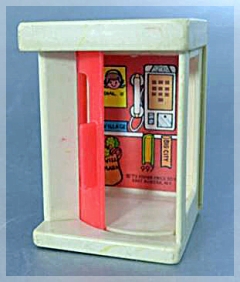 When my little grands came to play, I’d dig out the Fisher-Price “little people” village that had been their parents. Being from the early 70s, it included a free standing phone booth and I had to explain what it was and why pay phones were necessary. Phone booths are so scarce now that I suspect Superman needs to find another changing room! I can’t remember when last I dialed a phone, let alone filled a fountain pen, used carbon paper or even a typewriter. Mimeograph machines, 45s, rabbit-ear antennas, 8-track, VHS, and cassette tapes are all long forgotten. 35 mm film has been replaced by digital technology, dictionaries by spell check, and that cumbersome 26 volume encyclopedia by search engines. If you don’t understand my references, you probably don’t have a landline phone or use an alarm clock, address book, pocket calendar or travel agent. You stream your music rather than play CDs, use a GPS rather than maps, and get your news on the Internet! It’s amazing how many things have become antiquated in just my lifetime. There is, however, one thing that hasn’t become obsolete in 3,500 years: the Bible!
 Saturday mornings we usually walk through a nearby park that is home to a unique subspecies of squirrel found here in southwest Florida: the Big Cypress fox squirrel (or BCFS for short). Larger than a common gray squirrel, the BCFS has a black head and back, buff sides and belly, white ears and nose, and a long bushy tail.
 Devotions of the Heart