
Then Jesus said, “Come to me, all of you who are weary and carry heavy burdens, and I will give you rest. Take my yoke upon you. Let me teach you, because I am humble and gentle at heart, and you will find rest for your souls. For my yoke is easy to bear, and the burden I give you is light.” [Matthew 11:28-30 (NLT)]
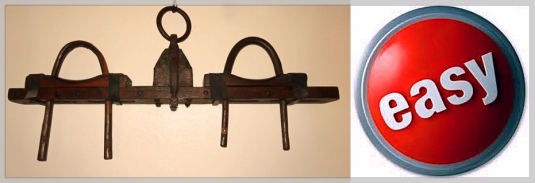
Several years ago, an office supply company featured an “easy” button in its advertisements and you still can purchase one for less than $9. “Don’t stress it; press it,” their web site suggests. Apparently, when placed on your desk, you can show others how easy it is to find solutions to their problems. Wouldn’t it be nice if all we had to do was push a button to make things easy (or at least easier)?
Rather than a button, however, Jesus offers us a yoke: a wooden frame used as a sort of harness to join two draft animals so they can work together. Among assorted farm implements that once decorated our mountain home, we had the yoke pictured above. It hung upside down but that heavy wooden beam actually rested on the animals’ necks. Without any padding, it doesn’t look that easy to bear! If it is all the same to God, I’d much rather push an easy button than take on anything like a yoke! Fortunately, Jesus was speaking figuratively.
The heavy burden to which Jesus was referring was that of the Pharisees and their legalistic law-keeping that went far beyond God’s demands. For example, there were 39 major categories with hundreds of subcategories defining what constituted work on the Sabbath. While the Jewish way offered the yoke of the law without the power to be obedient, Jesus offered a yoke of faith empowered by the Holy Spirit!
Nevertheless, this passage also can be interpreted as Jesus being our burden sharer. While many things are too heavy for us to bear alone, nothing is too great for Him. By taking His yoke, we give up trying to do life on our own; instead of finding rest in a method, we find rest in a person: Jesus! His yoke is better than an easy button because it actually works! When yoked to Him our burdens are no longer our own!
Can you think of any kinder words than Jesus asking us to come to Him to find rest? Life isn’t easy but God never promised that it would be. Rather than an easy button, we have Jesus and His promise that life is doable with Him. Unlike the yoke that hung on our wall, His yoke is easy to bear and the burden is light. We never have to carry the heavy load of life on our own because He will share it with us. Better yet, since He is so much stronger, most of the weight will be on His heavenly shoulders.
Today, as I take on Jesus’ yoke and share life’s weight with Him, I recall the old Swedish proverb that says, “Shared joy is a double joy; shared sorrow is half a sorrow.” Wearing His yoke will make my life much brighter and my burdens much lighter.
 In all three accounts of Jesus healing the paralytic whose friends carried him to the Lord, Jesus forgave the man before healing him. While the combination of both forgiveness and healing demonstrated Jesus’ power over both sin and disease, His offer of forgiveness before healing might lead us to think there is a causal relationship between sin and sickness or forgiveness and physical healing.
 When Jesus forgave the unnamed woman’s sins, he caused quite a stir among the Pharisees and religious leaders who were His fellow dinner guests. People can forgive an offense against them, but they can’t forgive an offense against someone else or God! While I can forgive your $10 debt to me, I have neither the right nor the power to say you don’t have to pay the $150,000 you also owe the Bank of America, Sallie Mae, Capital One and Chase for your mortgage, college loan, car financing, and credit card purchases. A person can’t do that but God can! Because only God has the authority to forgive people’s sins, implied in Jesus’ forgiveness of the woman’s sins, is a claim that He is God.
 When entering someone’s home, while we might be offered some hand sanitizer or asked to remove our shoes, none of us expect the host to provide us with water to wash our feet. Back in Biblical times, however, hospitality was quite different. No one wore socks and the shoes and sandals bore little resemblance to the Nikes, Tevas, and Keens of today. Between the dusty roads and the oxen, horse, donkey and camel droppings on them, people’s feet were filthy. Foot washing was an expected sign of hospitality and a good host always offered water so a guest could wash his own feet. If the host were rich enough, his servant did the washing and, if the guests were honored enough, the host might do the washing. For example, both Abraham and Lot offered foot washing to their heavenly visitors and, before feeding them, Laban provided Abraham’s servant and men water for foot washing. On the last night of His life, Jesus took on the role of a servant and washed the feet of His disciples.
 My father had what’s often described as a Type-A personality. An impatient workaholic, he always took on more than he could handle. Life, for him, was one crucial task after another, none of which anyone else could do, at least not correctly. Always in a hurry, he never wanted to stop for anything, even when his gas gauge read precariously close to empty. Something more pressing always took precedence over a brief stop for gas. As a result, his car was often left on the roadside while he trudged off with a gas can to find the nearest service station. Instead of saving time, his refusal to stop cost him time. Living that way actually cost him his life; he died of a massive coronary at the age of fifty-six. It’s often been said that your in-box still will be full when you die and, indeed, his was. None of us can accomplish everything on our to-do list and we may well destroy both our relationships and ourselves while trying.
 Yesterday, I wrote about Job’s lamentation. 19th century bible scholar George Granville Bradley said this about Job 3: “Where in the world will you find a sadder strain of more hopeless, uncontrolled, and unbroken lamentation and mourning? … Filled to the brim, they run over with pain.” I have to agree.
 Devotions of the Heart