
 Then Jesus, full of the Holy Spirit, returned from the Jordan River. He was led by the Spirit in the wilderness, where he was tempted by the devil for forty days. [Luke 4:1-2a (NLT)]
We must not count temptation a strange thing. “The disciple is not greater than his master, nor the servant than his lord.” If Satan came to Christ, he will also come to Christians. [J.C. Ryle]
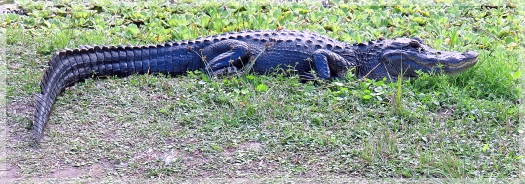
One of my favorite trails is an old tram road through a maple-cypress swamp. After a short walk on a crushed shell path and a boardwalk, we come to a slightly raised grassy trail originally used for logging. It is on this narrow path, with water on both sides of it, that we frequently encounter an alligator sunning himself on the trail! Since it’s a swamp, we should expect gators, snakes, raccoons, otters, and birds but seeing an alligator directly in our path is disconcerting. More alarming, however, was when I stepped out of the car at another park and found an alligator sunning himself just a few feet away from my feet! A gator in the swamp should be expected but one in the picnic area is an unpleasant surprise (as are the alligators that occasionally move into the lake by our home or rest amid the flowers at the botanic garden).
Following his baptism, Jesus was led by the Holy Spirit into the wilderness. Had He been led to a pagan temple or the 1st century equivalent of a bar or gentleman’s club, Satan’s presence could be expected but you’d think the wilderness would be a temptation-free zone. Perhaps that’s why the Spirit specifically led Him there to be tempted—it’s a vivid reminder that we don’t have to be where we don’t belong or doing what we shouldn’t be doing to have Satan come looking for us. Going where the Spirit leads is no guarantee that Satan won’t try to follow. Like alligators, he’s no respecter of boundaries and will show up where least expected.
In various mythologies, evil supernatural beings like vampires can’t enter your house unless they’re invited inside. Make no mistake about it, Satan doesn’t wait for an invitation and he’ll show up when and where we least expect him. Eve didn’t ask that serpent into the garden nor did the naïve woman expect the evil one to lie. But, he lied to her, he lied to Jesus, and he’ll lie to us.
Here in Florida, we don’t have to be walking in a swamp to encounter danger; wherever there’s brackish or fresh water, alligators should be expected. Whether or not we see them, they’re there. The same can be said for Satan—he’s lurking somewhere near and we don’t have to be in the equivalent of a swamp. Satan and alligators are opportunistic and both will quickly lunge at prey should the opportunity arise. The gator’s preferred method of hunting, however, is to patiently stalk his prey, silently sneak up, and then attack. Satan works much the same way. We must walk cautiously whether in a swamp or a garden because no place is truly safe. When we happen upon a gator, we keep our distance, turn around, and go the other way. When we encounter Satan, with the power of the Holy Spirit, like Jesus, we’ll stand our ground, rest on the Word of God, and send him packing.
As the most dangerous winds may enter at little openings, so the devil never enters more dangerously than by little unobserved incidents, which seem to be nothing, yet insensibly open the heart to great temptations. [John Wesley]
 What is the most important moment in your Sunday service? If your church follows a liturgy, perhaps it is the confession, absolution, or thanksgiving. Singing praise music, hearing an inspiring sermon or sharing in the Lord’s Supper may be the highlight of your worship. Reciting the Creed, saying the Lord’s Prayer, greeting one another, communal prayer—all are important parts of the day’s worship service but are they the most important part of it? I wonder if the holiest moment of our Sunday morning occurs when the service is over and we leave the sanctuary (or turn off the computer) and go into the world. When the service has concluded, instead of our obligation to God being over for the week, could it just be starting? Could the next six days and twenty-three hours be more critical than that hour or so we spent at church?
 When Alexander the Great’s army was advancing on Persia, his troops were so weighted down by the spoils of war they’d taken in earlier campaigns that they moved too slowly to be effective in combat. At one critical point, it seemed that defeat was inevitable. As much as the greedy Alexander desired the silver, gold, and other treasures they’d pillaged, he ordered that all the plunder be thrown into a heap, burned, and left behind. Although his troops complained bitterly, they did as directed. Once unencumbered by the excess weight of their treasure, his army saw the wisdom of Alexander’s command when their campaign turned from impending defeat to victory. “It was as if wings had been given to them—they walked lightly again,” said one historian.
 In a recent Pearls Before Swine comic (drawn by Stephen Pastis), Rat asked Pig if he would be getting out of bed that day. Replying no, the sweet little swine explained, “I fear the big bad world and want no part of it.” When Rat told him he couldn’t stay in bed forever, Pig disagreed. “I have a bed, a bathroom, and a food delivery app that I’ve asked to just throw my food through the window.” In the next frame, we see Rat snug in bed with his friend and asking to borrow a pillow. I understand. There certainly are days in this crazy world of ours that we’d all prefer to just snuggle under the covers and never have to get up to face the challenges of the day, especially if DoorDash would deliver bedside. That, however, is not an option.
 Yesterday I wrote about the Song at the Sea or Song of Moses found in Exodus 15. There is another psalm known as the Song of Moses. Found in Deuteronomy 32, it was sung forty years after that first one, when the Israelites were again preparing to enter Canaan. With Moses’ death imminent, God had appointed Joshua as the nation’s new leader. Knowing that the people would turn their back on Him once in Canaan, the Lord met with Moses and dictated the words to this song. God’s words were ones of warning and Moses was to teach this song to the Israelites as a reminder of the consequences of disobedience.
 Following the Israelites’ successful passage through the Red Sea and the destruction of Pharaoh’s army, we find Moses and the people singing a song of deliverance and praise in Exodus 15. This beautiful and powerful psalm vividly describes the warrior God Yahweh hurling Pharaoh’s chariots and army into the sea. This is Moses’ song but he doesn’t figure in the account at all. A paean to the supremacy and unrivaled power of Jehovah, all of the glory is given to God.
 Devotions of the Heart