DID YOU HAVE A MOSES?

They forgot God, their savior, who had done such great things in Egypt—such wonderful things in the land of Ham, such awesome deeds at the Red Sea. So he declared he would destroy them. But Moses, his chosen one, stepped between the Lord and the people. He begged him to turn from his anger and not destroy them. [Psalm 106:21-23 (NLT)]

corkscrew swamp sanctuaryOur small group is studying personal evangelism and the study guide suggested writing a note of gratitude to the person or persons who helped point our way to Christ. After all, the single greatest gift any of us can give someone is an introduction to Jesus. Since mine was a gradual journey and, other than my mother, no one immediately came to mind, I skipped this simple step. After finishing the books of Exodus, Leviticus, Numbers, and Deuteronomy, I’m reconsidering.

While reading through the story of the exodus, I was struck by the Israelites’ ingratitude. When they made and worshipped that golden calf, God threatened to destroy all of them but Moses interceded; although 3,000 died, the nation survived. When God cursed Miriam with leprosy for her rebellion against Moses, it was Moses who interceded for her and begged God for her healing. When the Israelites failed to believe God’s promises and refused to enter Canaan, an angry God threatened to destroy them with a plague. Again, it was Moses who interceded and saved them. Frankly, by that time, I would have been tempted to tell God to kill the whole lot of them!

When a contingent of 250 Israelite leaders confronted Moses and Aaron with false accusations and complaints, an angry God again threatened to destroy them all. It was Moses and Aaron who fell on their faces and pled with God not to judge the whole nation for their sin. After Moses told the people to move away from the rebels, the ringleaders were swallowed by the earth and God’s fire consumed the others. The next day, instead of thanking Moses for saving the rest of them, the people accused Moses of being responsible for the previous day’s deaths. An angry God told Moses and Aaron to move away from them so that He could consume the ungrateful mob. Yet again, Moses and Aaron fell to the ground in prayer and supplication. Seeing a plague starting, Aaron filled a censer with incense and ran into the crowd to stop the plague by atoning for their sin. Apparently slow learners, when the Isarelites grew impatient and again spoke against God and Moses, the Lord sent poisonous snakes among them. Once again, Moses prayed for the salvation of his people and saved the day.

For over forty years, Moses led a thankless lot of “stiff-necked” people through the wilderness and continually interceded on their behalf to God. Although we read of Moses leading them in offering thanks to God, we never read of any of them thanking Moses for his service. The Israelites mourned for him when he died but it seems they never thanked him when he lived.

Many of us had a Moses and Aaron, more likely several, who led us on our faith journey through the wilderness into the Promised Land—the Kingdom of God. While I can’t single out one specific person who pointed the way, I remember several people who welcomed me when I felt ill at ease, loved me when I felt unlovable, encouraged me on difficult parts of my journey, offered guidance when I started to lose my way, lifted me when I began to fall, challenged me to be all that God wants me to be and, like Moses, interceded for me in prayer. I thank God for them but, today, I also thank them. Did you have a Moses and Aaron who led you into the Promised Land? Have you thanked them?

None of us got to where we are alone. Whether the assistance we received was obvious or subtle, acknowledging someone’s help is a big part of understanding the importance of saying thank you. [Harvey Mackay]
Through the angel who appeared to him in the burning bush, God sent Moses to be their ruler and savior. And by means of many wonders and miraculous signs, he led them out of Egypt, through the Red Sea, and through the wilderness for forty years. [Acts 7:35b-36 (NLT)]

Copyright ©2018 jsjdevotions. All rights reserved.

GIVING THANKS

Make thankfulness your sacrifice to God, and keep the vows you made to the Most High. … But giving thanks is a sacrifice that truly honors me. If you keep to my path, I will reveal to you the salvation of God. [Psalm 50:14,23 (NLT)]

It’s one thing to be grateful. It’s another to give thanks. Gratitude is what you feel. Thanksgiving is what you do. [Tim Keller]

Black-crowned night heronYesterday I happened upon a wood stork enjoying a fish breakfast. I was astonished as the stork swallowed the whole wriggling fish in one big gulp. “I’ll have to put that in my gratitude journal,” I thought as I walked on. Later, I spotted two woodpeckers hammering away at a tree and got up close and personal with a pond snail laying eggs. Two more for the journal, I thought. Did I put those little blessings in my journal last night? Shamefully, I forgot to write in it at all; worse, I totally forgot about them in my nightly prayers!

When I look back at the rest of yesterday, all sorts of wonderful little things happened for which I was grateful and yet failed to thank God. Without having one red light, I got to an appointment with time enough to take a short walk on the beach. I’m not self-centered enough to think God turned all those lights green just for me; nevertheless, my day went better because of it and it deserved thanks. I met a delightful young couple at cooking class. Did God put them there just for me? I don’t know, but I was thankful to have them as cooking partners for the afternoon. There was a beautiful cooling breeze and the sunset was magnificent. Did God arrange the weather to my wishes? I doubt it, but I should have told Him how much I appreciated it! I was remiss in acknowledging God’s presence or thanking him for the day’s numerous small blessings.

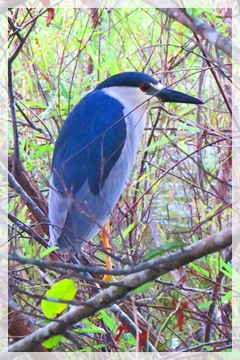
Today, I set out again and spotted a black-crowned night heron hiding in the bushes. While getting a photo, I thought, “I’ll have to put that in my gratitude journal.” This time, however, that small voice reminded me how lackadaisical I’ve gotten with my journal and asked me why I was waiting to thank the creator of all those beautiful moments. That gave me pause. If I’d been walking with someone else, I would have shared those sightings. Although I wasn’t walking with another person, I was walking with God. Why wasn’t I talking to Him? Why wasn’t I sharing my joy with the one who gave it to me? God was right beside me and He shouldn’t have to wait until I get around to thanking him or writing in my journal, especially since I’m not good about remembering to do so. Thanks should be speedy and sincere.

We thank God through our prayer. We don’t need church, a table blessing or a gratitude journal to do so. We certainly don’t need to wait until our regular prayer time to offer thanks and, most especially, we shouldn’t wait until November for Thanksgiving Day! Our whole day, every day, should consist of a prayer of thanksgiving. God is with us as we take our daily walk; let us remember to thank him for the joy we find along with way.

We need to discover all over again that worship is natural to the Christian, as it was to the godly Israelites who wrote the psalms, and that the habit of celebrating the greatness and graciousness of God yields an endless flow of thankfulness, joy, and zeal. [J.I. Packer]

And give thanks for everything to God the Father in the name of our Lord Jesus Christ. [Ephesians 5:20 (NLT)]

 Give thanks to the Lord, for he is good! His faithful love endures forever. [1 Chronicles 16:34 (NLT)]

Copyright ©2018 jsjdevotions. All rights reserved.

SEASONS

For everything there is a season, a time for every activity under heaven. A time to be born and a time to die. A time to plant and a time to harvest [Ecclesiastes 3:1-2 (NLT)]

aspens and pines - Steamboat COWhile some might groan, others may cheer on this the first day of winter. I remember being asked my favorite season and, since we were skiing in the mountains at the time, I said it was winter. I loved it for the powder days on the slopes, pines laden with snow cookies, and aspens glistening with hoarfrost. Winter meant snuggling by the fire with a hot drink while watching the snow fall and the wind blow the trees. Then, I remembered that winter brings shoveling, cleaning off the car, cold toes, drippy noses, falling on the ice, and heating bills so I quickly changed my answer.
Perhaps spring was the favorite—the snow starts to melt, song birds reappear, snowbells and crocuses peek out of the ground, coats and boots are shed, and we again feel the sun’s warmth. Then I remembered the crowds and traffic jams of spring break, rain, mud, spring cleaning, and tax day! Summer was a possibility with its peonies, peaches, butterflies, sandals, tank tops and lazy days at the lake. Then again, summer brings mosquitoes, allergies, humidity, weeding, mowing, and tornadoes. When I remembered the autumn colors, the cranes and geese gathering before migration, Thanksgiving dinner, and the sound of leaves rustling while walking through the woods, I thought my answer should be autumn except for the box elder bugs, gloomy days, leaf raking, more allergies, and hurricanes.

Years later, I’m still unable to give a decisive answer to which is my favorite season; I hope to never see it as one of those problematic online security questions. Fortunately, with the passing of each year, we get to return to all the things we like about a season and, when we tire of that season’s challenges, we know a new season will arrive within a few months’ time.

Unlike the calendar’s seasons, we only get one spring, summer, fall and winter in life. Unfortunately, much of our time in any season often is spent trying to move into the next or return to the previous one. The four-year old proudly tells you she’ll be five at her next birthday and, the day she turns fifteen, she claims to be almost sixteen. She may be OK with being twenty-two but she drags her heels as thirty approaches. Trying to hold the next season at bay, she “recently turned forty” at forty-five and, when the invitation to join AARP arrives at fifty, she bursts into tears. By sixty, she looks longingly at the clothes she used to wear a decade earlier, hates having her picture taken, and refuses to share her age. It’s not until her nineties that she again brags about how old she’ll be at her next birthday.

While we know the date and length of the calendar’s seasons, we have no such knowledge of our own personal seasons. My mother-in-law, at 101, is enjoying a lengthy winter; my mother died at 47 and had none. In answer to that question about a favorite season, perhaps the wisest answer is that our favorite season is the one we’re in! We can’t recapture yesterday and tomorrow comes way too quickly so let us thankfully and joyfully accept our today.

It’s only when we truly know and understand that we have a limited time on earth – and that we have no way of knowing when our time is up – that we will begin to live each day to the fullest, as if it was the only one we had. [Elizabeth Kübler Ross]

This is the day the Lord has made. We will rejoice and be glad in it. [Psalm 118:24 (NLT)]

Teach us to realize the brevity of life, so that we may grow in wisdom. [Psalm 90:12 (NLT)]

Copyright ©2017 jsjdevotions. All rights reserved.

WE PRAISE HIM

Praise the Lord! How good to sing praises to our God! How delightful and fitting! … Glorify the Lord, O Jerusalem! Praise your God, O Zion! [Psalm 147:1,12 (NLT)

Praise God, from Whom all blessings flow;
Praise Him, all creatures here below;
Praise Him above, ye heav’nly host;
Praise Father, Son, and Holy Ghost. [Thomas Ken]

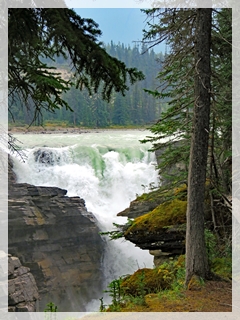
Athabasca Falls CanadaFortunately, the words to Vivaldi’s “Laudamus te” from his Gloria were shown on the screen in the front of the auditorium: “We praise you. We bless you. We adore you. We glorify you.” The soprano’s exquisite voice did that beautifully. When she was finished, I thought back to last summer when hiking in the Canadian Rockies. While gazing at the breathtaking scenery, I turned to my husband and said, “I’m singing at the top of my lungs—you just can’t hear me!” While relishing the splendor of a glacial lake and waterfall, I was silently singing the Doxology for a private audience and the One for whom I sang heard me loud and clear. Had I sung that song of praise aloud, however, it wouldn’t have sounded anywhere as pleasant as that soprano’s clear voice. Nevertheless, I think God enjoyed my song just as much.
After the concert, I wondered if we praise, bless, adore and glorify God anywhere near as much as we should. Every action we take, every thought we think, and every word we say should do those very things but, at least for me, that is not the case. Praising God is joyfully detailing all that God has done. As I did in the mountains, we often offer praise when we are overwhelmed by His magnificent creation but often forget Him in the little routine gifts of everyday life. Yet, I wonder, how can we possibly bless God? Whenever He’s blessed us, our lives have been enriched—we’ve been helped, healed, gifted or made stronger or wiser. How can we bless God when there’s nothing we can do for or give to Him that could make Him any better than He already is? When we bless God, however, we’re proclaiming our gratitude, appreciation and admiration for His blessings. To adore God is to love and worship Him and to glorify Him is to acknowledge His greatness. After all, it is He alone who deserves to be honored and worshipped; it is all His creation and anything we have achieved is only through His power. In all of these actions, we joyfully make an offering of self and surrender to God’s will.

Let’s not wait until we view majestic mountain scenery or a stellar sunset, hear Vivaldi’s Gloria or Handel’s Messiah, or even sing the Doxology to acknowledge God’s power and glory and take joy in His limitless grace. God’s fingerprints are as visible in our everyday chores as they are in a beautiful waterfall and our every thought, word and deed should be a prayerful song that praises, blesses, adores and glorifies His holy name.

God is most glorified in us when we are most satisfied in Him. [John Piper]

I will praise the Lord, and may everyone on earth bless his holy name forever and ever. [Psalm 145:21 (NLT)]

Shout with joy to the Lord, all the earth! Worship the Lord with gladness. Come before him, singing with joy. [Psalm 100:1 (NLT)]

Copyright ©2017 jsjdevotions. All rights reserved.

IN HONOR OF OUR VETERANS

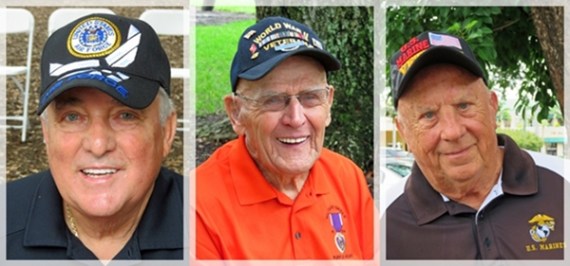
Veterans of WW IIOur fight is not against people on earth. We are fighting against the rulers and authorities and the powers of this world’s darkness. We are fighting against the spiritual powers of evil in the heavenly places. [Ephesians 6:12 (ERV)]
This morning, I quietly read my Bible, some Billy Graham, and prayed. Over coffee, I looked through the newspaper and watched the news. I laughed at a political cartoon, read editorials that both praised and criticized our president, and heard politicians from opposite sides of the aisle disagree about taxes and health care. Once at my computer, I checked my calendar (Bible study tonight) and read about Tuesday’s election. In my email, along with news from friends and Christian devotions, I got an action alert from a local conservation group asking me to contact my representative about a proposed bill. I also received several Veteran’s Day advertisements.

Veteran’s Day wasn’t meant to be another reason to go shopping. Originating in 1919 as Armistice Day, it celebrated the end of World War I — said to be the “war to end all wars” until WW II proved that wrong. In 1954, Armistice Day became Veteran’s Day — and a day to honor all military veterans for their service, patriotism, and willingness to sacrifice for the good of our nation.

Within the first two hours of my day, I’d experienced an incredible amount of freedom, in large part because of those veterans we’ll honor this weekend. We are comfortable and secure in our homes, able to speak openly, vote, run for political office, read without restrictions, gather together freely, and worship openly. We can even safely complain both about and to the government. We can do all that and much more because of the men and women who took a stand against evil—not just with their votes, voices, prayers, or money—but with their service. In many cases, they returned home with scars both visible and hidden. In some cases, they returned in body bags.

I came of age in an era of anti-war/anti-military sentiment and I continue to abhor the thought of weapons and warfare. Nevertheless, time has taught me that sometimes fighting evil means real soldiers and an actual battlefield. As the character Ransom learned in C.S. Lewis’ novel Perelandra, when reasoning fails to defeat Satan, one may have to resort to actual combat. The struggle against the enemy is not always a spiritual one; sometimes it is physical and the hands God uses belong to real men and women. Until the day when our weapons can be turned into agricultural tools, we will continue to need people who will put their lives on the line to fight evil. While we continue to pray for peace, may we also pray for the members of our armed forces (both past and present) and thank God for their service. Let’s remember to express our deep and lasting gratitude to them, as well.

The Lord will mediate between nations and will settle international disputes. They will hammer their swords into plowshares and their spears into pruning hooks. Nation will no longer fight against nation, nor train for war anymore. [Isaiah 2:4 (NLT)]

Copyright ©2017 jsjdevotions. All rights reserved.

THE BLESSING

As they were eating, Jesus took some bread and blessed it. Then he broke it in pieces and gave it to the disciples, saying, “Take this and eat it, for this is my body.” And he took a cup of wine and gave thanks to God for it. He gave it to them and said, “Each of you drink from it, for this is my blood, which confirms the covenant between God and his people. It is poured out as a sacrifice to forgive the sins of many. [Matthew 26:26-28 (NLT)]

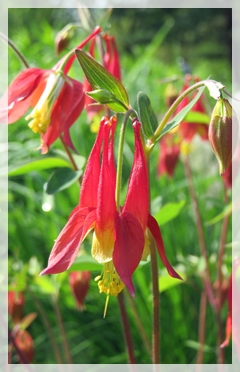
columbineThe celebration of the Eucharist or Holy Communion has been central to our Christian worship since the early church. If asked the meaning of the word eucharist, most of us would probably respond that it is the Christian sacrament that commemorates the Last Supper with bread and wine. While it has come to mean that and often refers to the consecrated elements, especially the bread, the word eucharist originally meant something else entirely. Coming from the Greek words eukharistos, meaning grateful, and kharizesthai, meaning to offer graciously, it is a translation of the Hebrew word berekah which means a blessing or benediction. Acknowledging God as the source of all good things, a berekah would be similar to the grace or table blessing we offer before or after a meal.

When Jesus spoke the traditional Passover meal berakahot that night in the upper room, he gave them new meaning when he added the words, “this is my body” and “this is my blood.” In thanks, He raised the bread just as his body soon would be raised on the cross. He took the matzah that symbolized the suffering of Israel, thanked God for it, and broke it, knowing that his body would be broken in less than a day. As He passed it to the disciples, the bread that once symbolized Israel’s suffering became the bread that would symbolize His. The disciples may have thought he was simply offering a blessing for the Passover bread but Jesus was offering thanks for the body which soon would be defeated by thorns, whip, nails and cross. He then thanked God as he poured out the wine that symbolized Israel’s redemption from Egypt and passed it around. The disciples may have thought he was giving thanks for Israel’s redemption from Egypt but Jesus knew it was for their redemption from sin. For something to be redeemed, however, a price must be paid and Jesus knew that price would be his blood. While pouring out the wine, He knew his blood would soon pour from his body and yet he still gave thanks. Knowing full well the torment he would suffer, He graciously offered himself for us and gave thanks.

Last week, when the Words of Institution were spoken before Communion and the bread and wine were consecrated, I realized I hadn’t fully appreciated the circumstances in which those words originally were spoken. Jesus knew He’d be betrayed, disappointed and denied within hours. He knew the agony that would soon occur. Jesus knew he would be broken and bleed. He knew the real sacrifice was not the lamb on which they’d supped; He was the sacrificial Lamb of God and yet He acknowledged God as the source of all blessings and thanked Him! Blessed be the Lord; let us give thanks!

Blessed are You, Lord our God, King of the Universe, who brings bread from the earth. … Blessed are You, Lord our God, King of the Universe, who creates the fruit of the vine. [Jewish prayers over bread and wine] 

The next day John saw Jesus coming toward him and said, “Look! The Lamb of God who takes away the sin of the world! [John 1:29 (NLT)]

Copyright ©2017 jsjdevotions. All rights reserved.